You're moving.
Maybe you're a renter handing back keys.
Maybe you sold the house you've owned for 20 years.
Either way, somebody is going to walk through that empty space and judge it.
Here's what most Des Plaines residents don't realize.
Des Plaines is not covered by Chicago's RLTO. Most local rentals fall under the Cook County Residential Tenant Landlord Ordinance instead.
And that county law is stricter on timing than Chicago's.
In most cases, your landlord has 30 days — not 45 — to return your deposit or send an itemized list of damage.
Routine cleaning is not a valid deduction under it.
But "damage" is. And landlords often call baked-on oven grease or a stained basement floor "damage."
Homeowners face a different test.
If you sold on the standard Illinois purchase contract, you agreed to leave the house "broom clean." The buyer gets a final walkthrough before closing.
Des Plaines is mostly a homeowner town.
78.3% of occupied homes are owner-occupied, according to the U.S. Census Bureau's American Community Survey (ACS 5-year estimates).
So this guide covers both moves: the renter protecting a deposit, and the owner handing over a house.
It gives you the legal rules, a clear DIY-or-hire decision, room-by-room checklists for houses, condos, and basements, and a timeline built around your real deadline.
You're Moving — But What Are You Really Feeling Right Now?

Short Answer: Moving is one of life's most stressful events. In Des Plaines, it usually comes with a hard date — a lease end or a closing. You're packing, coordinating movers, changing utilities, and cleaning an empty home all at once. The pressure you feel is normal. There is a clear path forward.
The stress is real.
I talk to Des Plaines households every week who are mid-move.
The worry sounds the same whether they rent or own.
"We close on Friday. The movers come Wednesday. When are we supposed to clean?"
Most of our Des Plaines clients aren't students or first-time renters.
92.3% of residents lived in the same home a year earlier, per the Census Bureau (ACS 5-year estimates).
That means when people here move, they're usually leaving a place they've lived in for years.
Years of living leave years of buildup.
Grease on the range hood. Scale on the shower glass. Dust on top of the basement ductwork.
Now add a full move-out cleaning on top of packing and paperwork.
Scrubbing ovens. Wiping baseboards on two floors. Cleaning a basement you haven't looked at closely since you moved in.
It feels like running a marathon while packing for a road trip.
The excitement is real too.
Maybe you're a Young Professional leaving an apartment near the Des Plaines Metra station for a bigger place in Arlington Heights.
Maybe you're an Empty Nester downsizing from a four-bedroom split-level to a condo downtown.
Maybe you're a Traditionalist moving closer to your children after 40 years in the same ranch home.
Or you're a nurse, a warehouse lead near O'Hare, a teacher, or a small-business owner — working a full schedule while the move takes over your evenings.
Des Plaines works hard.
Health care (14.2%), retail (10.1%), and manufacturing (10.0%) are the largest job sectors for residents, according to CMAP's Community Data Snapshot (2022 data).
For most of these households, the question isn't whether they can clean.
It's whether they have the hours and energy left after a full shift.
Here's the math every Des Plaines household faces during moving week.
You need to pack.
Clean the home you're leaving.
Coordinate movers.
Handle closing documents or the lease handoff.
Set up utilities at the new place.
And make sure the new place is clean before furniture arrives.
Parents with Children carry one more job: keeping kids fed and on schedule through all of it.
And here's what most movers forget.
They focus hard on the place they're leaving.
Then they move into the next place without cleaning it first.
A home that looks tidy isn't always clean.
The previous occupants' residue, dust, and grime are still there — inside cabinets, behind appliances, and along baseboards.
The same care that protects your deposit or your closing should apply to your move-in.
Dr. Paula Cannon, professor of microbiology at USC's Keck School of Medicine, has explained that heat-based cleaning can kill pathogens, including viruses and bacteria.
That's one reason I use steam as the backbone of our cleaning method.
"The emotional toll of a move goes beyond logistics — it's the cognitive load of managing a dozen deadlines simultaneously that breaks people down."
— Dr. Susan Krauss Whitbourne, Professor Emerita of Psychological and Brain Sciences, University of Massachusetts Amherst
That stress points to the most important question of your move-out.
What exactly are you trying to accomplish with this clean?
What's Your Real Goal — Your Deposit, Your Closing, or Leaving It Right?
Short Answer: Most Des Plaines movers fall into one of three camps. Renters want their deposit back. Home sellers need to pass the buyer's final walkthrough. And long-time residents want to leave the place right because that's how they were raised. All three share a hard deadline, but the cleaning scope is different. Knowing your camp sets your whole strategy.
I see three types of clients from Des Plaines every month.
SCENARIO A: "I Just Want My Deposit Back"
You rent. You want your money back.
You want to do what's needed to pass inspection — no more, no less.
About 22% of occupied homes in Des Plaines are rentals, per the Census Bureau (ACS 5-year estimates).
That includes apartments, rented condos, townhomes, and single-family houses.
What you need is simple: what your landlord will check, the legal standard you must meet, whether DIY or hiring makes financial sense, and how to push back on unfair deductions.
SCENARIO B: "We Sold the House — Now We Have to Hand It Over"
You own. You've signed a sale contract.
There's no deposit at stake. But there is a buyer, a final walkthrough, and a closing date that won't move.
This is the most common Des Plaines scenario we see.
Sellers often underestimate how different an empty house looks.
Furniture hid the carpet lines, the dusty baseboards, and the scuffed stairwell.
What you need: what "broom clean" legally requires, what buyers actually notice, and how to fit cleaning between the movers and the closing.
SCENARIO C: "I Want to Leave This Place Right"
Maybe you raised your family here.
Maybe you simply won't hand over keys to a dirty home.
This mindset is common among Empty Nesters and Traditionalists who've spent decades in one place.
For them, a clean handoff is about respect — for the house and for the next family.
What you need: a full room-by-room approach, solutions for Des Plaines challenges like hard water scale, winter salt, and basement dust, and chemical-free methods that leave a space clean instead of smelling like bleach.
The Overlap
All three scenarios share common ground.
The deadline won't move.
The stress is real.
And someone will judge the empty space.
If you're in Scenario B or C, the standard you're aiming for is close to a move-in deep clean.
That standard cuts both ways.
When you move into your next home, check it before your boxes arrive.
If you're renting and the new unit isn't clean, document it right away and ask your landlord to fix it before furniture arrives.
If you're buying, note anything unclean at your own final walkthrough.
"A clean handoff isn't just courteous — it's financially strategic. It reduces the likelihood of disputes."
— Marcia Stewart, Co-author, Every Tenant's Legal Guide, Nolo Press
Whichever camp you're in, the rules come first.
Renters, start with the next section. Sellers, the section after it covers the sale contract.
What Does Cook County Law Actually Say About Your Security Deposit in Des Plaines?

Short Answer: Most Des Plaines rentals are covered by the Cook County Residential Tenant Landlord Ordinance (RTLO), in effect since June 1, 2021. If your landlord deducts for damage, they must mail an itemized list within 30 days of move-out and return the rest within 30 days. Routine cleaning is not a valid deduction. Violations can cost the landlord two times the deposit plus attorney's fees. Some small owner-occupied buildings and certain single-home rentals are excluded.
Des Plaines sits in suburban Cook County.
So Chicago's RLTO does not apply here.
The rule that usually applies is the Cook County Residential Tenant Landlord Ordinance.
The County Board passed it in January 2021, and it took full effect on June 1, 2021.
Before that, most suburban renters had very little deposit protection.
What the RTLO Requires
Your landlord can only keep money for two things.
- Unpaid rent and court costs (not attorney's fees).
- A reasonable amount to repair damage beyond ordinary wear and tear.
That's it. Nothing else.
If your landlord deducts for damage, the timeline is tight.
They must mail or deliver an itemized statement within 30 days of the day you move out, according to Chicago tenant attorney J. Andrew Brabender.
The rest of your deposit is also due within 30 days.
If the list uses estimated costs, the landlord gets 30 more days to send paid receipts.
If they skip the itemized list, they owe you the full deposit within 30 days.
And if they break these rules, the County's own summary says you can recover two times the deposit.
Attorney's fees and court costs can be added on top.
Two more protections matter at move-in.
A Cook County landlord can't charge a deposit higher than 1.5 times one month's rent.
And the deposit must be held at a federally insured bank in Illinois — with the bank's name disclosed in your lease.
Does the RTLO Cover Your Rental?
Not every Des Plaines rental is covered.
This matters here more than in Chicago, because so many local rentals are houses, condos, and small buildings.
The main exclusions are:
- Units in owner-occupied buildings with six or fewer units.
- A single house or condo rented by an individual owner who lived there recently, rents no other unit, and manages it personally.
If your building has five or more units owned by the same landlord, the Illinois Security Deposit Return Act may also apply. It gives landlords 45 days to return the deposit.
If neither law applies, your lease is the rulebook.
The Legal Nuance Most Des Plaines Renters Miss
Routine cleaning is not a valid deduction under the RTLO.
Only unpaid rent and damage beyond ordinary wear and tear count.
So you don't technically need a professional cleaner to get your deposit back.
You need to leave the unit without damage.
But here's the catch.
Landlords often blur the line between "dirty" and "damaged."
A greasy oven becomes "appliance damage."
A stained grout line becomes "tile damage."
A musty basement carpet becomes "water damage."
Heavy grease left in the oven is a textbook example of cleaning that gets reclassified as damage.
That's why a proper clean works like an insurance policy.
The same rules protect you when you move in.
Ask for your deposit receipt and the name of the bank holding it.
Then take dated move-in photos of every room — including the basement or storage unit if you have one.
Now that you know the rules, the next question is practical.
What standard of cleaning does your lease — or your sale contract — actually require?
What Does "Move-Out Clean" Really Mean in Your Lease or Sale Contract?
Short Answer: Leases usually require one of three standards: "broom clean" (floors swept, trash and belongings gone), "professionally cleaned" (professional-grade results, sometimes with a receipt), or "same condition as move-in, minus normal wear and tear" (the strictest). Illinois home sellers using the Multi-Board contract agree to "broom clean" plus removing everything not sold with the house. Your standard sets your plan and budget.
I ask every move-out client the same first question.
"What does your paperwork actually say about cleaning?"
Most don't know.
The first standard is "broom clean."
Floors swept. Trash removed. Personal belongings gone.
No deep cleaning is explicitly required.
The second is "professionally cleaned."
Your landlord expects professional-grade results.
Some leases ask for a receipt — and a receipt from a reputable cleaning company can end the argument before it starts.
The third — and strictest — is "same condition as move-in, minus normal wear and tear."
Your move-in condition report becomes the legal baseline.
This is where long-time Empty Nesters and Traditionalists struggle most.
After 10 or 20 years, even normal wear looks significant in an empty room.
Homeowners have their own version. I cover it in full in the next section.
How I Think About Move-Out Cleaning vs. Regular Cleaning
Regular cleaning keeps a lived-in home comfortable.
It focuses on visible surfaces you use every day.
Move-out cleaning is a different job.
It targets the hidden grime that built up over months or years.
It's about passing someone else's inspection.
It often takes two to three times longer than a routine clean.
In a Des Plaines house, that usually means:
- Inside the oven, fridge, dishwasher, and microwave.
- Inside every cabinet and drawer.
- Behind and under the fridge, stove, washer, and dryer.
- Baseboards and stair risers, wiped by hand.
- Window tracks, sills, and blinds.
- Closets, the laundry area, and the utility room.
- The garage-entry floor and the steps down to the basement.
In a condo or apartment, the focus is cabinet interiors, bathrooms, baseboards, closets, floors, window tracks, and appliances.
Some inspectors comb through every inch. Others do a quick walk.
It's always safer to exceed the standard than to count on leniency.
Normal Wear and Tear vs. Damage
Normal wear and tear is what landlords CANNOT charge for.
- Minor scuffs on walls.
- Carpet worn down in hallways.
- Small nail holes.
- Paint faded by sunlight.
- Light scratches on hardwood.
Damage is what landlords CAN charge for.
- Large holes in walls.
- Carpet stains from spills or pets.
- Broken fixtures.
- Grime so heavy it needs professional remediation.
- Mold growth caused by tenant neglect.
"The distinction between 'normal wear and tear' and 'damage' is one of the most contested areas in landlord-tenant law."
— Marcia Stewart, Every Tenant's Legal Guide, Nolo Press
The EPA has documented that levels of common organic pollutants are often two to five times higher indoors than outdoors — and cleaning products are one source.
That's why I use chemical-free methods.
The goal is a truly clean space — not one covered in residue the next occupant will breathe.
Selling Your Des Plaines Home? What "Broom Clean" Means at the Final Walkthrough

Short Answer: Most Chicago-area home sales use the Multi-Board Residential Real Estate Contract 8.0. It requires sellers to leave the property "broom clean" and remove all trash and personal property not sold with the house. Buyers can inspect before possession to confirm the home is in substantially the same condition, minus normal wear and tear. Broom clean is a low bar. Buyers still notice greasy ovens, dusty basements, and dirty cabinets — and those issues can delay a smooth closing.
Most Des Plaines movers own their home.
So for most readers, the big test isn't a landlord. It's the buyer.
What the Contract Actually Says
The Multi-Board Residential Real Estate Contract 8.0 is the standard purchase agreement across the Chicago area.
Paragraph 23 says the seller agrees to leave the property in "broom clean" condition.
All trash and personal property not sold to the buyer must be removed at the seller's expense before possession.
The buyer also has the right to inspect before possession.
They're checking that the home is in substantially the same condition as when the offer was accepted, normal wear and tear excepted.
Possession usually transfers at closing, when you've moved out and handed over the keys.
What "Broom Clean" Leaves Out
Broom clean is a minimum.
It doesn't require scrubbing the oven, washing cabinet interiors, or wiping baseboards.
But the buyer is walking into a home they just paid for.
And an empty house hides nothing.
What buyers notice most in Des Plaines homes:
- Leftover items in the basement, garage, crawl space, or attic.
- Grease inside the oven and on the range hood.
- Crumbs and residue inside kitchen drawers.
- Dust lines where furniture sat.
- Soap scum and scale in showers.
- Salt and grit at the garage entry.
- Cobwebs and dust in the laundry and utility area.
A dirty house doesn't usually breach a broom-clean clause.
But it can sour a final walkthrough, trigger last-minute requests, and create tension at the closing table.
Don't Clean Over a Moisture Problem
This matters in Des Plaines more than most suburbs.
The city sits along the Des Plaines River and has a long flooding history.
Des Plaines has invested more than $50 million over several decades in flood-reduction projects, according to the City of Des Plaines.
Some homes have flooded eight or nine separate times since the mid-1980s, according to FEMA data cited by Illinois Floods.
So be honest about what you find while cleaning.
Water stains, a musty smell, or damp drywall in the basement are not "dirt."
Illinois' Residential Real Property Disclosure Act requires sellers to disclose known flooding or recurring leaks in the basement or crawl space.
Cleaning away the signs doesn't change what you know.
Talk to your agent or attorney if you find something new.
A Simple Plan for Sellers
- Remove everything that isn't staying — basement, garage, and attic first.
- Schedule the clean after the movers leave and before the final walkthrough.
- Clean the kitchen, bathrooms, and floors to a buyer-ready standard.
- Take dated photos of every room after cleaning.
- Leave manuals, garage openers, and spare keys on the kitchen counter.
"Broom clean is the legal floor. The final walkthrough is the real test. A buyer who walks into a clean kitchen starts their first day in the house on good terms with you — and that makes closing day easier for everyone."
— Wells Ye, Founder, Fresh Tech Maid
Whether you're a renter or a seller, you now reach the same fork in the road.
Should you do it yourself, or bring in a professional?
Should You Clean It Yourself or Hire a Professional?
Short Answer: It depends on your time, budget, physical ability, and the size and condition of the home. DIY works if you have 8–16 hours for a two-bedroom unit (often more for a house with a basement) and a manageable situation. Hiring makes sense when your schedule is full, the home is large, or the stakes are high. A hybrid — DIY the basics, hire pros for the kitchen, bathrooms, and basement — often gives the best return.
When you clean for yourself, "clean enough" is fine.
For a move-out, someone else sets the bar.
A landlord has a checklist. A buyer has fresh eyes.
I've seen why DIY move-out cleaning often fails the final inspection.
The missed areas are almost always the same.
- Inside kitchen appliances (the number one deduction item).
- Baseboards and door frames.
- Window tracks and blinds.
- Behind and under heavy appliances.
- Bathroom grout lines.
- Basement floors and the laundry area.
Des Plaines homes add one more factor: size.
A three-bedroom house with a finished basement can have two or three bathrooms, two sets of stairs, and a laundry room.
That's a very different job from a one-bedroom apartment.
Take This Quick Assessment
I built this simple test to help clients choose a path.
If you answered Yes to five or more, PATH A (DIY) is probably right for you.
If you answered No to four or more, PATH B (hiring a professional) makes more sense.
If your answers were mixed, try the hybrid. DIY the easy tasks. Hire pros for the kitchen, bathrooms, and basement.
The Real Cost Comparison
DIY supplies run $50 to $100 if you're starting from scratch.
But the real cost is time.
Plan on 8 to 16 hours for a two-bedroom unit, and 12 to 20 hours for a three-bedroom house with a basement.
There's also risk.
If you miss something, the deduction — or the walkthrough dispute — can cost more than you saved.
Professional move-out cleaning in Des Plaines typically runs $180 to $250 for a studio or one-bedroom condo, $220 to $350 for a two-bedroom condo or townhome, $350 to $500 for a three-bedroom house, and $450 to $650 or more for a larger house with a finished basement.
Heavy buildup, pet hair, inside-appliance deep cleaning, and same-day service push the price higher.
In most cases, hiring professional move-out cleaners costs less than doing it wrong. See how professional cleaners save you hours during a move.
"The hidden cost of DIY move-out cleaning isn't the supplies. It's the time. If you work a full shift at the hospital or the warehouse, every evening you spend scrubbing is an evening you're not packing, signing papers, or resting."
— Wells Ye, Founder, Fresh Tech Maid
Most people budget for the move-out and forget the move-in clean.
That's a costly mistake.
You're really doing two deep cleans in the same week.
A practical approach: hire professionals for the time-critical move-out, where your deposit or closing is on the line.
DIY the move-in if you have a few days of empty access.
Or hire both and take the pressure off completely.
If you chose PATH A, here's exactly how I'd tackle a Des Plaines home yourself — room by room.
How Do You Clean a Des Plaines Home Yourself? (PATH A: The Complete DIY Guide)

Short Answer: Work top to bottom, back to front, and only in empty rooms. Start with the kitchen — inspectors look there first. Then bathrooms, then living areas and bedrooms, then the basement, garage entry, and stairs. Finish floors last, one level at a time. Des Plaines homes add Lake Michigan hard water scale, winter road salt, basement dust and moisture, and older surfaces that need gentle methods. Budget 8–16 hours for a two-bedroom unit and more for a house.
I teach my technicians the same order I'm about to share with you.
It comes straight from our cleaning methodology.
- Take out trash and rugs first.
- Spray the hardest areas and let them soak — sink, stove, counters, toilets, shower walls.
- Dust high to low, top to bottom: vents, light fixtures, tops of cabinets, then furniture-level surfaces, then baseboards and corners.
- Do a dry pass to pick up dust and debris.
- Do a wet pass to wipe every surface.
- Disinfect high-touch areas — handles, switches, railings.
- Clean the floors last, level by level: vacuum first, then mop.
Letting the tough spots soak while you dust saves real time.
And empty the room before you start.
A furniture-free room shows everything.
Clean after belongings are out — not while you're still packing.
How I Approach the Kitchen
The kitchen is where inspectors look first.
Inside the appliances is the number one deduction item.
I follow a strict eight-step kitchen protocol refined over a decade.
Step 1: Inside the oven and stovetop.
Apply a baking soda paste. Let it sit 30 minutes. Then scrub.
Burnt grease on racks can take up to an hour alone.
We use steam because it lifts baked-on residue without leaving a chemical film.
Step 2: Inside the refrigerator.
Remove the shelves and wash them separately. Wipe the whole interior.
Then pull the fridge out and clean behind it.
The dust back there is always worse than people expect.
Step 3: Inside the dishwasher.
Clear the filter. Wipe the gaskets and door edges by hand.
Step 4: Cabinet interiors.
Remove shelf liner. Wipe every shelf and drawer.
Inspectors and buyers open every single one.
In older homes, go easy on painted or wood cabinets. Use a damp — not wet — cloth.
Step 5: Countertops and backsplash.
Degrease fully and clean the grout lines between tiles.
If your counters are granite, marble, or other natural stone, skip vinegar and acids. They can etch the surface. Use warm water and a pH-neutral cleaner.
Step 6: Sink and fixtures.
Des Plaines buys its Lake Michigan water from the City of Chicago and the Northwest Water Commission, per the Des Plaines water quality report.
Lake Michigan water in the Chicago area averages about 130–150 PPM hardness (roughly 8 grains per gallon).
That white, chalky scale on your faucet is calcium and magnesium.
Diluted white vinegar or citric acid removes light scale on stainless steel and chrome.
Step 7: Under and behind appliances.
Pull the fridge and stove out and clean the floor underneath.
This is where the worst buildup hides in almost every home we clean.
Step 8: Exhaust hood and filter.
Degrease the range hood and soak the filter.
It gets sticky over time, and most DIY cleans skip it.
How I Approach the Bathroom
The bathroom shows neglect faster than any other room.
Step 1: Grout lines.
Mold and mildew here signal "not clean" right away. Handle this first.
Step 2: Toilet — every surface.
Clean the base, behind the tank, and the tank lid. Inspectors check all of it.
Step 3: Shower and tub.
Target hard water stains, soap scum, and caulk lines.
Scrub glass doors to remove the white film hard water leaves behind.
Step 4: Vanity and mirror.
Remove water spots and polish the faucet.
Step 5: Exhaust fan.
Dust on the fan cover is obvious and signals neglect.
In older bathrooms, avoid flooding the floor with water. Original tile and subfloors don't like it.
How I Approach Living Areas and Bedrooms
Step 1: Baseboards.
They're the first thing that catches the eye in an empty room.
Step 2: Closet interiors.
Wipe the shelves, rods, and floors.
Step 3: Light fixtures and ceiling fans.
These collect dust and dead insects.
Step 4: Window tracks and sills.
Dirt here shows immediately.
Step 5: Door frames, light switches, and stair railings.
Fingerprints and scuffs show on every one.
Step 6: Walls and floors.
Spot-clean marks. Fill small nail holes with putty.
Vacuum, then mop, one level at a time.
Many Des Plaines homes have older hardwood. Use a barely damp mop — never standing water.
If your home was built before 1978, painted trim and walls may contain lead-based paint. Wipe gently. Don't sand or scrape. The EPA explains why.
How I Approach the Basement, Garage Entry, and Stairs
This is the section most Chicago apartment guides skip.
In a Des Plaines house, it's often where a walkthrough goes wrong.
Step 1: Empty it completely.
Old paint cans, shelving, and boxes left behind are the most common seller complaint.
Step 2: Inspect before you clean.
Look for water stains, damp spots, a musty smell, warped flooring, or efflorescence (white, powdery deposits) on concrete walls.
Step 3: Dust high to low.
Basement ceilings collect dust on joists, pipes, and ductwork.
Step 4: Laundry and utility area.
Pull the washer and dryer out if you can. Clean lint behind and under them.
Wipe the utility sink and the top of the water heater.
Step 5: Stairs.
Clean each tread and riser by hand, plus the railing.
Step 6: Garage-entry floor.
Sweep and damp-mop the salt, grit, and dried slush that tracks in all winter.
If you find active water, sewage backup, or significant mold, stop.
Routine cleaning isn't the fix.
The EPA says if mold covers more than about 10 square feet, you should follow its mold cleanup guidance — and fix the water source first.
Renters should report it to the landlord in writing. Sellers should talk to their agent.
The 7 Areas Inspectors Check First
Across hundreds of move-out inspections, these seven areas trigger the most complaints.
- Inside the oven and appliances.
- Baseboards.
- Behind and under appliances.
- Window tracks and sills.
- Door frames and light switches.
- Bathroom grout lines.
- Carpet edges and corners.
In a Des Plaines house, add an eighth: the basement and garage entry.
If you only have time for a few things, start with these.
How I Handle Des Plaines' Hidden Cleaning Challenges
Every town has its cleaning quirks. Here are the ones we see most in Des Plaines.
Winter salt and grit. Road salt tracks into entryways, mudrooms, garage entries, and basement stairs. It leaves white marks on floors. A diluted white vinegar solution handles light buildup on vinyl and tile. Heavy staining needs a floor-safe product.
Hard water scale. Lake Michigan water leaves scale on every fixture. At Fresh Tech Maid, we use deionized (DI) water instead of tap water. DI water has zero mineral content, so it pulls existing deposits off surfaces instead of adding new ones. That's why our clients' fixtures come out spotless without harsh acids.
Basement dust and moisture. Lower levels collect dust on ductwork and joists. Many also show signs of past water. Clean what's dirt. Flag what's damage.
Older surfaces. Much of Des Plaines' housing is established rather than new. Original hardwood, older cabinets, painted trim, and natural stone need surface-safe methods — not aggressive scrubbing or lots of water.
Condo and building logistics. Some condo associations ask cleaners for proof of insurance or limit elevator and loading-dock times. Check with management before moving day. Fresh Tech Maid carries full coverage for exactly this reason.
"A Des Plaines split-level with a finished basement is a completely different job from a Loop studio. Salt at the garage door, scale on the shower glass, dust on the basement ducts, forty-year-old oak cabinets — these aren't in cleaning guides written for Phoenix or Miami."
— Wells Ye, Founder, Fresh Tech Maid
This same checklist works for your move-in, with different priorities.
At move-out, you clean to satisfy a landlord or a buyer.
At move-in, you clean so the home is ready to live in.
Focus on cabinet and drawer interiors before you unpack dishes. Clean bathrooms and the kitchen before first use. Remove residue left by the previous occupants.
And clean before the furniture arrives. You can't clean under a sofa once it's in place.
Tools I Recommend for DIY Move-Out Cleaning
If that scope feels like too much — or your timeline won't allow it — here's how to find a reliable professional and what to ask before you book.
How Do You Choose a Reliable Move-Out Cleaning Company? (PATH B: The Complete Hiring Guide)
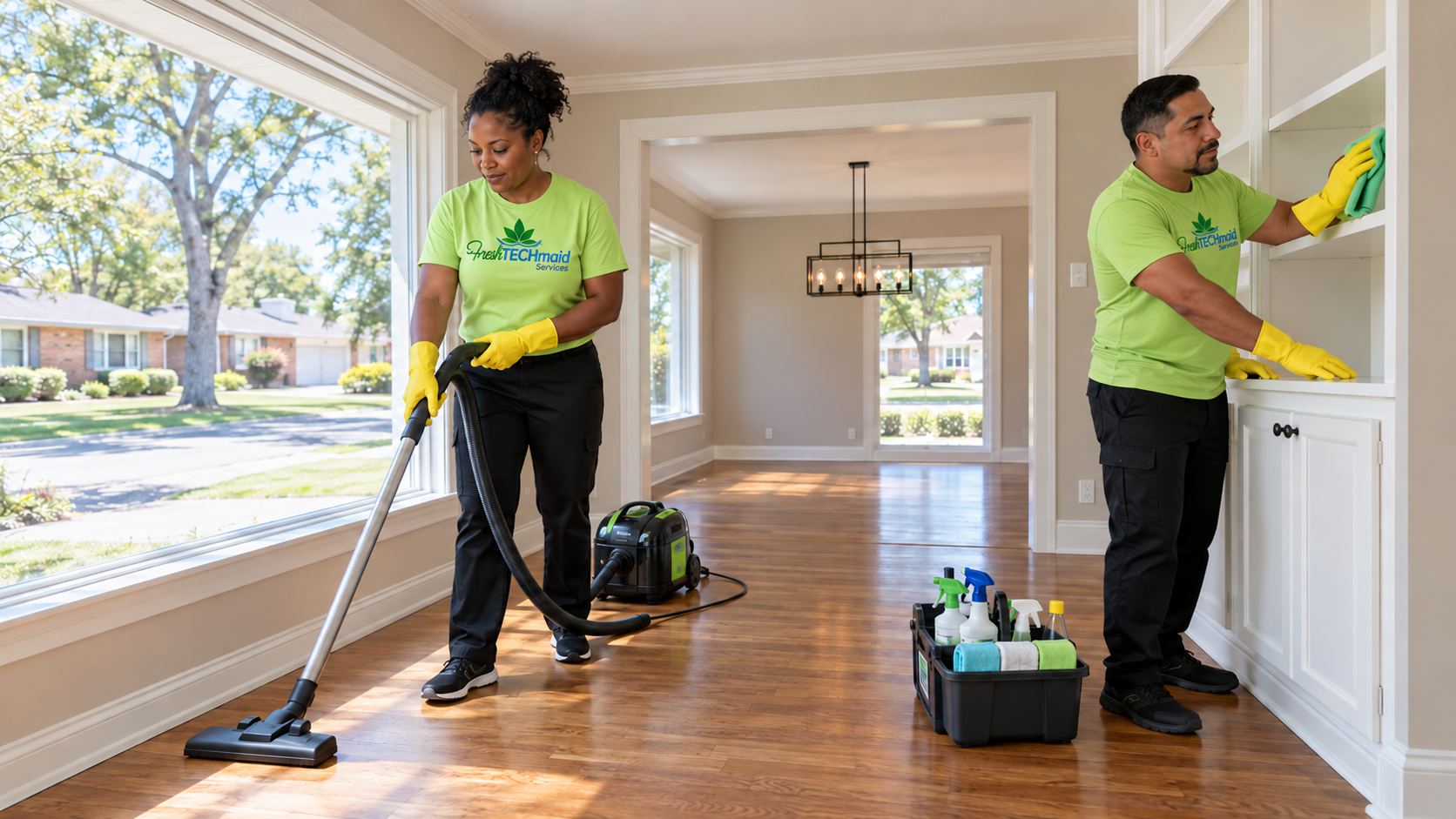
Short Answer: Look for W-2 employees (not contractors), transparent pricing, a written move-out checklist, a re-clean guarantee, and proof of insurance. Ask about backup staffing — one missed cleaning day can push back a closing or a key return. Ask how they handle basements, older surfaces, and condo building rules. Chemical-free methods leave no residue and signal real cleanliness.
Professional move-out cleaning in Des Plaines typically runs $180 to $250 for a studio or one-bedroom condo, $220 to $350 for a two-bedroom condo or townhome, $350 to $500 for a three-bedroom house, and $450 to $650 or more for a larger house with a finished basement.
Heavy buildup, pet hair or odor, inside-appliance deep cleaning, and same-day service all raise the cost.
The 5 Questions I Tell Every Client to Ask Before Booking
The first one is the question nobody thinks to ask.
Question 1: "What happens if my assigned cleaner is sick on my scheduled day?"
In Des Plaines, a missed cleaning day can mean a messy final walkthrough, a delayed key handoff, or paying for another day of possession.
You need a company with backup staff — not a solo operator who might cancel.
At Fresh Tech Maid, every client has an assigned technician plus two trained backups.
Your cleaning happens on schedule.
Question 2: "What's your move-out checklist? Can I see it in advance?"
Professional companies have written processes. Vague answers signal inexperience.
Ask specifically whether the basement, laundry area, and garage entry are included.
Question 3: "If my landlord or buyer flags a cleaning issue, will you come back?"
Reputable companies stand behind their work.
Question 4: "Are you insured for liability and workers' compensation? Can you show proof?"
This protects you if something is damaged. Many condo associations require it.
Question 5: "Do you use employees or contractors?"
Contractors can be less consistent and less vetted.
Companies with trained W-2 employees are more accountable.
I only hire employees at Fresh Tech Maid — never contractors.
Red Flags I Tell Clients to Watch For
- No written estimate or contract.
- Cash-only payment.
- No online reviews.
- Can't explain their process.
- Prices far below everyone else's.
- No backup plan for sick staff.
- Contractors instead of employees.
- "We'll just bleach it" as the answer to a moldy basement.
The Hybrid Approach That Often Delivers the Best Return
This works well for households that want to save money without cutting corners.
DIY the easy parts: removing belongings and trash, general dusting and wiping, and light vacuuming.
Hire professionals for the high-impact areas: inside the oven and appliances, deep bathroom cleaning including grout and hard water scale, behind and under heavy appliances, and the basement and laundry area.
A hybrid typically costs $150 to $300 for a Des Plaines house and saves hours on the jobs most likely to trigger complaints.
Why I Built Fresh Tech Maid Around Chemical-Free Cleaning
Some landlords and buyers read a strong chemical smell as "cover-up," not "clean."
Chemical-free methods look and smell clean because they are clean.
They remove odors instead of masking them with fragrance.
The EPA confirms that common cleaning products release VOCs, which raise indoor pollutant levels.
A study in the journal Indoor Air found that cleaning products — even "green" labeled ones — can significantly raise VOC levels during and after use.
This matters even more at move-in.
At move-out, you're passing someone's visual check.
At move-in, you're living with whatever the last occupants left behind — for months or years.
That's true for any household: couples, older adults, people with allergies or asthma, pet owners, and families with young kids.
At Fresh Tech Maid, we use DI water, steam vapor at temperatures shown to kill up to 99.9% of bacteria, HEPA-filter vacuums, and HOCl — hypochlorous acid, the same molecule your immune system makes to fight germs.
No bleach.
No ammonia.
No synthetic fragrance.
"Some clients ask why chemical-free matters for a place they're leaving. I tell them the next person's nose knows the difference between clean and cover-up. A home that smells like nothing smells cleaner than one that smells like a chemical factory."
— Wells Ye, Founder, Fresh Tech Maid
Whether you go DIY, professional, or hybrid, the next challenge is timing — across two homes at once.
How Do You Coordinate Cleaning at Both Your Old and New Place?
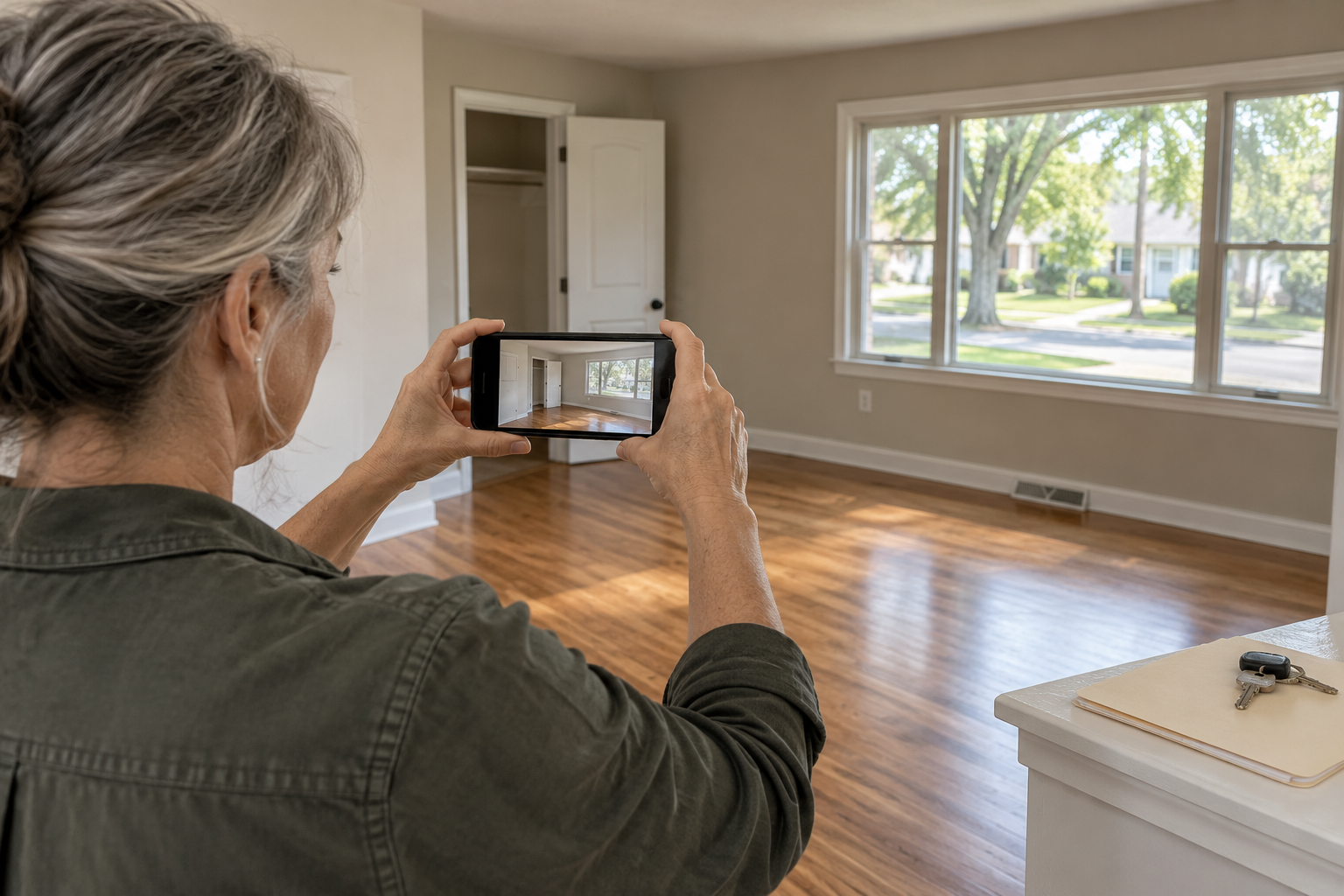
Short Answer: Start four weeks before your lease end or closing date. Book cleaners two to three weeks ahead — good companies fill up around month-end and busy closing weeks. Schedule the move-out clean after the movers leave and before the final inspection or walkthrough. Schedule the move-in clean before furniture arrives. Take dated photos at both homes.
This is where most moves fall apart.
Not because people don't try.
Because they don't plan far enough ahead.
Des Plaines doesn't have one big moving season.
People move here all year — after a home sale, at a lease end, when they downsize, or when a job changes.
So your timeline starts from your own deadline: the lease end, the closing, or the key handoff.
Then ask one question.
"Can I realistically clean the entire empty home before the move takes over my schedule?"
Use these questions to answer it.
- How large is the home, and how many floors?
- How many bathrooms and staircases?
- Is there a basement, garage, or laundry room to clean?
- How much time do I have between the movers and the deadline?
- How much buildup did we — or the last occupants — leave behind?
- Am I also packing, moving boxes, and handling paperwork myself?
- Would a few hours of professional help take real pressure off?
The 4-Week Timeline I Give Every Client
Four weeks out.
Renters: read your lease's cleaning clause and ask your landlord for a pre-move-out walkthrough.
Sellers: confirm your closing date and possession date with your agent.
Everyone: get quotes from two or three cleaning companies. Start decluttering — basement, garage, and storage first.
At the new home, confirm your key date. Take photos the moment you get access.
Three weeks out.
Book your cleaners. Quality move-out cleaning companies fill up fast near month-end.
Start patching small nail holes.
Book the move-in clean for one to two days before your furniture arrives.
Two weeks out.
Do the pre-move-out walkthrough if your landlord agreed. Fix what they flag.
Sellers: schedule haul-away for anything you're not taking.
Keep cleaning room by room if you're doing it yourself.
One week out.
Pack the last items.
Clean each room as it empties — but don't clean while packing. That doubles the work.
At the new home, the move-in clean happens while it's still empty.
Two to three days before your deadline.
Professional move-out cleaning happens after the movers leave.
This leaves time for your own final check and fixes before the landlord inspection or buyer walkthrough.
Take dated photos and a narrated video of every room.
Deadline day.
Do a last check once everything is out.
Renters: return keys and get written confirmation. Give your landlord your forwarding address in writing.
Sellers: leave keys, garage openers, and manuals for the buyer.
At the new home, do a final wipe-down before the furniture comes in.
When I Tell Clients to Call Professionals
You're probably fine on your own if you have two or more weeks, a manageable home, and full days to clean.
It's time to call professionals if:
- You have less than a week.
- Your closing or lease end moved up on short notice.
- Your old and new dates overlap with little gap.
- The home has a basement, multiple bathrooms, or several staircases.
- You work full shifts during moving week.
- You haven't deep-cleaned in months.
- A large deposit or a tense sale is on the line.
How I Tell Clients to Document Everything
Move-in photos set your baseline.
Move-out photos prove the condition you left.
For renters: if deductions look wrong, send a written dispute first. Mention the RTLO's 30-day rules and the two-times-deposit penalty. Small claims court is the next step if needed.
For sellers: photos after cleaning protect you if a buyer later claims something was left dirty or damaged.
"The pre-move-out walkthrough is the most underused tool a renter has. It shows you exactly what the landlord will flag — before your deposit is at risk. For sellers, the same idea applies: walk your own house the way a buyer will, one day before they do."
— Wells Ye, Founder, Fresh Tech Maid
Take photos at BOTH homes.
Wide shots of every room. Close-ups of any existing damage. Dated files. A narrated video.
Keep both sets. You'll need the move-in photos years from now when you move out again.
You have the timeline, the rules, and the cleaning plan.
Now let's turn it into a plan for this week.
What Should You Do This Week to Protect Your Deposit or Your Closing?
Short Answer: Read your lease's cleaning clause or your sale contract's condition paragraph. Ask for a pre-move-out walkthrough or confirm your buyer's walkthrough date. Decide your path — DIY, professional, or hybrid — with the assessment above. Take dated photos at your new home right away. Book cleaning early, especially near month-end.
You now know what most Des Plaines movers don't.
If you rent, the Cook County RTLO gives your landlord 30 days to send an itemized list and return your deposit — and routine cleaning isn't a valid deduction.
If you're selling, your contract likely requires "broom clean," and your buyer can inspect before closing.
Your standard is set by your paperwork, not by guesswork.
Your path — DIY, pro, or hybrid — fits your time, budget, and home.
And your timeline covers both homes during the same busy week.
The same standards that satisfy a landlord or buyer also make your next home ready to live in.
That's the idea I built Fresh Tech Maid around.
What Everyone Should Do This Week
- Read your lease's cleaning language — or paragraph 23 of your sale contract.
- Take the assessment above if you haven't chosen a path.
- Ask for a pre-move-out walkthrough, or confirm the buyer's walkthrough date.
- Walk your basement, garage, and storage areas and list what must go.
- Take dated photos at your new home as soon as you get access.
If You're Doing It Yourself
- Download the Des Plaines checklist below.
- Gather supplies — including a descaler for hard water and a floor-safe option for salt marks.
- Block more time than you think you'll need. First-time DIY move-out cleans always run long — especially with a basement.
If You're Hiring
- Get quotes from two or three companies.
- Ask the five reliability questions above.
- Confirm the basement, laundry area, and garage entry are included.
- Book early.
The Bottom Line
Moving is chaotic.
But losing your deposit — or starting a rocky closing — doesn't have to be part of it.
You now know the Cook County rules most renters never learn.
You know what "broom clean" means, and what buyers actually notice.
You have a room-by-room checklist built for Des Plaines houses, condos, and apartments.
And you have a timeline built around your real deadline.
The people who get a smooth handoff aren't the ones who scrub the hardest.
They start early, document everything, and focus on the areas inspectors actually check.
Start this week.
Frequently Asked Questions
Free Download: The Des Plaines Move-Out Cleaning Checklist
Get Your Chicago Move-In Cleaning Checklist!