Short Answer: A guest-ready home is not a perfect home. It's a home where the rooms your guests use are clean, the air smells fresh instead of perfumed, and you have time to sit down. Start at the front door and follow the path your guests will take: entry, guest bathroom, kitchen counters and sink, and the place you'll gather. Remove odors at the source instead of covering them. Pick a plan that fits your time: one week, one day or one hour. Then stop. Nearly half of Americans spend three or more hours cleaning before holiday guests [1]. Most of that time belongs on a few spots.
A client called us on the Tuesday before Thanksgiving.
The whole reason fit in one sentence: "My mother-in-law is coming."
I understood right away. That call wasn't really about dust. It was about being judged.
If you've felt that, you have company. In one survey, 74% of Americans said they judge holiday hosts on how clean and tidy their homes are, at least a little [2]. And when people rank the guests who make them most anxious about a clean house, 65% put their own mother in the top three [3].
After years running a maid service in Chicago, here’s what I tell people: you don't need a perfect house.
You need the right rooms clean, a home that smells fresh, and time to sit down with your family.
This guide shows you how, in the time you actually have.
How clean does your home need to be for holiday guests?
Short Answer: Clean enough that guests feel comfortable, not museum-perfect. Focus on what they'll use and smell: the entry, the guest bathroom, the kitchen and the place you'll sit together. Research on the "spotlight effect" shows that people overestimate how much others notice about them [4]. So put your energy where it counts, and let the rest wait.
"Guest-ready" doesn't have one fixed standard.
People have different ideas of clean enough.
A family with a crawling baby, a host whose father uses a walker and a group of roommates hosting Friendsgiving will each draw the line in a different place.
So instead of a standard, I use a sequence. We call it the guest-ready framework:
- Guest needs: who is coming and what they need.
- Guest path: the rooms they'll actually use.
- Essential tasks: the jobs on that path that matter most.
- Available time: a week, a day or an hour.
- Stop and host: a finish line you set in advance.
The last step is the one most hosts skip.
Those words aren't the same job. Moving the mail off a chair makes the chair usable. It doesn't clean a sticky table.
Why do we feel so judged? (Mom, mother-in-law, and the spotlight effect)
In a survey of U.S. and Canadian adults, 65% ranked their mother among the three guests who make them most anxious about home cleanliness [3]. Only 15% named their mother-in-law as the guest who worries them most [3]. So the classic mother-in-law fear may be smaller than the one we carry about our own moms.
Parents feel the pressure more.
People with children at home were more likely to worry about guests' opinions of their home's cleanliness: 64%, compared with 43% of people without children [1].
Here's the good news. Psychologists who studied the "spotlight effect" found that people overestimate how much others notice their appearance and actions [4]. In the original experiments, very few people noticed the embarrassing T-shirt that the wearers expected everyone to see [5].
Your guests are paying far less attention to your baseboards than you are.
What "clean enough" looks like
Etiquette experts put comfort ahead of perfection.
"Make sure guests are greeted warmly, then made to feel welcome throughout the party." — Emily Post Institute [6]
That's the job. A warm welcome, a clean bathroom, a clear place to sit, and a host who isn't still scrubbing.
Quote: "Your guests are coming to see you. They are not coming to inspect your house." — Wells Ye
Next, let's look at what guests really notice when they walk in.
What do guests actually notice in your home (and what don't they)?
Short Answer: Guests tend to notice smells, the bathroom they use, sticky kitchen counters, a cluttered entry and the floor by the door. Baseboards, cabinet insides, closets and the top of the fridge can usually wait. Hosts see it differently: 48% say they don't notice how dirty their home is until guests come over [7]. So clean for your guests, not for your worries.
Surveys about first impressions point to the same two things: cleanliness and smell.
In one survey of 1,874 singles, 41% said cleanliness was the first thing they noticed in someone's home, and 28% said smell [8]. It wasn't a nationally representative survey, so treat it as a signal, not a rule.
And bathrooms carry extra weight.
In the same singles survey, 42% said a dirty bathroom would make them think less of the host [8].
Why you can't smell your own home
When you live with a smell, your nose stops reporting it.
In one study, adults who were exposed to an odor at home for two weeks became less sensitive to it, and their sensitivity came back within a week after it was gone [9]. In a lab, people lost some sensitivity to a steady odor after just 10 minutes [10]. Older people tend to tune out smells even more [11].
"Whatever is new in your environment, that huge signal rises above the rest." — Pamela Dalton, cognitive psychologist [12]
Your guests walk in with fresh noses.
That's why section 5 is about removing odors, not covering them.
So borrow a fresh nose.
Ask someone in your household to walk in the front door and point out any smell on the way to the bathroom and the kitchen. Give them that one job, not "Does the house look bad?"
What can wait
No study ranks what guests ignore. So the list below is my practical guidance, not a research finding.
Quote: "Clean the spots your guests will touch, use and smell. Everything else is a project for January." — Wells Ye
Which rooms should you clean first when time is short?
Short Answer: Follow the guest path. Start at the front door, then the guest bathroom, the kitchen counters and sink, and the living or dining area. Close doors to rooms guests won't enter. That matches what most hosts already do: 71% focus on tidying the spaces guests are most likely to see [13]. Skip the rest without guilt.
Think about the route a guest takes from the moment they ring the bell.
They come in, shed a wet coat and boots, use the bathroom, drift into the kitchen and settle where everyone gathers. Overnight guests add one more stop: the bed.
That route is the guest path.
Most hosts already work this way.
In a 2025 survey, 71% of hosts said they focus on the spaces guests are most likely to see, and 64% of Americans said they empty the trash bins before guests arrive [13].
If you only have time for one room, make it the guest bathroom.
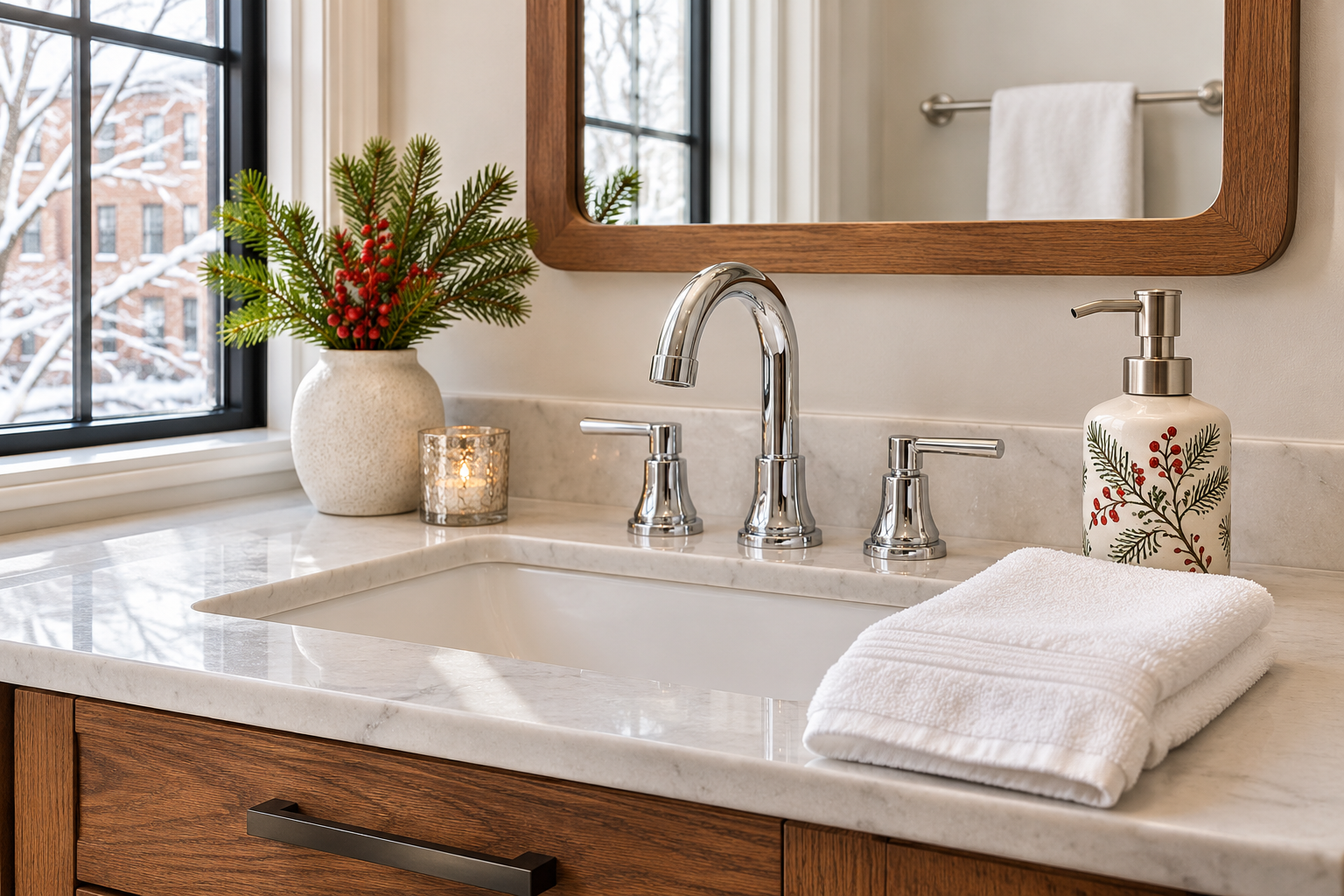
Clean the toilet, sink and counter, and set out soap, toilet paper and a clean hand towel, so no one has to open your cabinets.
Walk the path with a basket for things that are out of place. Put them away afterward, so you don't just move the pile to a hallway.
Two more spots deserve a place near the top:
- The kitchen sink. In a USDA test-kitchen study, the sink was the surface home cooks most often contaminated during meal prep: 34% of participants spread bacteria to it [14].
- High-touch spots. The CDC advises cleaning surfaces like light switches, doorknobs and countertops regularly "and after you have visitors in your home" [15].
"Skip" means "later," not "never." If something spills or creates a hazard, deal with it.
"Holiday hosting shouldn't be just about appearances - health and comfort matter just as much." — Jennifer Abril, president and CEO, American Cleaning Institute [13]
Quote: "Start at your front door and walk the route your guests will walk. That's your cleaning list." — Wells Ye
Now let's turn that list into a plan that fits your calendar.
What's a realistic guest-ready plan for 1 week, 1 day, or 1 hour?
Short Answer: One week out, do the deeper jobs: guest linens, the oven, fridge shelves and vents. The day before, do bathrooms, floors and high-touch spots. One hour before, empty the trash, wipe the sink and counters, swap the hand towels and let in fresh air for a few minutes. Then sit down.

Most people need more than an hour. In one survey, 71% of adults said they need at least a day to get ready for guests, and three days on average [16]. Some start early: 30% of hosts in another survey began more than 10 days ahead [3].
So pick the plan that matches the time you really have.
The 1-week plan
This is for the jobs that take time or need the fridge.
- Clear and wipe the fridge shelves. You'll need the room. A frozen turkey needs about 24 hours in the refrigerator for every four to five pounds, so a 15-pound bird takes three days [17][18].
- Check the fridge temperature. The FDA advises keeping it at 40°F or below [19].
- Clean the oven if you'll cook a big meal.
- Wash guest linens and an extra blanket (see section 8).
- Dust vents and the high spots on the guest path.
- Book help now if you want it. We ask clients to book two to three weeks ahead, because Thanksgiving and Christmas weeks fill fast .
Do the jobs that stay done first. Save the ones that cooking and daily life will undo for the last day.
Quote: "Cold air must circulate around refrigerated foods to keep them properly chilled." — U.S. Food and Drug Administration [19]
The 1-day plan
- Clean the guest bathroom top to bottom.
- Vacuum and mop the floors on the guest path.
- Wipe high-touch spots: switches, doorknobs, faucet handles and the fridge handle.
- Make up the guest bed or the couch kit.
- Set up the entry station for boots and coats (see section 7).
The 1-hour plan
- Empty every trash can on the guest path.
- Wipe the kitchen sink and counters.
- Swap in clean, dry hand towels.
- Clear the entry and one surface for coats and bags.
- Open a window or run the exhaust fans for a few minutes (see section 5).
- Then sit down.
Don't start reorganizing a closet. That only creates more unfinished work.
The 15-minute "we're on our way" reset
Someone texts that they're 15 minutes out. Do this, in this order:
- Toilet seat, sink and mirror in the guest bathroom.
- Fresh hand towel and a spare roll of toilet paper.
- Trash out.
- Dishes into the dishwasher or a sink of soapy water.
- Clear the entry floor.
- Stop.
Quote: "The plan isn't done when the house is perfect. It's done when you reach your stopping time." — Wells Ye
The one job on every list is making the house smell fresh. Here's how to do it without a spray.
How do you get a fresh-smelling home without sprays or candles?
Short Answer: Remove the smell's source instead of covering it. Empty the trash, clean the drains and the fridge, wash towels and throw blankets, vacuum with a HEPA filter, and air the house out briefly, even in winter. The EPA lists air fresheners among household sources of volatile organic compounds [20], and in one survey 34.7% of adults reported health problems from fragranced products [21].
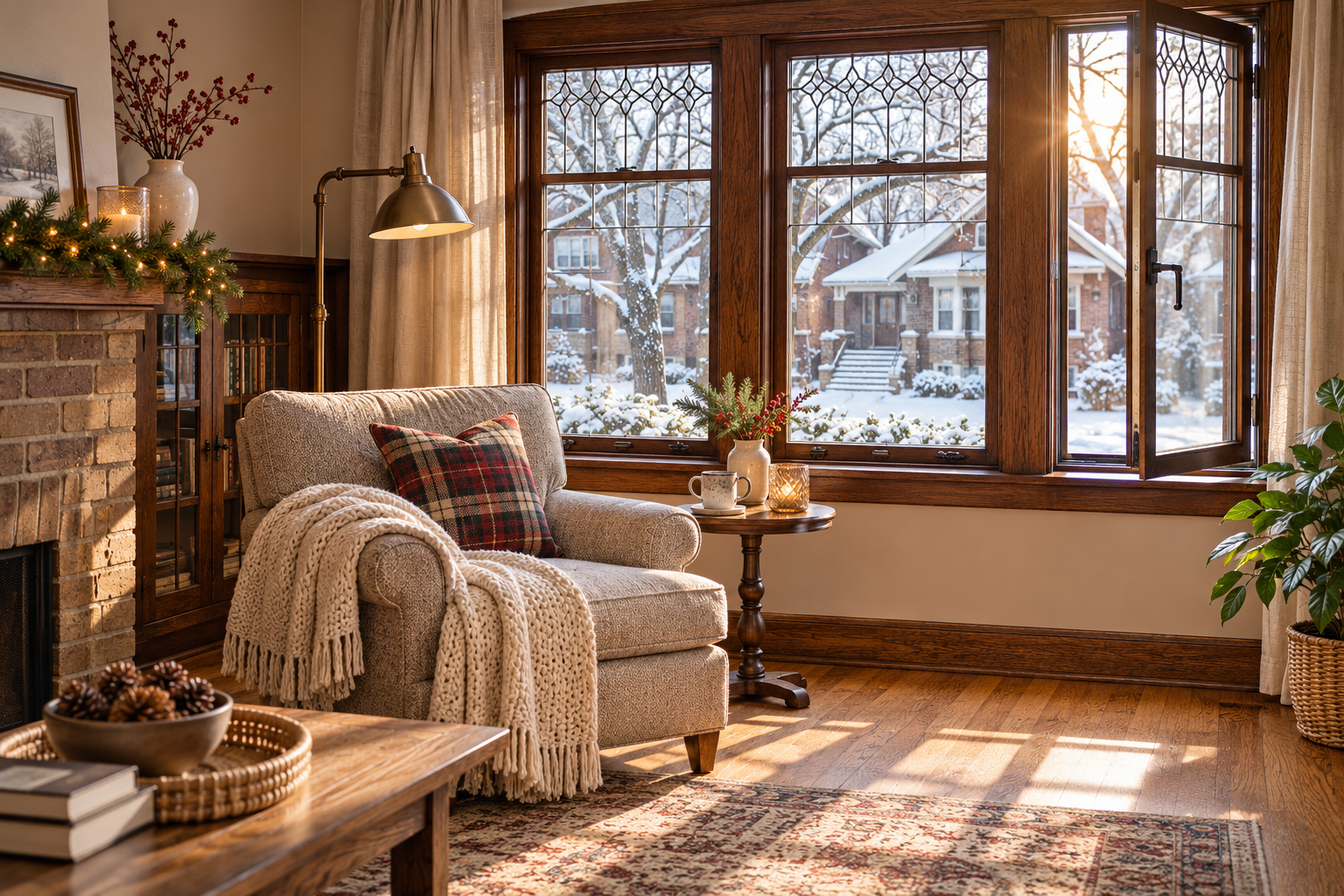
A fresh home smells like nothing in particular.
Why winter houses smell stale
In a Chicago winter, the windows stay shut for months.
Cooking, trash, pets, damp boots and wet towels all add to the air, and less of it gets swapped for outdoor air.
The EPA says some indoor pollutants are often two to five times higher than typical outdoor levels [22], and that bringing in more fresh air helps reduce pollutants inside [23].
A few minutes with a window cracked helps, and so do bathroom and kitchen fans that vent outdoors.
The EPA notes that those fans increase ventilation and help remove pollutants [23]. A fan that just recirculates air isn't the same thing.
Source-removal checklist
Work through the places odors start: trash cans, the kitchen drain, the fridge, towels and throws, pet bedding, entry mats, and floors and soft furniture.
If a smell lingers after all that, find the source instead of adding scent. A gas, mold or sewage smell is a job for a professional, not a cleaning plan.
Why we skip added fragrance
A lot of hosts reach for a candle.
In a 2025 survey, 57% of Americans said they use air fresheners or candles to scent their homes before guests come [24].
I'd skip it.
Scent doesn't clean anything.
It sits on top of the smell, and it adds to the air your guests breathe.
The EPA warns that pine- and citrus-scented air fresheners, cleaners and fragrances can react with ozone indoors to form fine particles and formaldehyde [25]. In a study of 112 London homes, candle use produced fine-particle peaks as high as 622 µg/m³ [26].
The American Lung Association says it plainly: "Avoid air fresheners, scented candles, and incense." [27] If someone in the home has asthma, it's best to avoid air fresheners, scented candles and pinecones [28].
At Fresh Tech Maid, we reject added fragrance.
A guest with asthma, allergies or migraines shouldn't have to pay for your house smelling like a candle shop.
"Remove odor sources through regular cleaning instead of masking odors with fragrances." — American Lung Association [27]
Quote: "If you can smell the cleaning, you're smelling the products. Clean air shouldn't smell like anything." — Wells Ye
Fresh air is one part of a healthy gathering. The next question is about germs.
Do you need to disinfect before holiday guests during cold and flu season?
Short Answer: Usually not. The CDC says that in most situations, regular cleaning is enough to prevent the spread of germs [15]. Disinfecting is mainly for when someone is sick or at higher risk of getting sick [29]. Do clean high-touch spots like light switches and doorknobs before and after guests. Those are among the spots people forget most [30].
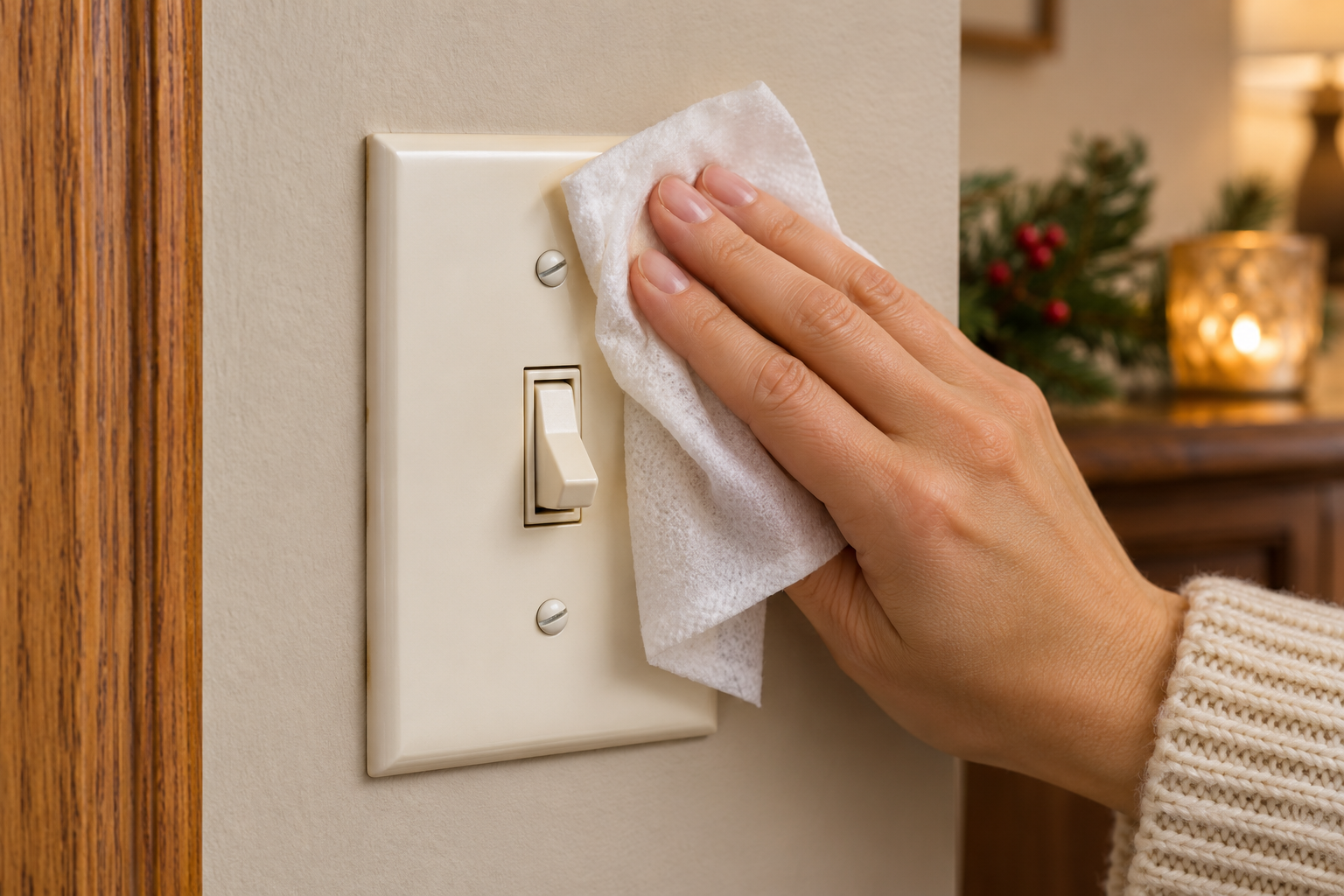
The holidays land in cold, flu and RSV season.
Older relatives, new babies and kids home from school often share one table.
The EPA puts it simply. Cleaning removes dirt and organic matter. Sanitizing kills bacteria on surfaces using chemicals, and it isn't meant to kill viruses. Disinfecting kills viruses and bacteria [31].
When to add disinfecting
The CDC advises disinfecting in addition to cleaning when someone at home is sick, or when someone has a higher risk of illness because of a weakened immune system [15].
If you do disinfect, read the label.
Use a registered disinfectant on a surface it's made for, and follow the contact time: how long the surface must stay wet [31].
"The surface should be visibly wet for the entire contact time." — U.S. Environmental Protection Agency [32]
A quick wipe that dries in seconds doesn't meet that bar.
This guide is general information, not medical advice. If someone in your home is sick or high-risk, follow their doctor's guidance.
The forgotten spots
In a 2025 survey, 81% of Americans said they forget at least one area when they clean.
Light switches (45%), doorknobs (39%) and vents (39%) were among the most missed [30]. 28% forget to clean refrigerator shelves [33]. Baseboards made the list, too.
Germs can linger there.
The CDC says RSV can survive for many hours on hard surfaces such as tables and crib rails [34].
Quote: "Clean the light switches and doorknobs before guests arrive and again after they leave. It takes five minutes." — Wells Ye
Cleaning is one part of getting ready. It can't promise that a gathering carries no risk of illness.
Germs ride in on hands. Salt and slush ride in on boots, which is the next Chicago problem.
How do you keep Chicago snow and road salt from ruining your floors when guests arrive?
Short Answer: Set up a two-mat system: a rough scraper mat outside and an absorbent mat inside, plus a boot tray and a spot for shoes. Damp-mop salt residue with plain or deionized water, never a soaking-wet mop, then dry the floor. Chicago started last winter with about 420,000 tons of road salt on hand [35], and plenty of it walks inside on boots.
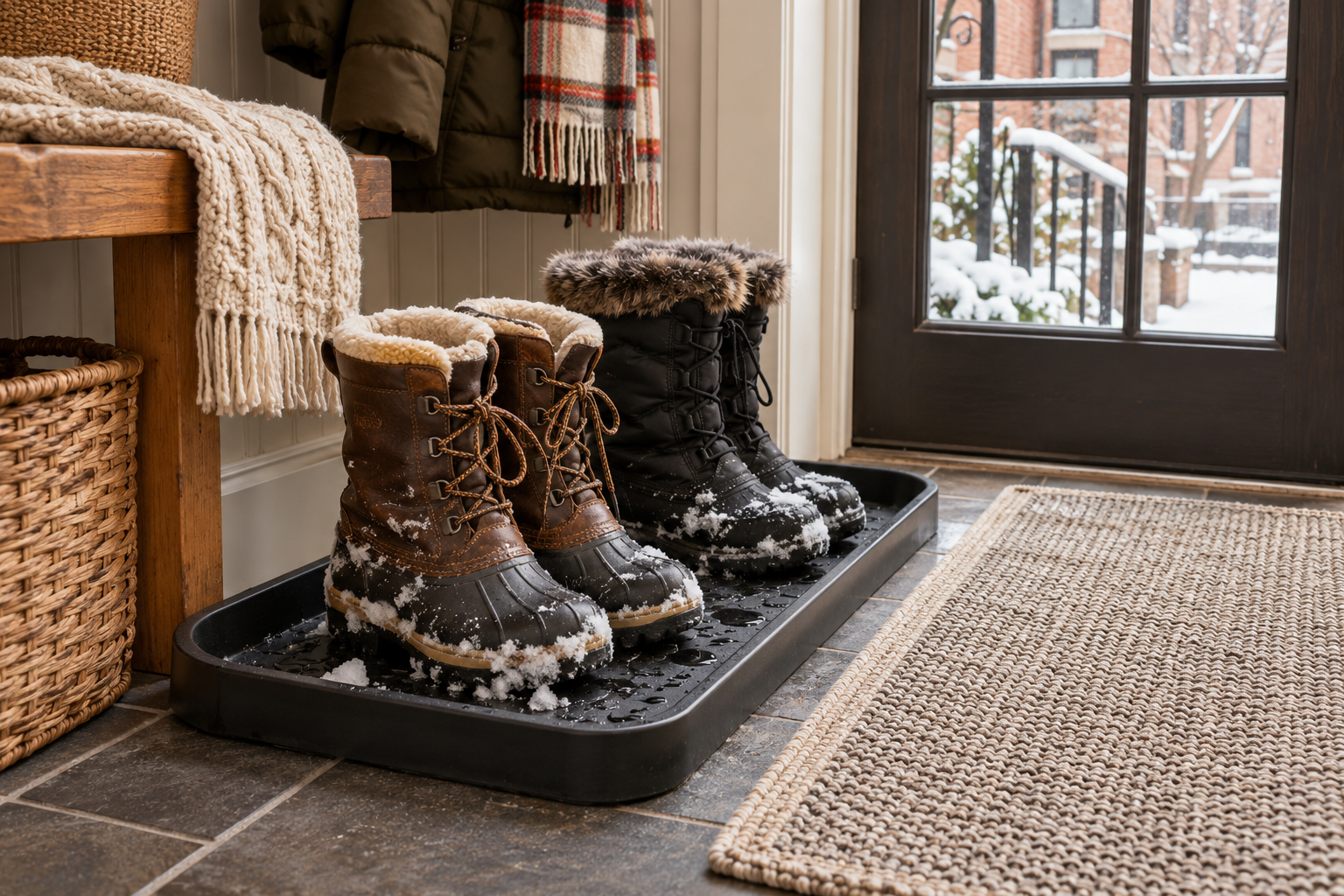
Chicago hosts deal with something guides from warmer places skip: salt.
It ends up on sidewalks, on boots and, if you're not ready, on your floors.
The Thanksgiving snowstorm reality
Don't count on dry weather.
On Saturday, Nov. 29, 2025, two days after Thanksgiving, O'Hare recorded 8.4 inches of snow, the snowiest November day on record in Chicago, plus 0.3 inches on Sunday [36][37]. The National Weather Service said snow that heavy is rare in the region in November [38].
A normal Chicago season brings 38.4 inches of snow [39]. On average, the first snowfall of more than 0.1 inch arrives around Nov. 18 [40].
Plan for wet boots at every holiday gathering.
Why salt is hard on floors
Salt leaves a white film, and that film can do damage.
Quote: "Salt especially tends to leave a white, abrasive residue that can scratch up your hardwood surface." — National Wood Flooring Association [41]
Water dissolves salt by pulling its sodium and chloride apart [42], so a damp mop works.
But more water isn't better.
The National Wood Flooring Association warns that excess water can seep into the seams and damage wood [43]. Use a well-wrung mop, dry the floor after, and follow your floor maker's care instructions.
Mats help a lot.
In commercial buildings, five feet of entrance matting captures 33% of walked-in debris, and ten feet captures 52% [44]. At home, the lesson holds: more mat, less salt on your floor.
Coat, boot and wet-glove station for a crowd
Quote: "Set up the boot station before the first guest rings the bell. It's much easier than mopping salt out of the living room rug." — Wells Ye
With the entry ready, the last big job is the bed for guests who stay the night.
How do you prep a guest room and bathroom for overnight visitors?
Short Answer: Wash the sheets and an extra blanket, clear one drawer and a few hangers, and leave a night light and the Wi-Fi password. In the bathroom, lay out dry towels, extra toilet paper and an empty trash can. A clean bed and a clean bathroom matter most to overnight guests, so spend your time there first.

Overnight guests need a few things a dinner guest doesn't: a bed, a bathroom of their own if possible, and a little space.
Start with a simple question: "What would make the sleeping setup work better for you?"
It's more useful than buying extras that may not help.
When travelers were asked what comforts they want most during holiday travel, they named dedicated beds, private bathrooms and personal space [45]. (The survey came from a hotel company.)
Wash the bedding the right way
Wash sheets and blankets in hot water.
The Asthma and Allergy Foundation of America advises washing sheets, blankets and throw rugs weekly in water that is at least 130°F to kill dust mites [46].
Quote: "Wash bedding weekly." — Mayo Clinic Staff [47]
Warm and safe
Guests do notice the sleep setup.
In one survey, 37% of hosts had received a complaint about it, and a cold room was the most common one (27%) [48]. Put an extra blanket at the foot of the bed.
For older guests, safety comes first.
The CDC lists throw rugs and clutter that can be tripped over among home hazards [49]. Clear the path from the bed to the bathroom and leave a night light on.
If your guest sleeps on the couch
You're not alone.
In a 2025 survey, 4 in 10 Americans had no guest room, and 56% of those said their overnight guests sleep on the couch [50].
Make up the couch before bedtime, and decide where the bedding goes during the day, so the living room can still be a living room.
Quote: "A clean bed, a clean bathroom and a warm blanket. Get those right and your guests will sleep well." — Wells Ye
Next, here's how our technicians approach the same jobs.
Why do deionized water, HEPA and HOCl make guest-prep easier?
Short Answer: Each tool does one job with fewer added products. Deionized water rinses glass and hard surfaces with fewer mineral spots. HEPA vacuums are built to trap very fine dust. HOCl is part of how we handle high-touch spots. Fewer products also means fewer added scents, which matters when you're getting a home ready for company.

Here's how I define it honestly: we keep chemicals to a minimum. We don't claim zero. Water is a chemical. So is HOCl.
How our process works
Our technicians follow an 8-step process for kitchens and bathrooms and a 6-step process for other rooms. In kitchens and bathrooms, that means:
- Set up an apron and a bucket for the room.
- Take out the garbage and the rugs.
- Spray and soak the hard-to-clean areas first: the sink, stove and counters in a kitchen; the toilet, shower walls, sink and counters in a bathroom.
- Dust high to low, from top to bottom, including corners and around furniture legs.
- Do a "dry trip" through the room.
- Do a "wet trip."
- Take care of the high-touch areas and any areas the client names, and leave a small sticker as a reminder.
- Change gloves and other protective gear before the next room.
Other rooms get the same flow in six steps, without the soak or the wet trip. Floors come last: we vacuum and mop after every room on a floor is done.
You can borrow that order at home. Start the soak first, dust high to low, and do the floors last.
What each tool does
Deionized water. DI water has had its ions removed [51]. Ordinary water carries minerals, and the spots and film it leaves on glassware are hard-water residue.
Quote: "This is more hard-water residue—not dangerous, but unsightly." — U.S. Geological Survey Water Science School [52]
HEPA filtration. The EPA says HEPA filters can, in theory, remove at least 99.97% of airborne particles 0.3 microns in size [53]. That number describes the filter. It doesn't mean a vacuum removes that share of the dust in a whole home.
HOCl. Hypochlorous acid is part of how our technicians handle high-touch spots in our process. HOCl has a nickname: “Miracle Disinfectant”. It kills germs thoroughly with only water and tiny amount of salt after that. It is so safe that HOCl is used to clean vegetables for salads.
Fewer products, fewer scents. In a small study of 30 cleaning products, green, fragrance-free products produced nearly eight times fewer VOC emissions than conventional ones [54].
For more on our approach, see The complete guide to chemical-free cleaning.
When does it make sense to hire help before guests arrive?
Short Answer: Hire help when your time is worth more spent on cooking, family or rest, or when a deep clean hasn't happened in months. Nationally, Angi reports an average of $176 for house cleaning and $180 to $375 for a deep clean, based on its own marketplace data [55][56]. Book two to three weeks ahead. Thanksgiving and Christmas weeks fill fast.

On an average day in 2025, Americans spent about two hours on household activities [57].
Women spent 2.4 hours, compared with 1.6 hours for men [58]. The holidays pile cooking, shopping and guests on top.
Buying back some of that time can be worth it.
In a study of 4,469 adults, people who spent money to buy themselves time reported greater life satisfaction, yet only 28.2% did so each month [59].
Quote: "We provide evidence that using money to buy time can provide a buffer against this time famine, thereby promoting happiness." — Ashley V. Whillans and colleagues, study authors [60]
Ask yourself: which essential jobs would I gladly hand over, and what would I do with that time?
For Chicago prices, see How much does house cleaning cost in Chicago in 2026?.
Which households benefit most
Parents trade scrubbing hours for time with their kids. Empty nesters often have the time but not the energy for a whole-house clean and a big meal in one week. Older adults gain the most by handing off ladder and kneeling work. And for young professionals, one clean before a Friendsgiving can save a weekend.
What to ask a cleaning company
- Employees or contractors? It affects who handles pay, taxes and training. In Illinois, someone regularly employed eight hours a week or more to clean a home is a domestic worker entitled to the $15 state minimum wage, which can be higher in some cities and counties [61]. Here's why I ask.
- Insured? The Better Business Bureau advises calling to verify that a cleaning service's bond and insurance policies are actually in effect [62].
- What's included? Ask what the quote covers, what counts as an add-on and what stays your job. Then, in the BBB's words: "Get everything in writing." [62]
- What products? Ask about added fragrance, and whether they'll work around a guest's asthma or allergies.
If you'd like us to handle it, our 3-month cleaning package covers the holiday season.
Quote: "You don't have to earn the right to sit down at your own party. Hand off the jobs that keep you from it." — Wells Ye
Help before the party is half of it. The other half is the morning after.
What should you clean after holiday guests leave?
Short Answer: Start with the food and the trash the same night, then the kitchen. The next day, wash guest linens and towels, wipe high-touch surfaces again and vacuum the entry where salt collected. Cleanup weighs on hosts: 43% say cleaning up afterward is the most stressful part of hosting a holiday gathering [63]. Plan your recovery before the party, not after.
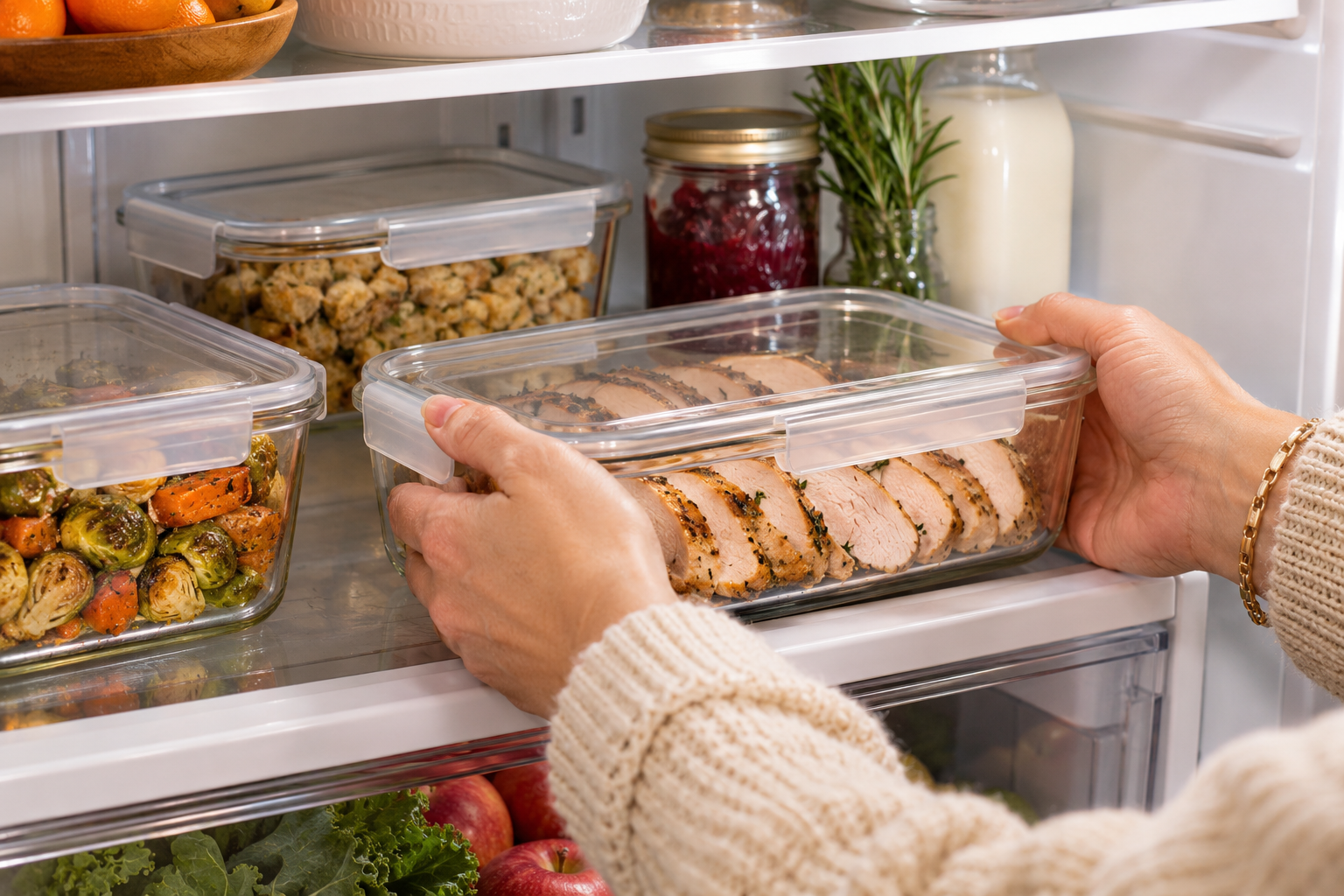
Day 0: the night of the party
Food comes first. Refrigerate all perishable food within two hours of it coming out of the oven or refrigerator [64]. If it's warmer than 90°F, the limit drops to one hour [65]. Holiday foods matter here: the CDC says most outbreaks of C. perfringens food poisoning happen in November and December, and many have been linked to foods like turkey and roast beef [66].
Then take out the trash, load the dishwasher and wipe the counters and sink.
Day 1: the next day
- Wash the guest sheets, towels and throw blankets.
- Wipe high-touch spots again. The CDC advises cleaning them "after you have visitors in your home" [15].
- Vacuum and damp-mop the entry where salt and slush collected.
- Use refrigerated leftovers within three to four days, or freeze them [65].
The week after
- Clean out the fridge before leftovers turn.
- Put away the extra chairs, the boot tray and the guest bedding.
- Book your next clean, or your January reset.
- Look back at your list. Which job made the visit easier? Which one ate time without helping a guest? Skip that one next year.
Quote: "Decide who does the dishes before the first guest arrives. Recovery is part of the plan, not an afterthought." — Wells Ye
Every household's plan looks a little different, so here's how to adjust it.
How should different households get guest-ready?
Short Answer: Your plan depends on your household. Empty nesters can spread prep over a week. Parents with children can give kids their own "zones." Older adults can skip ladders and heavy lifting. Young professionals can use the one-hour plan, and university students can focus on just the bathroom, the kitchen and the trash.
Empty nesters
You may be hosting adult children, grandchildren and your own parents at once.
Spread the work over a week. If a former bedroom now has another job, decide what has to move before you promise it as a guest room.
Make the home safe for older guests.
More than 14 million adults 65 and older, or 1 in 4, report falling every year [67]. In Illinois, 19.9% of adults 65 or older reported a fall in the previous year [68]. Clear walking paths and remove small rugs, or tape them so they don't slide [69].
Parents with children
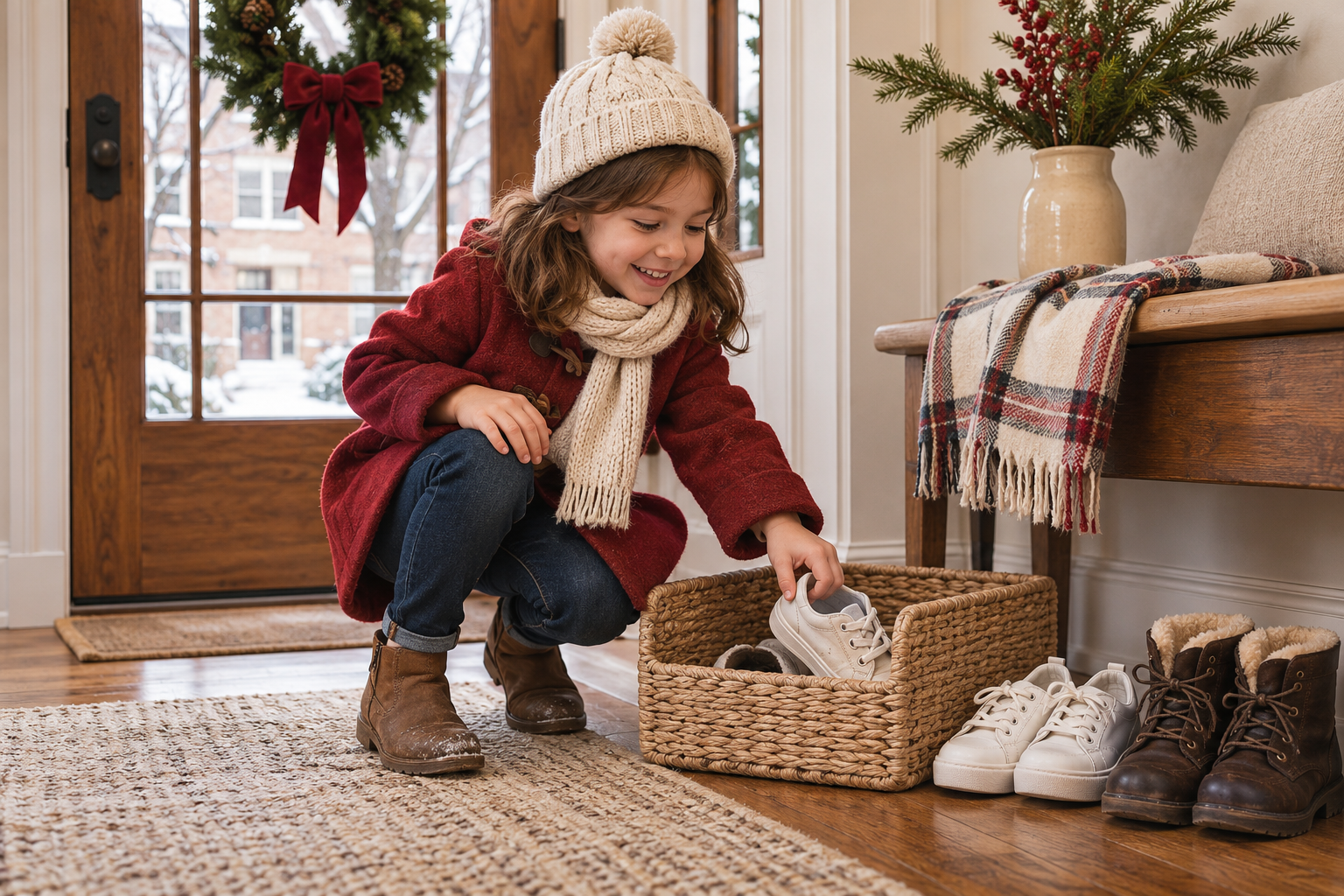
Give each child a "zone": the shoe pile, their bedroom floor or the bathroom sink. Small, clear jobs get done.
Visiting kids bring their own risks.
Ask guests to keep bags and coats with medicines in them up and away, out of children's sight [70], and keep medicines and cleaners locked up [71]. Household cleaning substances were the top category of poison exposures among children 5 and under in 2024, with 87,031 cases [72]. Keep button batteries out of reach, too: swallowed, they can cause life-threatening injuries [73].
"In homes with small children, avoid decorations that are sharp or breakable." — American Academy of Pediatrics [73]
Seniors
Skip the ladder, the heavy lifting and the oven scrubbing on your knees.
Hand those off, and keep your energy for the cooking and the company.
Young professionals
Use the one-hour plan.
In an apartment, the guest path is short: door, bathroom, kitchen, couch. Don't give one space two jobs, like serving food where the coats are piled.
University students
Focus on the bathroom, the kitchen and the trash, and split them between roommates before anyone invites guests.
Quote: "There's no single right way to get ready. Pick the plan that fits your home and your week." — Wells Ye
Frequently asked questions about getting your home guest-ready
Should guests take their shoes off?
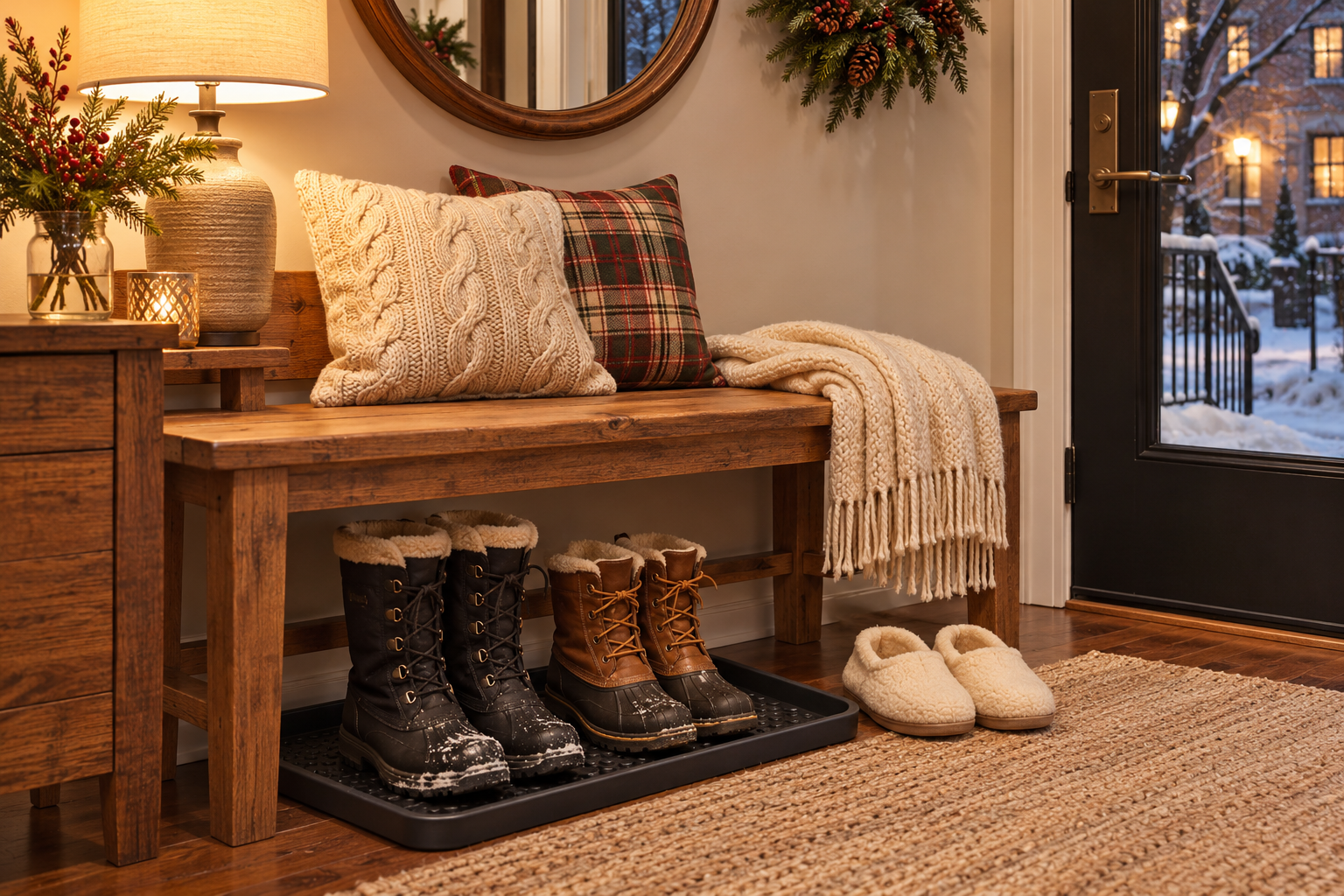
It keeps tracked-in dirt off your floors, and contaminated soil can carry lead in on shoes [74]. But older guests should keep non-slip shoes on, even indoors [69]. Offer a boot tray, and let anyone who needs support wear clean indoor shoes.
How far ahead should I start cleaning?
Start a week out for the fridge and the oven, and do the bathroom and floors the day before. Most people say they need three days on average to get ready [16]. For professional help, book two to three weeks ahead .
What if my mom criticizes my house?
You're in good company: 65% of people rank their mother among the guests who make them most anxious about a clean house [3]. Clean the guest path and let it go. If a comment comes, acknowledge it and move on with the visit.
Are candles OK?
I'd skip them. Scented candles add particles to indoor air [26], and the American Lung Association advises avoiding them, especially around asthma [27][28]. Remove the smell's source and open a window briefly instead.
What if I have pets and a guest has allergies?
Keep pets out of the allergic guest's bedroom [75]. Shutting a cat in one room won't contain its allergens [76], and pet allergens can cause symptoms up to six months after an animal is gone [77]. See our pet-safe cleaning guide.
What do I do about last-minute guests?
Use the 15-minute reset in section 4. Then relax.
"Be flexible and gracious." — Emily Post Institute [6]
What does a one-time professional clean include?
At Fresh Tech Maid, a one-time clean is a basic program plus add-ons you choose. See one-time cleaning for what's included, and check our zip codes to confirm we serve your area.
Should I hire a maid service in Chicago before holiday guests arrive?
Hire help when your time is better spent on cooking, family or rest, or when a deep clean hasn’t happened in months. Book as early as you can so you get the date you want.
What does a guest-ready home really give you?
Short Answer: Time to sit down. Most hosts spend hours cleaning, and 65% say they clean their home until the second before guests arrive [78]. A focused plan gives you a calm entry, a fresh bathroom, fresher air and a clear evening, so the holiday is about your people, not your baseboards.
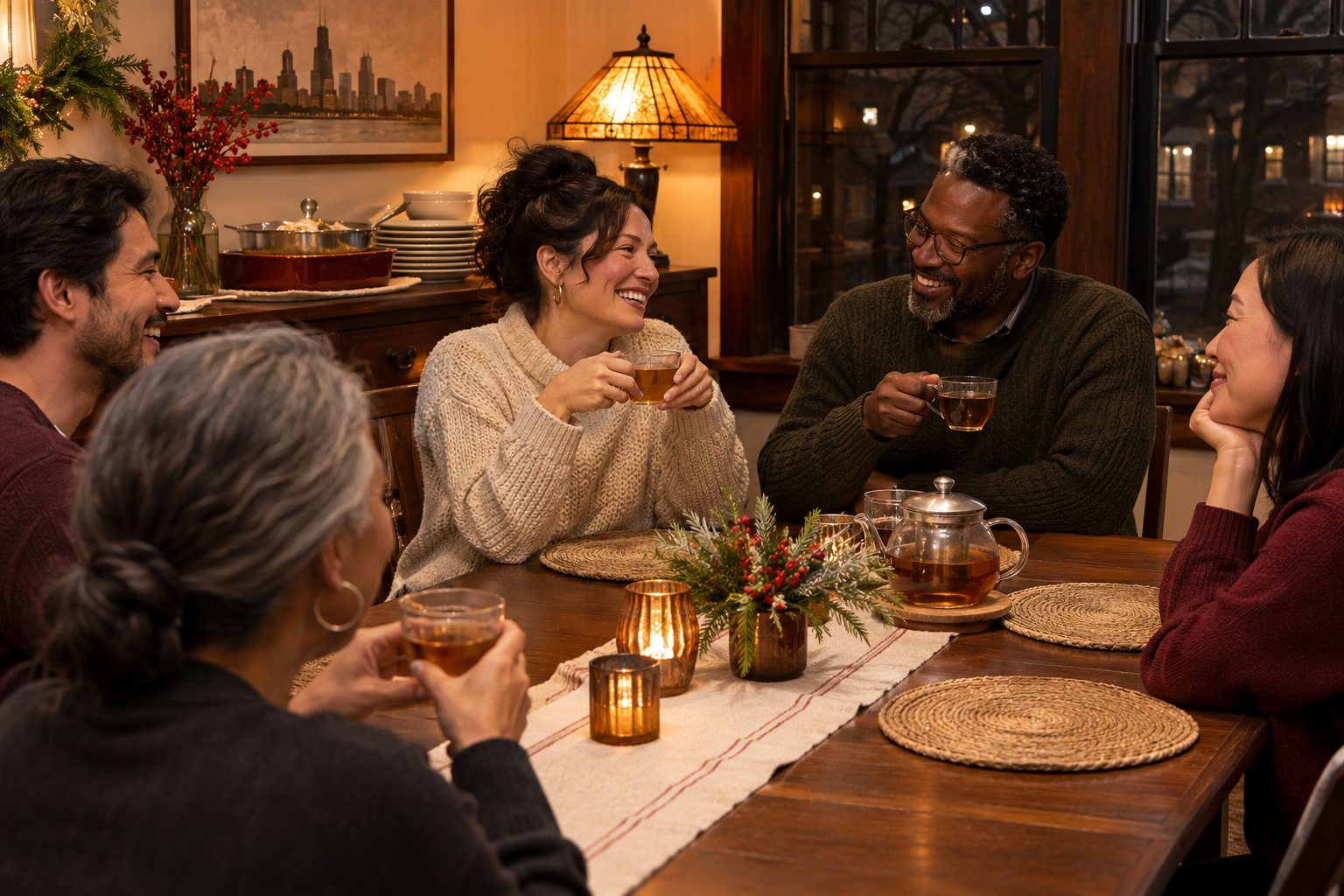
We're spending less time with each other than we used to.
On an average day in 2025, 30% of Americans socialized or communicated with others, down from 38% in 2015 [79].
And most of us say family time matters: 73% of U.S. adults rate it as one of the most important things to them personally [80].
Quote: "High-quality relationships can help people live longer, healthier lives." — Centers for Disease Control and Prevention [81]
So here's your finish line:
- Walk the guest path.
- Clean the essentials on it.
- Remove smells instead of covering them.
- Make it safe for your oldest and youngest guests.
- Stop at the time you set, and sit down.
Then put the cleaning tools away.
Your house can stay a lived-in home. Your guests still get a warm welcome.
Need more help in this season?
Plan your guest prep in 10 minutes. Pick your plan, assign the jobs and set a stopping time, so you're sitting down when the doorbell rings.
Want us to handle the guest prep? Our 3-month cleaning package takes the cleaning off your list for the holidays. You can also see our Chicago holiday house cleaning service.
"The best part of hosting isn't the clean house. It's the moment you finally sit down with the people you love." — Wells Ye
For more help this season, see Thanksgiving stress hacks 2026.
Sources
1. Ipsos. “Half of Americans spend three or more hours cleaning their homes in preparation for holiday guests.” December 2021. https://www.ipsos.com/en-us/half-americans-spend-three-or-more-hours-cleaning-their-homes-preparation-holiday-guests. Accessed November 8, 2026.
2. American Cleaning Institute (via Business Wire). “Yes, Your Holiday Guests DO Judge How Clean Your House Is.” December 2021. https://www.businesswire.com/news/home/20211207006022/en. Accessed November 8, 2026.
3. Bona. “Holiday Cleaning: Stress-Buster or Social Pressure?.” October 2024. https://www.businesswire.com/news/home/20241008838605/en/Holiday-Cleaning-Stress-Buster-or-Social-Pressure. Accessed November 9, 2026.
4. Journal of Personality and Social Psychology. “The spotlight effect in social judgment: an egocentric bias in estimates of the salience of one's own actions and appearance.” February 2000. https://pubmed.ncbi.nlm.nih.gov/10707330/. Accessed November 9, 2026.
5. Psychology Today. “Why Some People Assume Everyone Is Looking at Them.” November 2021. https://psychologytoday.com/us/blog/mental-mishaps/202111/why-some-people-assume-everyone-is-looking-them. Accessed November 9, 2026.
6. Emily Post Institute. “Party Etiquette Tips for Hosts and Guests.” https://emilypost.com/advice/party-etiquette-tips-for-hosts-and-guests. Accessed November 9, 2026.
7. Talker Research (commissioned by BISSELL). “Is keeping your home tidy harder than your 9-to-5?.” December 2024. https://talkerresearch.com/is-keeping-your-home-tidy-harder-than-your-9-to-5/. Accessed November 8, 2026.
8. Today's Homeowner. “Study: People Are Definitely Judging Your Home. We Asked Them How.” April 2025. https://todayshomeowner.com/blog/guides/what-people-judge-about-your-home-statistics/. Accessed November 9, 2026.
9. Chemical Senses (via HAL open archive). “Older and young adults experience similar long-term olfactory habituation.” 2021. https://hal.inrae.fr/hal-03236495. Accessed November 9, 2026.
10. The Laryngoscope. “Pronounced Olfactory Habituation with Age.” April 2024. https://onlinelibrary.wiley.com/doi/full/10.1002/lary.31442. Accessed November 9, 2026.
11. ENTtoday. “Older People More Prone to Olfactory Habituation After Extended Exposure to Odors.” September 2024. https://www.enttoday.org/article/older-people-more-prone-to-olfactory-habituation-after-extended-exposure-to-odors/. Accessed November 9, 2026.
12. Fox News (via Newser). “Here's why your house doesn't smell like anything ... to you.” September 2014. https://www.foxnews.com/health/heres-why-your-house-doesnt-smell-like-anything-to-you. Accessed November 9, 2026.
13. American Cleaning Institute. “Survey Reveals Top Cleaning Tasks to Help Ensure Healthy Holidays.” November 2025. https://www.cleaninginstitute.org/newsroom/2025/survey-reveals-top-cleaning-tasks-help-ensure-healthy-holidays. Accessed November 8, 2026.
14. U.S. Department of Agriculture. “New USDA Study on Consumer Kitchen Behavior Underscores the Importance of Food Safety Education Month.” September 2023. https://www.usda.gov/about-usda/news/press-releases/2023/09/19/new-usda-study-consumer-kitchen-behavior-underscores-importance-food-safety-education-month. Accessed November 8, 2026.
15. Centers for Disease Control and Prevention. “When and How to Clean and Disinfect Your Home.” January 2025. https://www.cdc.gov/hygiene/about/when-and-how-to-clean-and-disinfect-your-home.html. Accessed November 9, 2026.
16. StudyFinds. “Hosting for Halloween? Americans love parties, but entertaining guests is stressing them out.” October 2023. https://studyfinds.com/hosting-parties-guests-stress/. Accessed November 9, 2026.
17. USDA Food Safety and Inspection Service. “How long can a thawed turkey remain in the refrigerator after thawing?.” October 2024. https://ask.fsis.usda.gov/article/How-long-can-a-thawed-turkey-remain-in-the-refrigerator-after-thawing. Accessed November 9, 2026.
18. U.S. Department of Agriculture. “Thaw Your Turkey Safely in Time for Thanksgiving.” November 2023. https://www.usda.gov/node/55388. Accessed November 9, 2026.
19. U.S. Food and Drug Administration. “Refrigerator Thermometers - Cold Facts about Food Safety.” https://www.fda.gov/food/buy-store-serve-safe-food/refrigerator-thermometers-cold-facts-about-food-safety. Accessed November 9, 2026.
20. U.S. Environmental Protection Agency. “Volatile Organic Compounds' Impact on Indoor Air Quality.” June 2026. https://www.epa.gov/indoor-air-quality-iaq/volatile-organic-compounds-impact-indoor-air-quality. Accessed November 9, 2026.
21. Air Quality, Atmosphere & Health. “Fragranced consumer products: exposures and effects from emissions.” October 2016. https://pmc.ncbi.nlm.nih.gov/articles/PMC5093181/. Accessed November 9, 2026.
22. U.S. Environmental Protection Agency. “Indoor Air Quality (Report on the Environment).” May 2026. https://www.epa.gov/report-environment/indoor-air-quality. Accessed November 8, 2026.
23. U.S. Environmental Protection Agency. “Care for Your Air: A Guide to Indoor Air Quality.” August 2026. https://www.epa.gov/indoor-air-quality-iaq/care-your-air-guide-indoor-air-quality. Accessed November 8, 2026.
24. American Cleaning Institute (via Business Wire). “Survey Reveals Top Cleaning Tasks to Help Ensure Healthy Holidays.” November 2025. https://www.businesswire.com/news/home/20251117308142/en/Survey-Reveals-Top-Cleaning-Tasks-to-Help-Ensure-Healthy-Holidays. Accessed November 8, 2026.
25. U.S. Environmental Protection Agency. “Sources of Indoor Particulate Matter (PM).” March 2026. https://www.epa.gov/indoor-air-quality-iaq/sources-indoor-particulate-matter-pm. Accessed November 8, 2026.
26. Environment International. “How routine fragrance product use elevates indoor PM2.5 exposure in London households.” September 2026. https://pubmed.ncbi.nlm.nih.gov/42691638/. Accessed November 8, 2026.
27. American Lung Association. “Fragrances.” October 2026. https://www.lung.org/clean-air/indoor-air/indoor-air-pollutants/fragrances. Accessed November 9, 2026.
28. American Lung Association. “Holiday Scents and Lung Disease Triggers.” December 2024. https://www.lung.org/blog/holiday-scents-asthma-triggers. Accessed November 9, 2026.
29. Centers for Disease Control and Prevention. “Cleaning and Disinfecting.” June 2025. https://www.cdc.gov/hygiene/cleaning-disinfecting/index.html. Accessed November 9, 2026.
30. Business Wire (American Cleaning Institute). “New ACI Survey Reveals Hygiene Gaps That Put Families at Risk During Cold & Flu Season.” October 2025. https://www.businesswire.com/news/home/20251009493851/en/New-ACI-Survey-Reveals-Hygiene-Gaps-That-Put-Families-at-Risk-During-Cold-Flu-Season. Accessed November 9, 2026.
31. U.S. Environmental Protection Agency. “What�s the difference between products that disinfect, sanitize, and clean surfaces?.” October 2026. https://www.epa.gov/coronavirus-and-disinfectants/whats-difference-between-products-disinfect-sanitize-and-clean. Accessed November 9, 2026.
32. U.S. Environmental Protection Agency. “Selected EPA-Registered Disinfectants.” August 2026. https://www.epa.gov/pesticide-registration/selected-epa-registered-disinfectants. Accessed November 9, 2026.
33. American Cleaning Institute. “2025 Fall Cleaning Survey.” October 2025. https://www.cleaninginstitute.org/newsroom/2025/2025-fall-cleaning-survey. Accessed November 9, 2026.
34. Centers for Disease Control and Prevention. “How RSV Spreads.” February 2026. https://www.cdc.gov/rsv/causes/index.html. Accessed November 8, 2026.
35. FOX 32 Chicago. “Chicago officials confident in salt supply as others face shortages.” January 2026. https://www.fox32chicago.com/news/chicago-officials-confident-in-salt-supply-as-others-face-shortages. Accessed November 8, 2026.
36. WBEZ Chicago. “Saturday was snowiest November day in Chicago, as nearly 9 inches blanketed parts of city.” November 2025. https://www.wbez.org/weather/2025/11/30/snow-storm-record. Accessed November 9, 2026.
37. National Weather Service Chicago. “November 29-30, 2025: Post-Thanksgiving Winter Storm Delivers Up to a Foot of Snow to the Region.” November 2025. https://www.weather.gov/lot/2025_11_29_WinterStorm. Accessed November 9, 2026.
38. WTTW News. “Weekend Storm Set a Chicago Record for November Snowfall.” December 2025. https://news.wttw.com/2025/12/01/weekend-storm-set-chicago-record-november-snowfall. Accessed November 9, 2026.
39. National Weather Service. “Chicago, IL Seasonal Snowfall Totals from 1884 to present!.” 2022. https://www.weather.gov/lot/chicago_seasonal_snow. Accessed November 8, 2026.
40. FOX 32 Chicago. “When is the first average snowfall in Chicago?.” October 2026. https://www.fox32chicago.com/weather/first-average-snowfall-chicago. Accessed November 8, 2026.
41. National Wood Flooring Association. “Avoiding Winter Weather Woes.” January 2022. https://woodfloors.org/avoiding-winter-weather-woes/3/. Accessed November 9, 2026.
42. U.S. Geological Survey. “Water, the Universal Solvent.” August 2026. https://www.usgs.gov/water-science-school/science/water-universal-solvent. Accessed November 9, 2026.
43. National Wood Flooring Association. “How to Clean and Take Care of Your Wood Floors: Essential Tips for Homeowners.” August 2025. https://woodfloors.org/how-to-clean-and-take-care-of-your-wood-floors-essential-tips-for-homeowners/. Accessed November 9, 2026.
44. CleanLink. “Effective Matting: Putting a Stop to the 72-cent Visitor.” July 2014. https://www.cleanlink.com/news/article/Effective-Matting-Putting-a-Stop-to-the-72-cent-Visitor--17288. Accessed November 9, 2026.
45. Hilton. “Half of Americans Make Excuses to Cut Holiday Family Visits Short, According to New Hilton Survey.” November 2025. https://stories.hilton.com/releases/half-of-americans-make-excuses-to-cut-holiday-family-visits-short. Accessed November 9, 2026.
46. Asthma and Allergy Foundation of America. “Dust Mite Allergy.” May 2026. https://aafa.org/allergies/types-of-allergies/insect-allergy/dust-mite-allergy/. Accessed November 9, 2026.
47. Mayo Clinic. “Dust mite allergy - Diagnosis and treatment.” September 2025. https://www.mayoclinic.org/diseases-conditions/dust-mites/diagnosis-treatment/drc-20352178. Accessed November 9, 2026.
48. Amerisleep. “The Guest Bed Report: How Americans Host Overnight Guests.” May 2026. https://amerisleep.com/blog/guest-bed-report/. Accessed November 9, 2026.
49. Centers for Disease Control and Prevention. “Facts About Older Adult Falls.” September 2026. https://www.cdc.gov/falls/data-research/facts-stats/. Accessed November 9, 2026.
50. Talker Research. “How long is too long? Hosts say six days is the limit for houseguests.” November 2025. https://talkerresearch.com/how-long-is-too-long-hosts-say-six-days-is-the-limit-for-houseguests/. Accessed November 9, 2026.
51. University of Illinois Urbana-Champaign. “What is Deionized Water?.” October 2007. https://van.physics.illinois.edu/ask/listing/1743. Accessed November 9, 2026.
52. U.S. Geological Survey. “Hardness of Water.” August 2026. https://www.usgs.gov/water-science-school/science/hardness-water. Accessed November 9, 2026.
53. U.S. Environmental Protection Agency. “What is a HEPA filter?.” January 2026. https://www.epa.gov/indoor-air-quality-iaq/what-hepa-filter. Accessed November 9, 2026.
54. Environmental Working Group (via EurekAlert!). “Cleaning products emit hundreds of hazardous chemicals, new study finds.” September 2023. https://www.eurekalert.org/news-releases/1000923. Accessed November 8, 2026.
55. Angi. “How Much Does Professional House Cleaning Cost? [2026 Data].” September 2026. https://www.angi.com/articles/how-much-does-it-cost-hire-house-cleaner.htm. Accessed November 9, 2026.
56. Angi. “How Much Does It Cost to Deep Clean a House? [2026 Data].” September 2026. https://www.angi.com/articles/deep-cleaning-house-cost.htm. Accessed November 9, 2026.
57. U.S. Bureau of Labor Statistics. “American Time Use Survey � 2025 Results.” June 2026. https://www.bls.gov/news.release/atus.nr0.htm. Accessed November 8, 2026.
58. U.S. Bureau of Labor Statistics. “Time spent in personal care activities averaged 9.8 hours per day in 2025.” August 2026. https://www.bls.gov/opub/ted/2026/time-spent-in-personal-care-activities-averaged-9-8-hours-per-day-in-2025.htm. Accessed November 8, 2026.
59. Proceedings of the National Academy of Sciences (via PubMed Central). “Buying time promotes happiness.” July 2017. https://pmc.ncbi.nlm.nih.gov/articles/PMC5559044/. Accessed November 9, 2026.
60. Proceedings of the National Academy of Sciences. “Buying time promotes happiness.” July 2017. https://pubmed.ncbi.nlm.nih.gov/28739889/. Accessed November 9, 2026.
61. Illinois Legal Aid Online. “My rights as a domestic worker.” January 2025. https://www.illinoislegalaid.org/legal-information/my-rights-domestic-worker. Accessed November 9, 2026.
62. Better Business Bureau. “BBB Tips: 7 Tips for Hiring a Cleaning Service.” April 2020. https://www.bbb.org/article/news-releases/20552-bbb-tips-7-tips-for-hiring-a-house-cleaning-service. Accessed November 9, 2026.
63. Peerspace. “Holiday Party Mishaps Report: When Festivities Go Off Script.” November 2025. https://www.peerspace.com/resources/?p=124279. Accessed November 9, 2026.
64. U.S. Department of Agriculture. “Leftovers: The Gift that Keeps on Giving.” November 2020. https://www.usda.gov/node/40832. Accessed November 9, 2026.
65. USDA Food Safety and Inspection Service. “How do I handle leftovers safely?.” December 2024. https://ask.fsis.usda.gov/article/How-do-I-handle-leftovers-safely/. Accessed November 9, 2026.
66. Centers for Disease Control and Prevention. “About C. perfringens food poisoning.” September 2026. https://www.cdc.gov/clostridium-perfringens/about/index.html. Accessed November 8, 2026.
67. Centers for Disease Control and Prevention. “Older Adult Falls Data.” September 2026. https://www.cdc.gov/falls/data-research/index.html. Accessed November 8, 2026.
68. Centers for Disease Control and Prevention. “Nonfatal and Fatal Falls Among Adults Aged �65 Years � United States, 2020�2021.” September 2023. https://www.cdc.gov/mmwr/volumes/72/wr/mm7235a1.htm. Accessed November 8, 2026.
69. U.S. Department of Health and Human Services. “Lower Your Risk of Falling.” August 2026. https://odphp.health.gov/myhealthfinder/healthy-living/safety/lower-your-risk-falling. Accessed November 9, 2026.
70. Centers for Disease Control and Prevention. “Up and Away Campaign Resources.” July 2025. https://www.cdc.gov/medication-safety/php/toolkit/index.html. Accessed November 9, 2026.
71. U.S. Consumer Product Safety Commission. “Medication & Cleaner Storage Safety | Protect Children at Home.” March 2026. https://www.cpsc.gov/node/66134. Accessed November 9, 2026.
72. National Capital Poison Center (Poison Control). “National poison center statistics, 2024.” 2025. https://www.poison.org/poison-statistics-national. Accessed November 8, 2026.
73. American Academy of Pediatrics. “Holiday Decoration Safety: 12 Tips for Families.” December 2025. https://www.healthychildren.org/English/safety-prevention/at-home/Pages/Holiday-Decorations-Safety-Tips.aspx. Accessed November 9, 2026.
74. U.S. Environmental Protection Agency. “Reduce the Risk of Lead Exposure at Home.” November 2026. https://www.epa.gov/lead/reduce-risk-lead-exposure-home. Accessed November 9, 2026.
75. National Institute of Environmental Health Sciences. “Pet Allergens.” https://www.niehs.nih.gov/health/topics/agents/allergens/pets. Accessed November 9, 2026.
76. American College of Allergy, Asthma & Immunology. “Pet Allergies.” https://acaai.org/allergies/allergic-conditions/pet-allergies/. Accessed November 9, 2026.
77. Asthma and Allergy Foundation of America. “Pet Allergy.” January 2025. https://aafa.org/allergies/types-of-allergies/pet-dog-cat-allergies/. Accessed November 9, 2026.
78. Talker Research. “Most time-consuming tasks for holiday hosts.” December 2024. https://talker.news/2024/12/19/these-are-the-most-time-consuming-tasks-for-holiday-hosts/. Accessed November 9, 2026.
79. U.S. Bureau of Labor Statistics. “American Time Use Survey � 2025 Results.” June 2026. https://www.bls.gov/news.release/archives/atus_06252026.pdf. Accessed November 9, 2026.
80. Pew Research Center. “Family time is far more important than other aspects of life for most Americans.” May 2023. https://www.pewresearch.org/short-reads/2023/05/26/family-time-is-far-more-important-than-other-aspects-of-life-for-most-americans/. Accessed November 9, 2026.
81. Centers for Disease Control and Prevention. “Social Connection.” May 2024. https://www.cdc.gov/social-connectedness/about/index.html. Accessed November 9, 2026.
Get Your Christmas Survival Guide! Now!