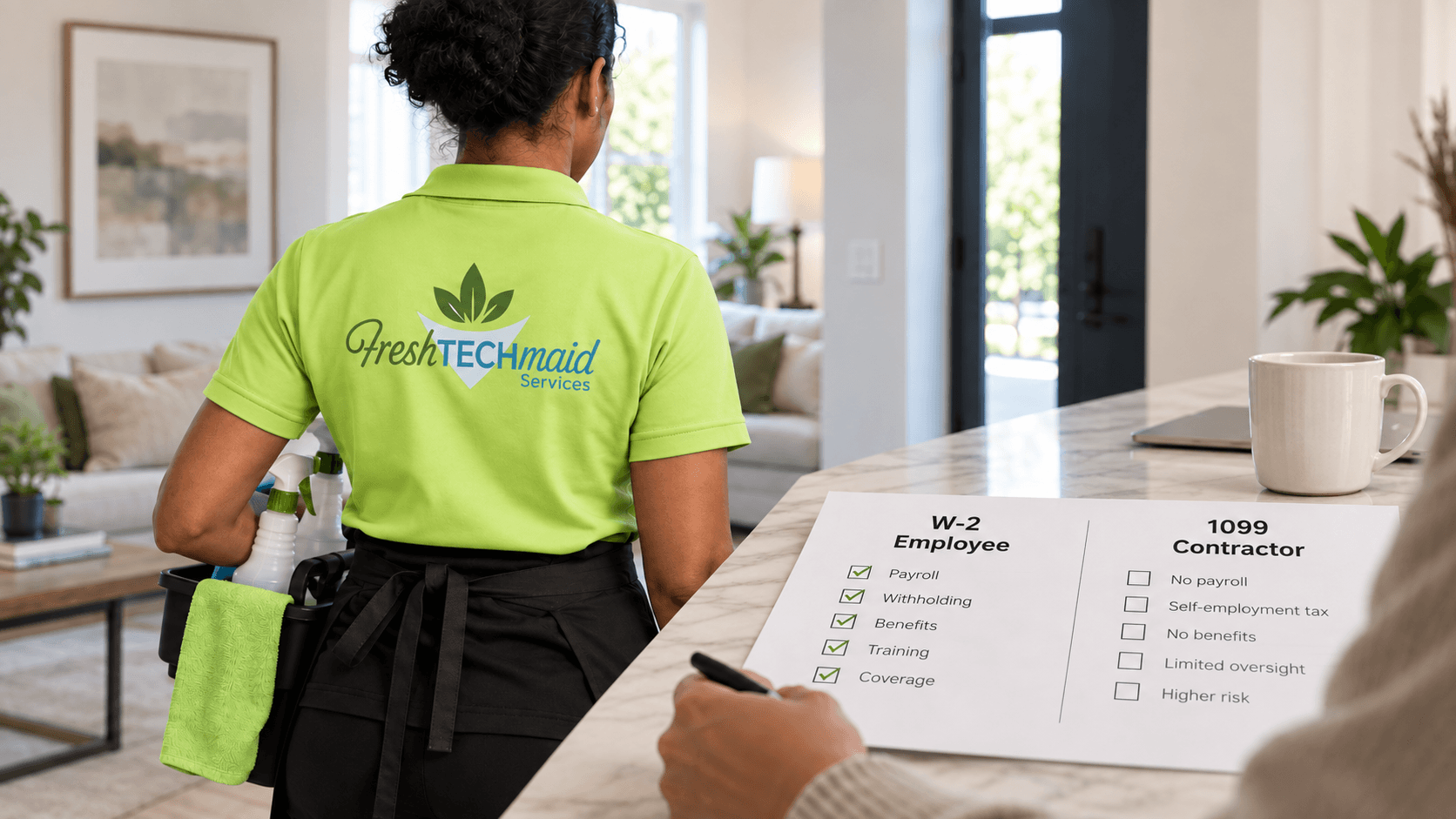
Most Chicago homeowners never think to ask this question: is the person cleaning your home an employee of
the cleaning company, or an independent contractor?
I ask it because the answer decides who pays when something goes wrong.
It decides whether your cleaner was ever trained.
It decides whether anyone carries insurance for an injury on your stairs.
And it decides whether the "company" you hired is really a company at all.
I have spent more than 20 years in the service industry. I have hired more than 2,000 people in the cleaning
business. Many of the cleaners I interviewed over those years came from companies that paid them as 1099
independent contractors.
When I asked those cleaners about their training, most gave me the same answer. There wasn't any.
That is not because those companies are lazy. It is because the contractor model legally punishes training. I will
explain exactly why in a moment.
This article is my honest attempt to educate you, not to scare you.
Some independent contractors are excellent at what they do. But you deserve to know how the model works,
what it saves the company, and what risk quietly moves onto you and your family.
By the end, you will know exactly what to ask before anyone walks through your door.
What is the difference between an employee and an independent contractor cleaner in Chicago?
The label sounds like paperwork. It is really about control and protection.
The IRS looks at three things when it decides whether a worker is an employee:
1. Behavioral control
2. Financial control
3. The type of relationship between the parties
Behavioral control asks who directs the work. Does the company tell the worker when to arrive, what order to clean in, and which supplies to use? That points to an employee.
Financial control asks who runs the business side. Does the worker buy their own equipment, cover their own expenses, and serve many clients? That points to a contractor.
The relationship test asks about the bigger picture. Are there benefits like insurance or paid time off? Is the work ongoing and central to the company's business? Those point to an employee.
No single factor settles it. And here is the part that surprises most people: a contract that says "independent contractor" does not make it true. The facts of the relationship decide, not the title on the paper.
In Chicago, both models are everywhere.
Some maid services send W-2 employees. Many others, including some big-name booking platforms, dispatch 1099 contractors. From your couch, the two look identical. A cleaning person arrives with a mop.
For Parents with Children, this distinction matters more than almost anything else about a cleaning service. An employee relationship is the legal foundation for everything you probably assume you are buying: training, supervision, insurance, and accountability.
So if the two models look the same at your door, why do companies choose contractors?
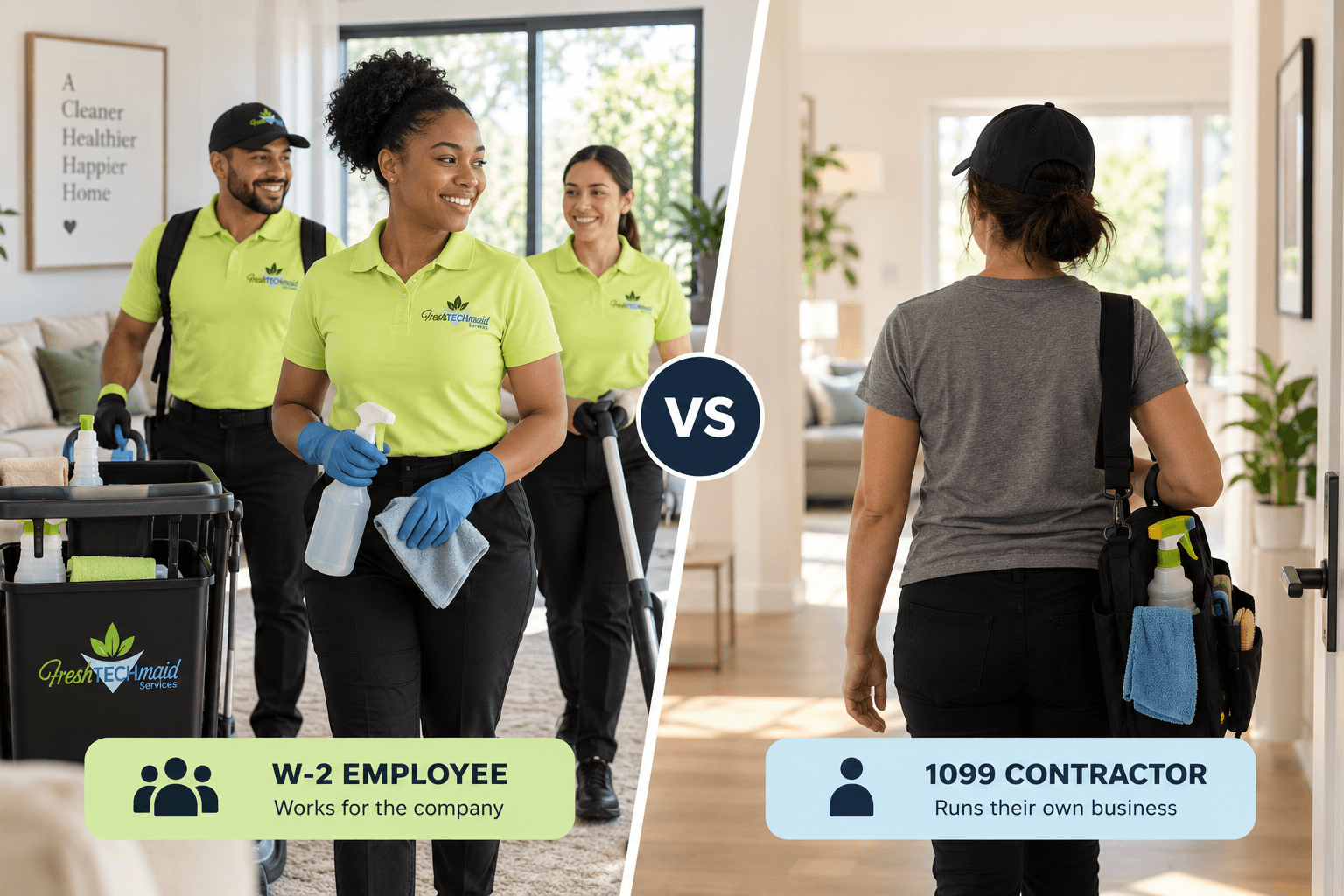
Why do cleaning companies hire independent contractors instead of employees in Chicago?
Let me show you the math, because the math explains almost everything.
When I pay a W-2 cleaning technician, I also pay a 7.65% match for Social Security and Medicare on top of every dollar of wages. A contractor-model company pays zero. The worker pays both halves themselves as a 15.3%
self-employment tax.
I pay federal unemployment tax (FUTA) and Illinois state unemployment tax. A contractor-model company pays neither, because contractors cannot collect unemployment when the work dries up.
I pay workers' compensation insurance premiums. Cleaning is physical work with real injury risk, so this is not a small line item. A contractor-model company usually pays nothing here either.
Then come the costs that never show up in a tax table: paid training hours, paid drive time, supplies, equipment, and benefits.
Add it up and the contractor model can shave a meaningful slice off the cost of every single clean. That discount has to go somewhere. Sometimes it goes into a lower price for you. Sometimes it just goes into profit.
This is why I tell Chicago parents comparing quotes on their phones: when one number looks surprisingly low, ask what was removed to get there.
Often the answer is the worker's entire safety net.
“Every cheap quote has a source. Too often, the source is a worker's missing safety net. I pay the 7.65% match gladly. It buys my team Social Security credit and my clients peace of mind.” — Author: Wells Ye
To be fair, saving money this way is legal when the workers are genuinely independent businesses.
The trouble starts when a company wants contractor prices and employee control at the same time. The IRS and the U.S. Department of Labor call that misclassification, and they treat it seriously.
Table 1. What an employer pays for a W-2 cleaner — and what the contractor model skips
Sources: IRS — Understanding employee vs. contractor designation | Illinois Workers' Compensation Commission — Insurance | SurePayroll — Federal payroll taxes
The savings above are visible on a spreadsheet. The next cost of the model is invisible — and it lands on quality.
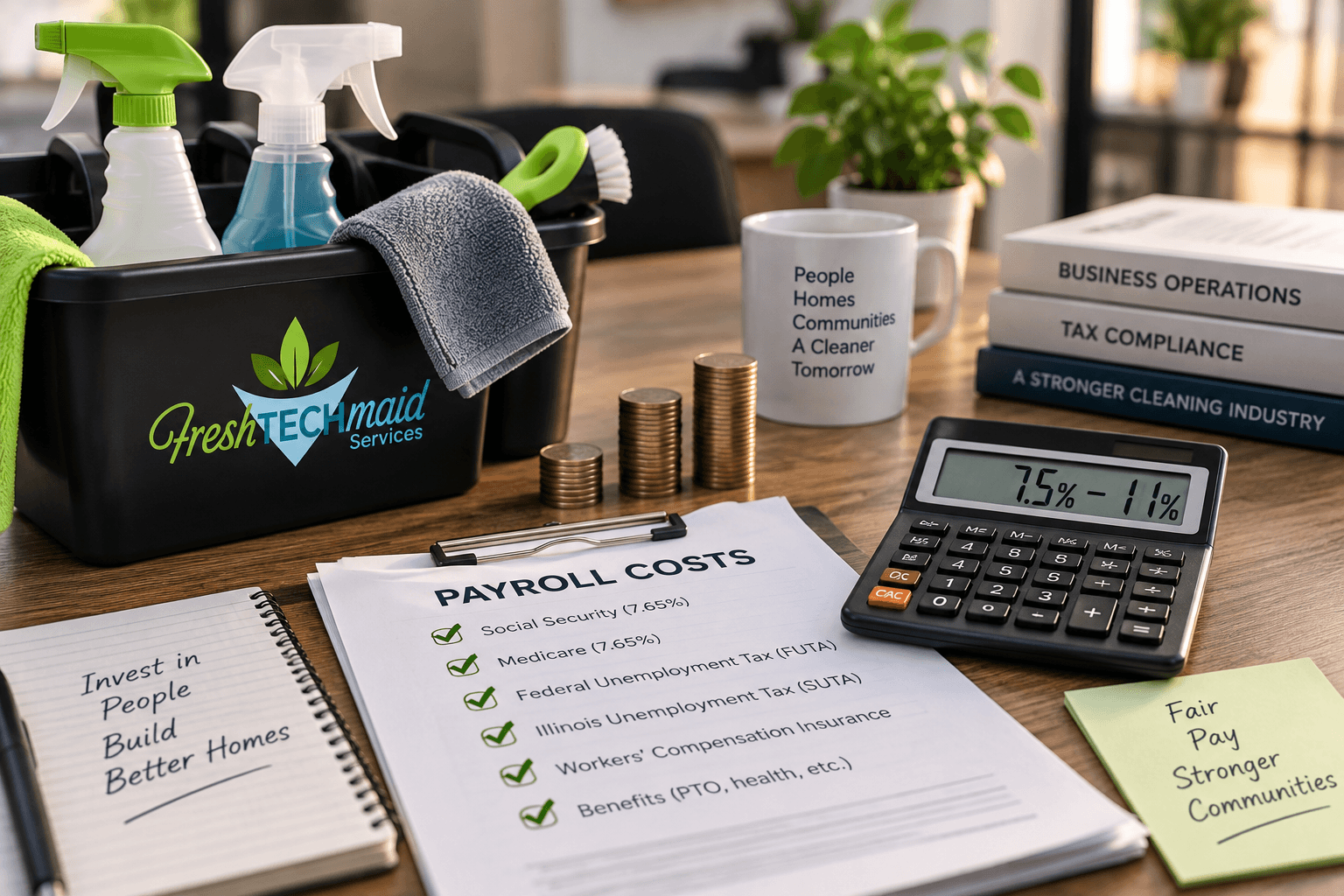
Can a Chicago cleaning company legally train an independent contractor?
This is the section that changed how I think about our whole industry.
The IRS is blunt about training.
If a business trains a worker on how to do the job, that shows the business wants the work done a particular way. Ongoing, periodic training is even stronger evidence of an employer-employee relationship.
The same logic applies to detailed instructions, to evaluation systems that grade how the work is performed, and, in many analyses, to required branded uniforms. Each one is a form of control.
Control is the heart of the employee test.
So picture the dilemma of a contractor-model cleaning company. The moment it builds a training program, writes a cleaning methodology, or audits how its cleaners actually work, it starts building the case that those cleaners were employees all along. Back taxes, penalties, and back pay can follow.
The rational move, and the common one, is simply not to train.
Think about what that means for you. The things you assume come with the words "professional cleaning company" — a method, standards, supervision, someone checking the work — are structurally off the table under that model.
This is personal for me.
Fresh Tech Maids cleans with physics instead of harsh chemicals: deionized water, HEPA filtration, and hypochlorous acid. Those methods take weeks to teach and ongoing coaching to keep sharp. There is no version of that system I could have built on 1099 labor. The law itself would have forbidden the teaching.
“Our chemical-free methods take weeks to teach. There is no 1099 version of that.” — Author: Wells Ye
For Empty Nesters arranging help for aging parents, ask this one question of any company: "Describe your training program."
A real employer will talk for ten minutes. A contractor model has to change the subject.
Training decides quality. The next question decides something heavier — who pays for an injury.
Who pays if a contractor gets hurt in your Chicago home?
This is the section I most want you to read twice.
Illinois takes workers' compensation seriously. The law requires employers to insure almost everyone they hire, starting with the very first employee. An employer that knowingly goes without coverage faces fines of $500 for every day of noncompliance, with a $10,000 minimum.
But that entire system protects employees. Independent contractors are not covered by the Illinois workers' compensation act.
When a genuine contractor is hurt on the job, there is no comp policy standing behind them unless they bought one for themselves. Most solo cleaners have not.
Now walk through what happens when an uninsured cleaner is injured in your home.
Cleaning is physical work: stairs, wet floors, lifting, ladders. The injured person has medical bills and lost income, and they will look for someone to recover them from.
The nearest target is you.
“An injury claim should never become a surprise bill for a family that just wanted a clean kitchen.” — Author: Wells Ye
Claims like this land on the liability portion of your homeowners policy — and many policies limit or exclude coverage for people working in your home. If coverage falls short, the claim can reach your savings.
Here is the trap I see constantly.
A homeowner asks, "Are you insured?" The company says yes, meaning general liability. But general liability covers damage to your property and injuries to third parties. It does not cover an injury to the worker. The Illinois Workers' Compensation Commission says this in writing: general liability insurance will not stand in for workers' comp.
To be fair, you are not automatically liable every time someone is hurt on your property. Negligence usually has to be shown. But "not automatically" is thin comfort when you are the one being named in a claim.
For Seniors and Traditionalists on fixed incomes, this is the single strongest reason to insist on a company whose cleaners are covered employees. One uncovered injury claim can undo decades of careful saving.
Insurance protects your finances. But what does the model do to the cleaning itself?
What does the contractor model mean for quality and professionalism?
In twenty years of hiring, I have learned that cleaning quality comes from three things: training, evaluation, and retention.
The contractor model blocks the first two by law, as we just saw. It quietly undermines the third.
Contractors receive no benefits, no paid time off, no unemployment cushion, and no path to advancement. So they leave. When they leave, the company sends someone new, and the new person learns your home from zero. Which door sticks. Which floor is real hardwood. Which room the baby naps in.
You pay that churn tax in re-explaining your home, visit after visit.
There is a professionalism layer too.
An employer vets, schedules, supervises, and answers for its people. A dispatch platform often just connects you. If something goes wrong, you may discover that the "company" considers itself a technology service, not a cleaning service.
And there is an ethical layer that I think Chicago consumers increasingly care about.
The U.S. Department of Labor has said for years that misclassified workers lose minimum wage protection, overtime, unemployment insurance, and more. The person scrubbing your bathroom may have no safety net at all.
University Students, I know the app-based clean is tempting on a shared-apartment budget. Just understand what the low price is made of before you hand over a key.
This is why our technicians at Fresh Tech Maids are W-2 employees. Not because it is fashionable, but because everything my clients actually want — a trained person, a consistent person, a covered person — is only legal to deliver under employment.
By now the contractor model sounds bleak. So let me be fair to it for a moment.
Are independent contractors ever the right choice for Chicago homes?
I want to be honest here, because honest is more useful than dramatic.
Some of the best cleaners I have ever met are true solo businesses. They set their own methods. They carry their own liability policy, and sometimes their own workers' comp coverage. They own their equipment, choose their clients, and take real pride in their craft. Hiring a person like that is hiring a business, and it can work beautifully.
Commercial cleaning is different terrain too. Office buildings and property managers usually demand certificates of insurance from every vendor before anyone touches a floor. The paperwork gets checked at the loading dock. In that world, contractor arrangements are routine and generally well policed.
“Some of the best cleaners I have met are true solo businesses. They carry their own insurance and their own pride.” — Author: Wells Ye
Your home has no loading dock. Nobody checks the paperwork unless you do.
So my position is not "reject all contractors."
My position is: reject ambiguity.
The arrangement that should worry you is the gray middle.
A "company" that advertises like an employer, schedules like an employer, takes your payment like an employer — but classifies its cleaners as 1099 contractors and accepts none of an employer's duties. That model wants employee-level trust at contractor-level cost, and the gap between the two lands on the worker and on you.
If you do choose a genuine solo contractor, treat it like hiring a business. Ask for proof of their own insurance. Ask how long they have operated and who else they serve. A real independent will have crisp answers, because independence is their product.
Which brings us to the practical question this whole article exists to answer.
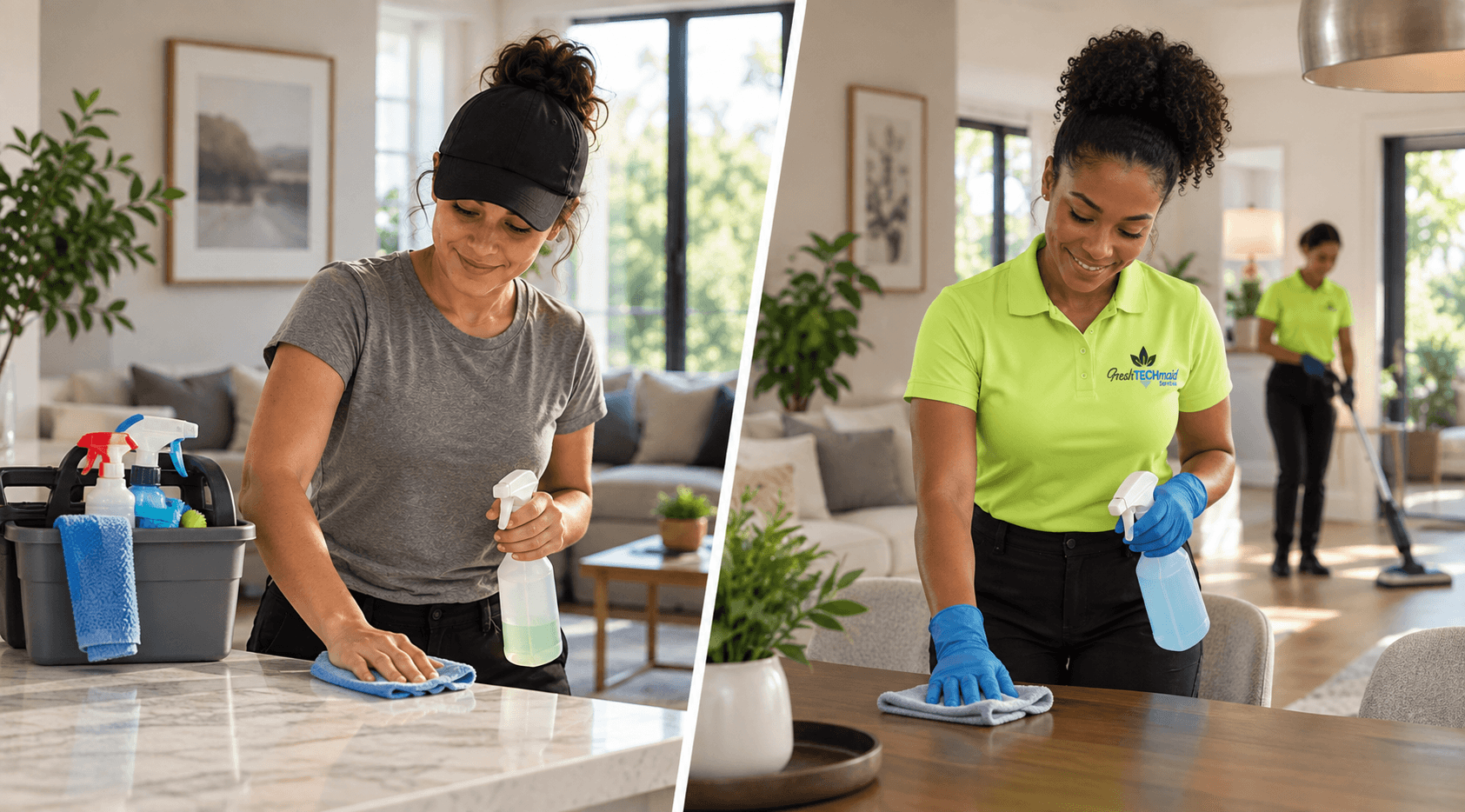
How can you tell if the cleaner in your Chicago home is an employee?
You do not need a law degree. You need five questions and ten minutes.
First: "Are the people you send W-2 employees of your company?" This is the master question. A real employer says yes instantly, because payroll is the least secret thing about their business. Hesitation, or a pivot to "all our cleaners are insured," tells you something.
Second: "Can you email me a certificate of insurance showing both general liability and workers' compensation?" A certificate of insurance, or COI, is a standard one-page document that insurance carriers issue on request. Legitimate companies produce one in minutes. A contractor-model company cannot show workers' comp for people it refuses to employ.
Third: "Who trains your cleaners, and on what method?" You now know why this question has teeth. Employers describe programs. Contractor models describe vibes.
Fourth: "Will I generally see the same person or team?" Consistency is a byproduct of employment and retention.
Fifth: "Who do I contact if something is damaged or goes wrong?" You want a company that answers for its people, not a platform that connects you to strangers.
“The best time to ask about insurance is before you book a cleaning. The worst time is in the emergency room.” — Author: Wells Ye
Alongside the questions, watch the everyday signals.
Payment demanded in cash or personal payment apps. Scheduling texts from a personal cell number. A different face at every visit. No uniform, no company car, supplies in grocery bags. None of these alone is proof, and remember that even a genuine contractor situation does not automatically make you liable for every mishap.
But three or four together tell a clear story.
I have packaged all of this into a free Chicago Homeowner's Cleaner Verification Kit — the five questions with an answer decoder, a copy-and-paste COI request email, and a red-flag scorecard. It is at the end of this article, and I genuinely hope you use it on every company you consider, including mine.
One last scenario deserves its own warning — hiring a cleaner yourself, with no company at all.
Table 2. The five questions — what good and bad answers sound like
Sources: Fresh Tech Maid framework
What else should you know before hiring a Chicago cleaner directly?
There is one more version of this story, and it stars you.
Suppose you skip companies entirely and hire a cleaning lady yourself. You set her schedule. You tell her which rooms, which products, which order. You provide the vacuum.
Congratulations — in the eyes of the IRS, you may have just become a household employer.
IRS Publication 926 draws the line exactly where this whole article has drawn it: control. If you control not just what work is done but how it is done, the worker is your household employee. Cleaning people and housekeepers are on the IRS's own list of examples.
Once wages pass an annual threshold the IRS updates each year, you owe Social Security and Medicare taxes on those wages, filed with Schedule H on your own Form 1040. Federal and state unemployment taxes can apply too, along with Form I-9 employment-verification duties that Illinois households are not exempt from.
Most families discover this at tax time, or worse, after an injury.
The flip side is one of the quietest advantages of hiring a real employer. IRS guidance is clear that when an agency provides the worker and controls what is done and how, the worker is the agency's employee — not yours. The payroll taxes, the workers' comp, the paperwork: all of it sits on the company's desk instead of your kitchen table.
That is exactly the deal my clients get with our recurring cleaning service. The cleaner is my employee. The burden is mine. This article is educational, not legal or tax advice — for your specific situation, a CPA is worth the phone call.
The one question I hope you remember
You now know more about worker classification than most people who own cleaning companies.
But if you keep only one thing, keep this: before anyone cleans your home, ask whether they are a W-2 employee covered by workers' compensation — and ask for the document that proves it.
That single question sorts the industry into companies that carry their own weight and companies that quietly hand it to you.
At Fresh Tech Maids, every technician is our trained, W-2 employee, covered by our workers' compensation and liability insurance, cleaning with chemical-free methods we are legally allowed to teach — because we employ the people we send.
If that is the kind of company you want in your home, you can explore our recurring cleaning and deep cleaning services or book a cleaning online. And even if you never call us, please download the free Verification Kit below and put every company you consider to the test.
Your home is worth ten minutes of questions.
Frequently asked questions
What is the difference between a cleaning lady and a professional maid service in Chicago?
A private cleaning lady is usually an individual you hire and direct yourself, which can make you a household employer in the eyes of the IRS. A professional maid service with W-2 employees carries the payroll taxes, training, supervision, and workers' compensation coverage itself. The label matters less than who controls and covers the worker.
What are the risks of hiring an independent cleaning lady versus a cleaning company in Chicago?
The main risks are insurance and tax exposure. An independent cleaner is not covered by Illinois workers' compensation, so an injury in your home can turn into a claim against your homeowners policy or you. And if you control the work, IRS Publication 926 household-employer taxes can apply to you personally.
How do I verify that a cleaning company is insured?
Ask the company to email you a certificate of insurance (COI) listing both general liability and workers' compensation coverage, with current policy dates. Carriers issue COIs routinely, so a legitimate company can send one within a day. "We're insured" without a document, or a COI missing workers' comp, is a red flag.
Are Fresh Tech Maids cleaners employees or contractors?
Employees. Every Fresh Tech Maids technician is a W-2 employee covered by our workers' compensation and liability insurance. That is what makes our training legal and our quality consistent: we teach every technician our chemical-free methods — deionized water, steam, HEPA filtration, and hypochlorous acid — and we answer for their work.
Know What to Ask Before You Book