



Here is the fast answer, before the story.
In Chicago in 2026, a standard house cleaning usually costs between about $113 and $308. Angi puts the Chicago average at $158, with a typical range of $113 to $229.
The final price depends on home size, condition, how often you clean, and risk.
But here is the part most price guides skip: two quotes for the same house can differ by $100 or more, and the cheaper one is often the more expensive choice once you add up damage, theft risk, schedule chaos, re-cleans, and legal exposure.
I have run a Chicago cleaning company for more than 20 years. I have seen what a $19-an-hour cash cleaner really costs a family by the end of the year.
This article hands you the numbers, the sources, and the exact framework I use, so you can read a price before you sign it.
1. How much does house cleaning cost in Chicago in 2026?
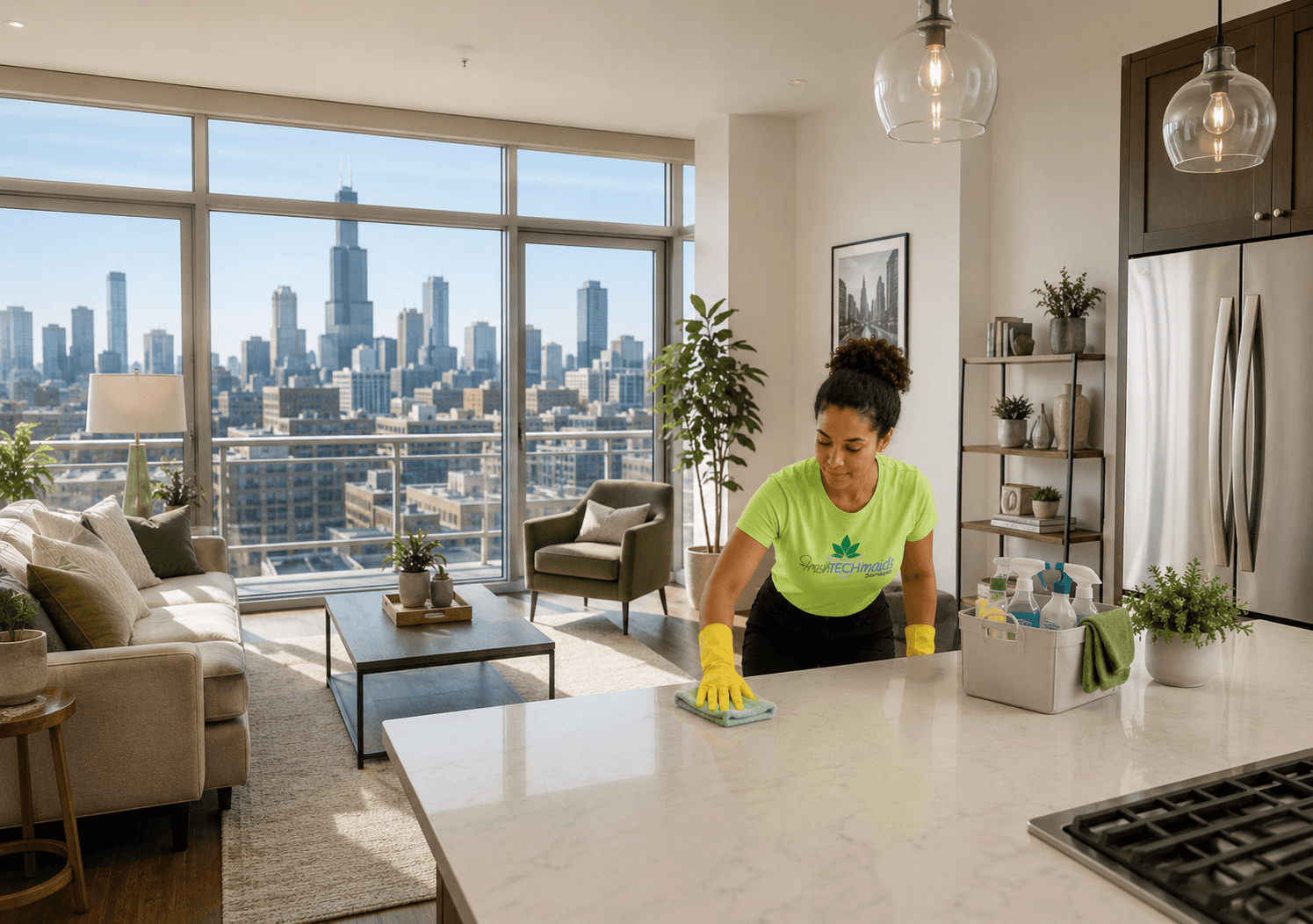
I want to open with the table, not make you wait for it.
The biggest mistake I see is treating “house cleaning” as one price. A quick wipe-down of a studio and a deep clean of a four-bedroom greystone are different jobs. Here is what the market actually charges in 2026.
Table 1. Chicago house cleaning prices by service type (2026)
Source: Angi — Chicago house cleaning; Angi — Chicago post-construction; Housecall Pro 2026 pricing; Fieldcamp 2026 pricing
The question people actually type: “How much should I pay for house cleaning in Chicago?”
My honest answer is: pick your row in the table, then adjust for condition, frequency, and risk. A home that has not been deep cleaned in a year sits at the top of its range. A weekly clean sits near the bottom because the work compounds in your favor.
This is also where I introduce the idea I will use through the whole article — the True Cost of Cleaning.
Sticker price is only the first of four numbers. I will build the full formula in section three.
Myth I want to retire: “cleaning is a commodity”
If cleaning were a commodity, the lowest price would always win, the way it does for a gallon of gas. It is not.
“The bitterness of poor quality remains long after the sweetness of low price is forgotten.” — Benjamin Franklin, founding father and author
A price buys a person you trust in your home, a process, tools, chemicals, a backup plan, and someone to call when something goes wrong. Two quotes at the same number can buy wildly different things.
That is the whole point of this guide.
So if a single average is not enough, the next question follows naturally: when two Chicago companies look at the same house, why does one say $250 and the other say $340?
That gap is not random. Here is what is hiding inside it.
2. Why do two Chicago quotes for the same house differ by $100+?

The cleanest way I can explain the gap is this: you are not buying hours in your home.
You are buying a managed outcome.
Two cleaners can both spend three hours in your house and leave behind two completely different results, and two completely different levels of risk. To make that gap easy to see, I use a simple six-part framework I call the Six T’s.
Table 2. The Six T’s — what a higher quote often pays for
Source: FreshTechMaids.com internal data
Notice what is missing from a cheap quote: usually timing, toxicity, and team backup — the three you cannot see until something fails. This is where cleaning quality and hiring quality meet.
“Show me how a company hires, and I will tell you how reliable your cleanings will be.” — Wells Ye, Founder, FreshTechMaids.com
A company can only promise backup and consistency if it has solved cleaner recruiting and retention. If it cannot keep cleaners past 90 days, it cannot promise you a steady schedule. I dug into that in “the cleaning industry doesn’t have a labor shortage, it has a recruiting problem”.
The “same quote, different service” is a reality.
Table 3. Same $200 quote, two very different services
Source: Framework by Wells Ye, FreshTechMaids.com
Once you see that a quote is really six promises bundled together, the next move is to put a dollar figure on the promises a cheap quote leaves out.
That is the formula I promised you.
3. Is the cheapest quote actually the cheapest? The true cost of cleaning formula

Let me give the formula a name so it is easy to remember and easy to quote. I call it the True Cost of Cleaning. It has four parts, and only the first one shows up on the quote.
Table 4. The True Cost of Cleaning formula
Source: Formula by Wells Ye; compliance-time anchor from IRS Publication 926
Here is why part four matters more than people expect.
When you hire a private cleaner directly, you may also become a household employer in the eyes of the IRS. That brings real paperwork. The IRS itself estimates around 60 hours a year to manage it. Your time is part of the true cost, even when no one bills you for it.
Myth 2: “price is what you pay”
Price is what you pay. Cost is what you absorb afterward. A $120 clean that triggers a $300 floor repair was never a $120 clean.
Myth 3: “just go with the low quote”
The low quote wins only if all four numbers are equal.
They rarely are.
The cheapest quote usually has the weakest backup, the least training, and the thinnest insurance — which means parts two, three, and four are the highest.
That fourth number — the one tied to becoming an employer — leads straight into the most common shortcut homeowners take: hiring an independent or gig cleaner to skip the agency markup.
Let me show you the real math on that.
4. Are independent and gig cleaners really cheaper than an agency?

I get why the gig route is tempting.
A private cleaner at $25 an hour looks cheaper than an agency at $45. But three things turn that saving upside down, and I have seen all three first-hand.
Hidden liability: what “I pay my cleaner cash” really signs you up for
When you control what work gets done and how it gets done, the IRS generally treats that worker as your household employee — not a contractor. That makes you responsible for employment taxes once you cross the threshold.
Here is a worked Chicago example.
Table 5. Hidden-liability ledger: a $25/hour private cleaner in Chicago
Source: IRS Publication 926 (Household Employer’s Tax Guide); Chicago rules at chicago.gov
Slower work: I was surprised how long an untrained cleaner took
The second hidden cost is time. A trained cleaning technician with a system can finish what takes a solo, untrained cleaner far longer.
I was genuinely surprised the first time I timed it. Systematic training makes cleaning quicker and more consistent — but here is the catch for the gig model: the IRS rules that help define a contractor mean a homeowner who trains and directs a “contractor” is really treating them like an employee.
You often cannot have it both ways: a true independent contractor you do not train, or an employee you do.
Professionalism: the part clients complain about most
The third cost is the experience. Clients who hire on price alone often tell me the same thing later: no uniform, no introduction, no consistency, nobody to call.
It feels less like a service and more like a gamble each week.
None of that shows up on the hourly rate, but all of it shows up in your stress level.
The reason a professional cleaning company can offer trained, uniformed, reliable cleaners comes back to hiring. Keeping good cleaners is hard, and most churn starts before day one.
The reason a good agency can field trained, uniformed, reliable cleaners is that it has solved hiring and retention. Most cleaner churn starts before day one. I broke that down in “I stopped 60-day cleaner churn dead” and in “8 ways AI will transform hiring in the cleaning industry in 2026”.
Taxes and training are the costs you can plan for. The next set is sneakier — the fees and failures that only appear after you have already signed.
Let me show you what lands on the bill.
5. What hidden fees show up on a Chicago cleaning bill?
I want to be careful here and label this clearly: the reliability pattern below is my own first-hand operating experience, not a published statistic. I am not going to invent a study. But after two decades, the pattern is consistent enough that I plan my whole business around it.
Table 6. Common hidden fees and what triggers them
Source: Angi — housekeeper cost and add-ons; reliability pattern from author’s operating experience, Fresh Tech Maid.
This reframes the word “cheap.”
“A canceled clean is not free. You pay for it in lost time and lost plans.” — Wells Ye, Founder, FreshTechMaids.com
For a parent prepping for a birthday party, a canceled clean is not a small annoyance — it is a ruined evening. For a young professional juggling work, a re-clean is hours they do not have.
The risk is not just money. It is your time and your calendar.
Surprise fees cost you money and time. The next category can cost you something heavier — legal responsibility. Many homeowners have no idea they have taken it on.
6. What legal risks come with hiring a private house cleaner directly?
I am not a lawyer, and nothing here is legal advice.
My goal is simply to make sure you know the rules exist, because most homeowners who hire directly have never heard of them. Three layers apply at once.
Table 7. Private cleaner compliance snapshot (Chicago)
Source: City of Chicago Office of Labor Standards; IRS Publication 926; Illinois General Assembly. Links in table.
Notice the city has even named its program around the idea that “your home is my workplace.”
Once a person works in your home under your direction, employment rules can apply, contract or not. That is not a reason to panic. It is a reason to either hire a company that carries this load for you, or to document everything if you hire directly.
Myth 5: “independent cleaners always offer better financial value”
Better hourly value, sometimes. Better financial value once taxes, contracts, and liability are counted, often not. The compliance load is real, and it is yours when you hire directly.
These rules can feel abstract until you see them play out in a real case. The most famous recent example involves one of the richest people on earth — and the lesson is not what most headlines suggested.
7. What did the Jeff Bezos housekeeper lawsuit teach homeowners?
I use this story carefully, because it is easy to turn into a celebrity takedown. That is not the point.
In 2022, former housekeeper Mercedes Wedaa filed suit in King County Superior Court in Seattle, alleging long shifts without proper breaks and no easily accessible bathroom. Bezos’s attorney denied the allegations and said she was terminated for performance (CNBC). I am not here to say who was right.
The lesson for a regular homeowner is simple: private-home work gets risky when expectations, breaks, access, boundaries, and worker status are never written down.
If a billionaire’s household can end up in a public dispute over basics like breaks and bathrooms, a normal home can too. Documentation is what protects both sides.
Table 8. Private-home boundary risks to document up front
Source: CBS News; CNBC. Allegations only; claims were denied.
Myth: “a private cleaner is always a simpler relationship”
Simpler on day one, maybe. But “simple” with nothing written down is exactly how small misunderstandings grow into big ones. Professional systems exist because they prevent this.
Taxes, fees, and legal exposure all point to one bigger idea — the gap between what you pay and what you absorb. Let me put that gap into a single story, then a single table.
8. Why can the cheapest cleaning quote become the most expensive?
Let me tell you how this goes wrong, because it almost always follows the same arc.
A family picks the $60 quote to save money before hosting. The cleaner skips the baseboards and the inside of the oven — “not included.” A vase gets knocked over, and there is no insurance and no office to call. The family ends up re-cleaning the night before guests arrive, and paying a second cleaner to finish. The $60 clean became a $300 evening. I call that the Cheap Quote Tax.
“The Cheap Quote Tax is paid in waiting for a response, theft investigation, re-cleans, repairs, and ruined evenings.” — Wells Ye, Founder, FreshTechMaids.com
Table 9. The Cheap Quote Tax: price paid vs cost absorbed
Source: Angi — Chicago house cleaning cost and add-ons. Scenario illustration by Wells Ye.
Myth 2 again: “price is what you pay”
By now you can see why I keep returning to this. The price is the easy number. The cost is the one that arrives later, when the cheap quote runs out of room.
If the danger is what a quote leaves out, then the defense is simple: learn to read a quote fully before you sign.
That is the tool I will leave you with.
9. How should homeowners compare cleaning quotes without getting baited?
This is the practical tool, and I built it to be simple enough for anyone — parents, seniors, empty nesters, young professionals, and students.
The goal is not to scare you off cheap cleaners. It is to help you ask better questions before you book. Score each quote with the same card.
Table 10. The Chicago cleaning quote scorecard
Source: Scorecard by Wells Ye, Fresh Tech Maid. Compliance context: IRS Pub 926 and City of Chicago
My action steps before you sign
- Get the full scope in writing — rooms, baths, square footage, and exclusions.
- Ask the three risk questions: cancellation, damage, and cleaner status.
- Assess all four True Cost numbers, not just the sticker price.
- If hiring directly, plan for the contract, wage, and tax rules.
- Score every quote on the same card before you choose.
Myth 3, one last time: “go with the low price quote”
Go with the best-scoring quote. Sometimes that is the lower price. Often it is not.
The scorecard tells you which.
The reward: what changes once you read price this way
Here is the beautiful after.
You book a clean and it actually happens, on schedule, every time.
The work is done right, so you are not re-cleaning at 10 p.m. before guests arrive. If anything breaks, a real office makes it right. Your home is safe for your kids and pets because low-tox options are on the table.
And you stop overpaying in hidden costs, because you priced all four numbers before you signed.
That is what reading a quote well buys you: a clean home, a calm calendar, and no nasty surprises.
Quick self-check: is your current cleaner a hidden risk?
Answer yes or no to each question. Then count your answers using the guide below. This is a self-check, not legal or financial advice.
Frequently asked questions
How much does a standard house cleaning cost in Chicago in 2026?
Most standard cleans fall between $113 and $229+, with a Chicago average around $158, according to Angi. One-time cleans can reach about $308. Deep cleans, move-out cleans, and post-construction cleans cost more.
Is it cheaper to hire a private cleaner instead of an agency?
The hourly rate is usually lower, but the total cost often is not. Once you cross the IRS threshold of $3,000 in 2026, you owe employment taxes, and misclassifying a worker can bring penalties. Untrained work can also take longer. Financial / legal risk of injury is severe.
Does Chicago require a contract for house cleaners?
Yes. Since January 1, 2022, Chicago requires a written contract for domestic workers, including home cleaners, in the worker’s preferred language. The city also sets a domestic-worker minimum wage of $16.60 per hour as of July 1, 2025.
What is the True Cost of Cleaning?
It is the formula I use: sticker price + schedule-disruption cost + damage and theft risk + re-clean and turnover cost. Only the first number shows up on the quote; the other three show up later..
Why do two quotes for the same house differ so much?
Because a quote bundles six promises: trust, training, tools, timing, toxicity, and team backup. A cheap quote usually drops timing, toxicity, and team backup, which are the parts you cannot see until something goes wrong.
What did the Bezos housekeeper lawsuit actually show?
It is a cautionary tale, not a verdict. A former housekeeper alleged unsafe conditions and break problems; Bezos’s representatives denied the claims. The lesson for homeowners is to document breaks, access, hours, and worker status in advance.
Related reading from EmployJoy
The cleaning industry doesn’t have a labor shortage, it has a recruiting problem
8 ways AI will transform hiring in the cleaning industry in 2026
I cut interview no-shows near zero: here’s what cleaning companies get wrong
I stopped 60-day cleaner churn dead
