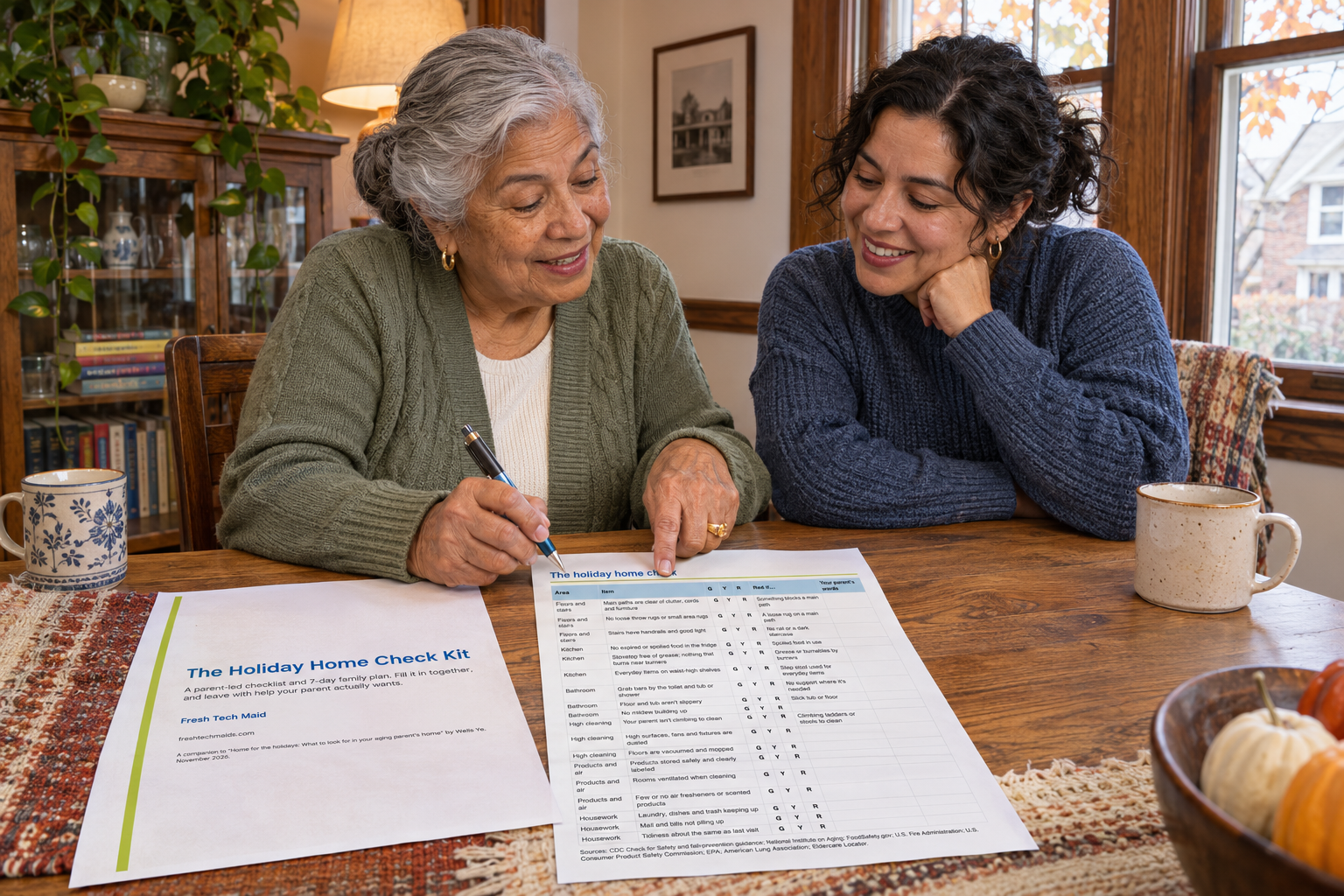
Short Answer: Use the holiday visit to walk through your parent’s Chicago-area home with them, not around them. Check six areas: floors and stairs, the kitchen, the bathroom, high and hard-to-reach cleaning, cleaning products and air, and signs the housework has become too much. Mark each item green, yellow or red. Fix red items first, agree on one or two kinds of help, and let your parent lead. In one survey, 1 in 5 Americans noticed a decline in an older loved one's well-being while together over the holidays [1].
Picture this.
You arrive for Thanksgiving and hug your mom at the door. Then you notice the hallway rug has curled at the corner. The stack of mail on the counter is taller than it used to be. And there's a step stool next to the fridge, right where she keeps the good serving platter.
Nothing is wrong, exactly.
But something has changed.
I’ve run a maid service in Chicago for 18 years, and I'd put it this way: waiting rarely makes the conversation easier. Noticing early, and talking about it kindly, usually does.
When should you do a holiday home check, and how do you ask?
Short Answer: Do it during the visit, in person, with your parent's permission. Ask which rooms they'd like to look at together and let them choose the time. Start with an open question about which chores feel harder. You're there to notice and listen, not to inspect, and the check works best when your parent feels in charge.
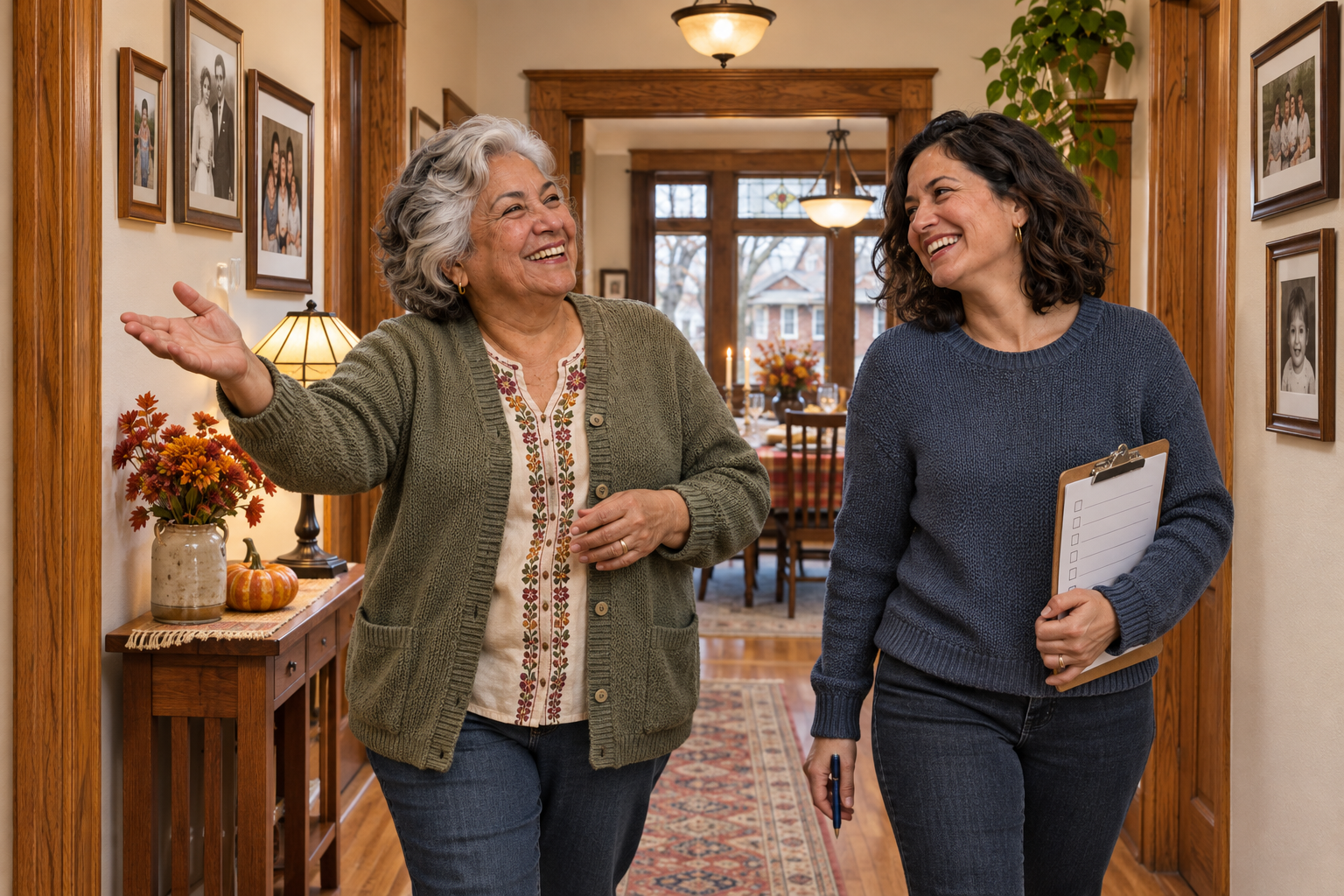
In person you can "see up close and personal what's actually going on in the home," as one geriatrician puts it [2].
About 28% of adults 65 and older living in the community live alone [3], and 75% of adults 50 and older want to stay in their current homes as they age [4].
So start with that shared goal.
Staying home is the point. The check is how you protect it.
Try an opener like this: "Would you like to walk through the house together and tell me which jobs you'd most like help with?"
Before you start, agree that nothing gets moved without your parent's okay, and ask before taking photos or sharing notes with relatives.
"Make observations, not assumptions." — Laurie Archbald-Pannone, MD, geriatrician, University of Virginia
How does the holiday home check work?
Short Answer: The check has 18 simple items in six areas. For each one, you and your parent mark green (fine), yellow (needs attention soon) or red (a safety concern to fix first). There's no score to pass or fail. A single red item goes to the top of the list, no matter how many greens there are. It's a household conversation, not a medical or memory test.
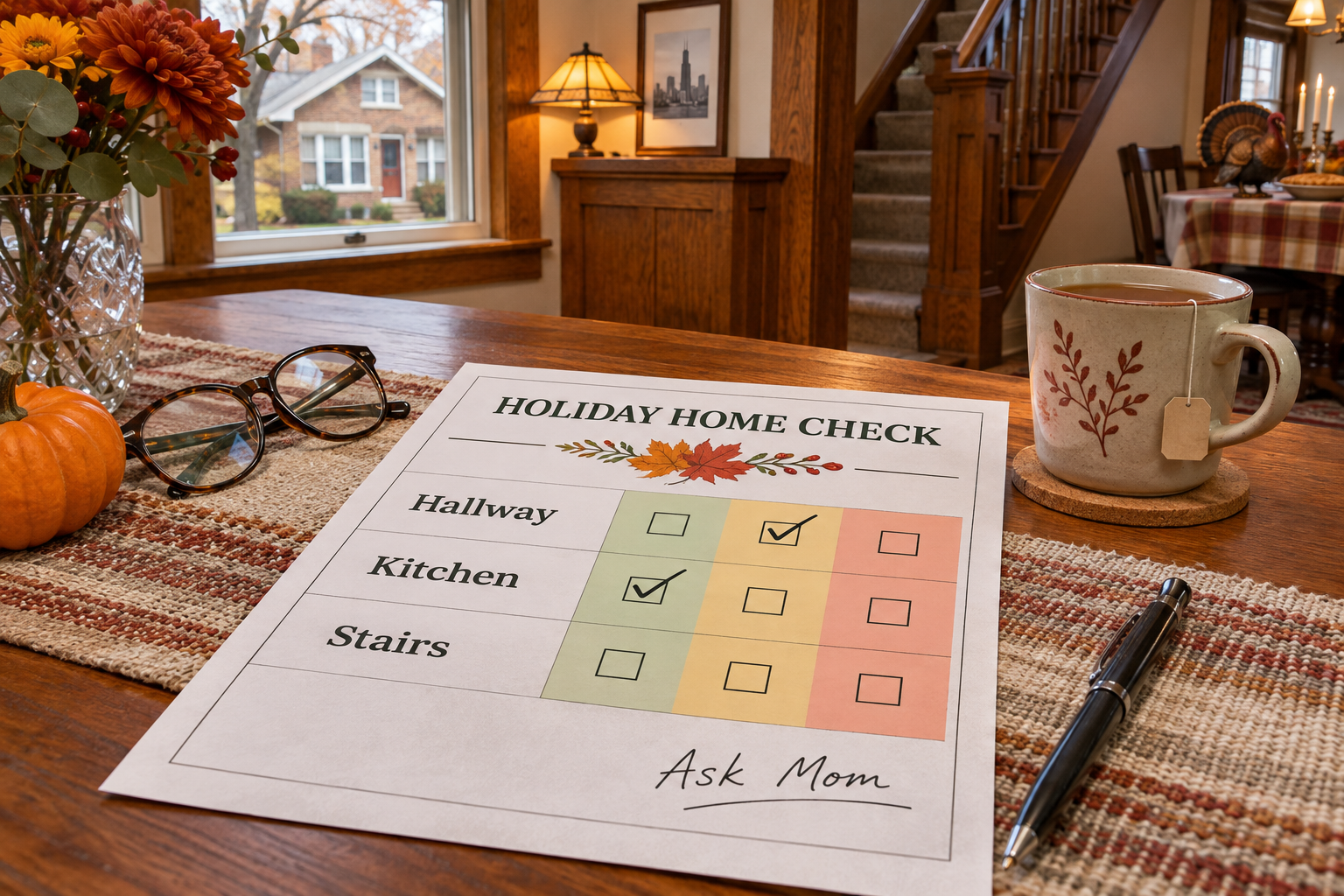
The idea comes from the CDC's Check for Safety brochure, which pairs each question about a hazard with a fix, such as asking someone to move furniture so the walking path is clear [6].
"Use this checklist to find and fix hazards in your home." — Centers for Disease Control and Prevention
You can also mark an item "not checked" if your parent would rather skip it today, or "doesn't apply."
Don't add up a score: one red item matters more than ten greens.
Leave room for your parent's own words beside each finding.
And keep it kind.
Clutter or a missed chore isn't proof that something is wrong with your parent. It's just information.
What should you look for, room by room?
Short Answer: Walk the home together and check six areas: floors and stairs, the kitchen, the bathroom, high and hard-to-reach cleaning, cleaning products and air, and signs the housework has become too much. Look for things you can see, like loose rugs, a step stool by the fridge, expired food or laundry piling up. Each item has a simple fix.

Get the free Holiday Home Check Kit
Print it, fill it in with your parent, and leave with a plan you both agree on.
Floors, stairs and walkways
The CDC recommends keeping floors clear, removing or securing throw rugs, adding lights and handrails on stairs, and installing grab bars by the toilet and in and beside the tub [8].
Walk the paths your parent uses most, especially bed to bathroom, and ask what that route is like at night. Brighter bulbs help.
"Don't use throw rugs or small area rugs." — National Institute on Aging
Kitchen and food
Look in the fridge together.
Older adults are more likely to be hospitalized or die from foodborne illness [11].
Check the stovetop for grease and anything that can burn near the burners; adults 65 and older had 2.5 times the general population's risk of dying in a fire in 2023 [12].
If you move anything, let your parent choose where it goes.
Bathroom
Check for grab bars, a floor and tub that aren't slippery, and mildew in the corners.
Keep cleaning requests separate from repairs like installing grab bars; they need different help.
High and hard-to-reach cleaning
Dusting a ceiling fan or the top of the fridge means climbing.
In 2022-2023, emergency departments treated an estimated 53,100 ladder-fall injuries among adults 65 and older [13]. In suburban Cook County, 62% of older adults surveyed rated heavy housework as at least a minor problem [14].
If your parent is climbing to clean, mark it red.
Cleaning products and air
Look under the sink.
The EPA notes that "Many products used in the home, including cleaning solutions, air fresheners, and personal care products can contribute to indoor PM." PM means fine particles.
The American Lung Association advises keeping the area well ventilated when using cleaning products [16].
Signs the housework has become too much
A noticeable change in tidiness or sanitation is one of the Eldercare Locator's 10 warning signs that an older family member may need help [17].
The key word is change.
A home that has always been a little cluttered isn't a warning sign. A home that used to be spotless and isn't anymore might be.
"The step stool by the fridge tells you more than the dust on the shelf. It tells you what your parent is still trying to do alone." — Wells Ye
What do the results mean, and what comes first?
Short Answer: Red items come first, before anything else on the list. Then pick one or two yellow items your parent agrees to tackle. Keep three things separate: what you saw, what your parent wants, and what you think it means. And if your parent has fallen, feels unsteady or is afraid of falling, that's a conversation for their doctor, not just a cleaning plan.
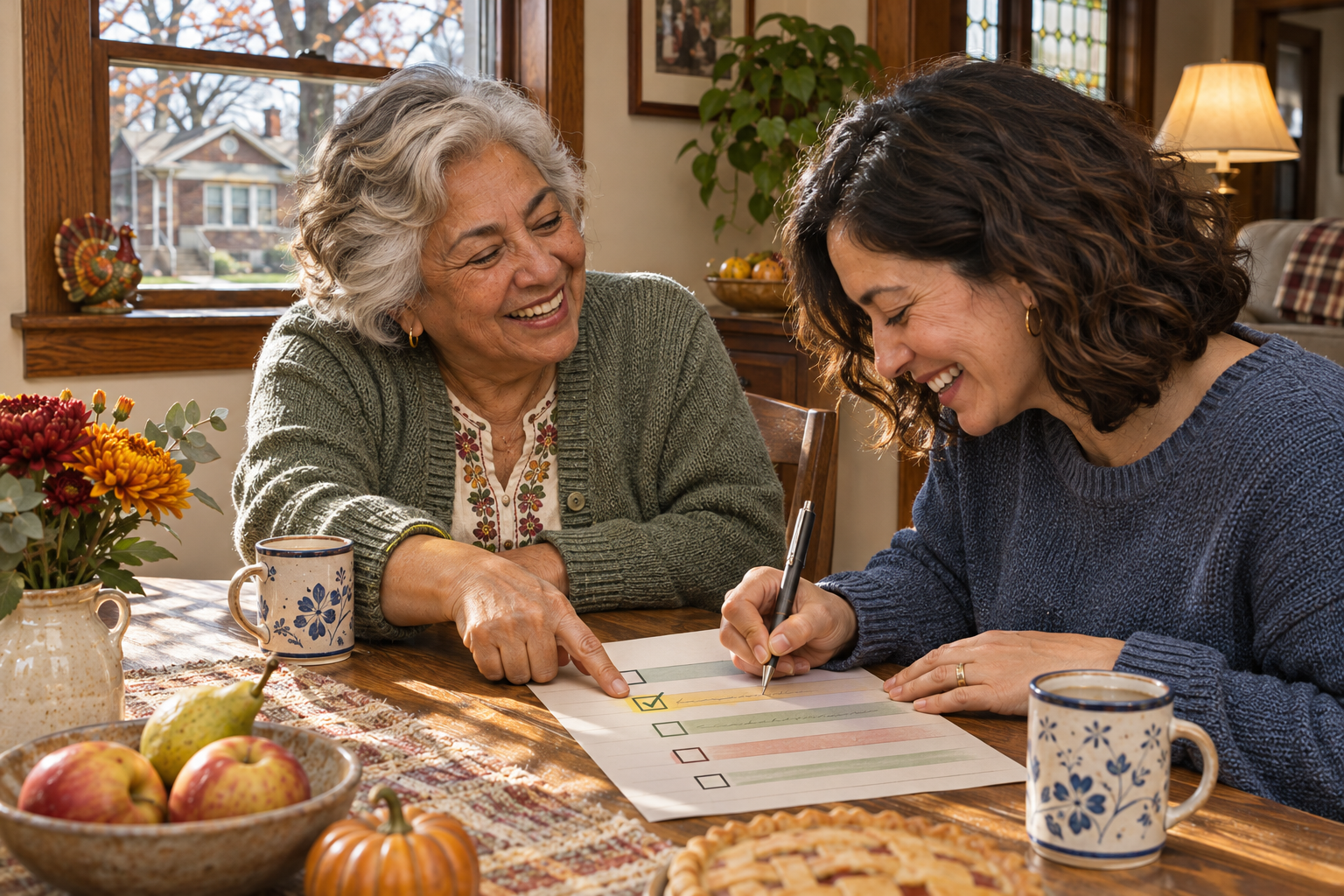
Sort each red item by the help it needs: a loose handrail is a repair, a floor nobody can reach is a cleaning job, and a recent fall is a health question.
Falls tend to repeat.
About 1 in 4 adults 65 and older report falling every year [18], and falling once doubles the chances of falling again [19]. In Illinois, 1,252 residents 65 and older died from unintentional falls in 2023 [20]. An older person who falls and hits their head should see a doctor right away [21].
"Tell your doctor if you have fallen, if you feel unsteady when standing or walking, or if you are afraid you might fall." — Centers for Disease Control and Prevention
Offer to join the appointment if your parent wants you there.
"One agreed fix beats ten suggestions. Start with the one your parent says yes to." — Wells Ye
How can you help a parent who doesn't want help?
Short Answer: Start with what your parent wants, which is usually to stay at home, and frame help as the way to do that. Listen to their reasons for saying no. Describe what you noticed instead of labeling it, ask about one task, offer choices and suggest a trial visit. Let them choose who helps and set the rules. If they still say no, accept it for now and come back to it later.
Resistance is normal, and it usually has reasons.
In a small study of older adults in Chicago and Fort Wayne, reluctance to accept help was tied to worries about losing control, not trusting others and being a burden [23].
In another small study, over 77% of adult children and 66% of the parents themselves said the parent at least sometimes acted in ways seen as stubborn [24].
These strategies help:
- Start with their goal. In a small study of people receiving home care, staying at home was the main reason they accepted it.
- Listen first. Ask what worries them about having help.
- Describe, don't label. "I noticed the rug by the door is curling" lands better than "This place is a hazard."
- Ask about one task. "Would someone else handling the bathroom floor help?" is easier to say yes to than "You need a cleaner."
- Offer choices: family help, a service for one job, or a single trial visit.
- Let them choose who helps. The Family Caregiver Alliance recommends involving your parent in choosing in-home help when possible.
- Ask them to describe a good visit. Write down exactly how they want things done.
- Bring in someone they trust, like a sibling, friend or their doctor.
- Accept a "no" for now. Ask if there's a smaller task they'd welcome, and revisit it next visit. Never arrange help or entry behind their back.
"Help works best when it's your parent's idea. Your job is to make the idea easy to say yes to." — Wells Ye
When does a cleaning service help, and what should it include?
Short Answer: A cleaning service helps when the hard jobs are on the red list: floors, high surfaces, bathrooms and anything that means climbing. Look for a service that adjusts to your parent's needs, uses products with no added fragrance, puts the scope in writing and lets the family stay involved. Ask who will come into the home and how they're employed.
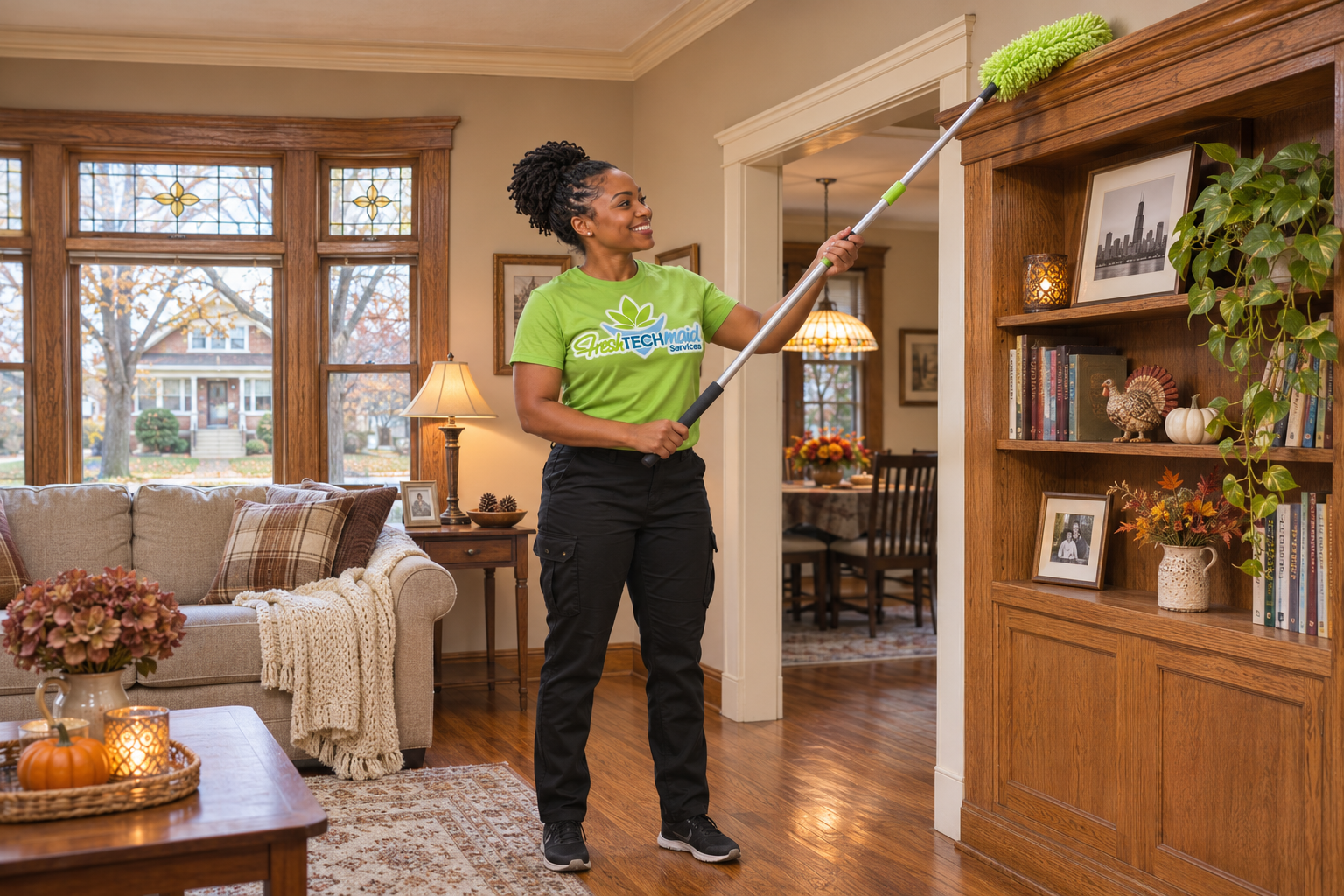
In a southwestern Illinois survey, 30-40% of older adults who answered said they needed help with housework [28].
What to look for
- Customized tasks that match your parent's needs, written down in a scope they've seen.
- Products without added fragrance. The EPA's Safer Choice program limits volatile organic compounds (VOCs) in certified products to reduce indoor air pollution.
- Everything in writing, including which chores and when.
- Registered, bonded and insured, with references you can call.
- Who comes into the home: employees or contractors? Here's why I ask.
"Fragrance-free means that fragrance materials or masking scents are not used in the product." — U.S. Environmental Protection Agency
How we do it at Fresh Tech Maid
As a Chicago maid service, we customize our cleaning tasks to each senior’s needs and we do the same for clients recovering from an illness or surgery.
The scope goes up or down as their condition changes, and it includes the floors and high surfaces that are hardest to manage.
Our cleaning products contain no added fragrance and no VOCs.
Our technicians use deionized water and HEPA-filtered vacuums. Every technician is a W-2 employee, not a contractor; in my view, employees are more reliable. And all of them speak fluent English, so your parent can explain exactly what they want.
See our senior maid cleaning service.
For holiday dates, book two to three weeks ahead; earlier is better . For prices, see what house cleaning costs in Chicago.
"We don't hand a senior a standard checklist. We ask what they need, and we change the plan when their needs change." — Wells Ye
How can adult children stay involved without taking over?
Short Answer: Ask your parent how involved they want you to be. Write down their priorities and their "please don't" list before the first visit, be there for that visit if they'd like, and set up a simple way to share feedback. Many older adults have high standards and strong preferences about their homes. Your role is to help those preferences be heard, not to replace them.

An estimated 63 million Americans provide ongoing care to an adult or child with a complex medical condition or disability [32]. And 77.10% of those caring for adults help with housework [33].
- Decide roles together. Who receives the service, who pays and who coordinates may be different people.
- Write down the details: rooms that matter most, private rooms, how they like things done.
- Be there for the first visit if your parent wants you there, and let them explain their preferences.
- Ask about specific tasks afterward. "How did the bathroom floor turn out?" is easier to answer than "How was it?"
- Hold family meetings with an agenda, and ask the nearby relative what would help them, too.
"A successful family meeting gives everyone a chance to be heard." — Family Caregiver Alliance
At Fresh Tech Maid, adult children across Chicago and the suburbs can book and pay for a parent's cleaning, be there for the first visit, get updates and give feedback.
"Your parent's standards are the standard. Our job, and yours, is to meet them." — Wells Ye
What can you do in the 7 days after the visit?
Short Answer: Before you leave, agree on one or two actions. In the first two days, confirm who does what. By day five, finish the quick fixes and book any help. By day seven, ask your parent how it's going. Then check in again at 30 days. Deciding not to go ahead yet is a valid outcome, as long as you agree when to revisit it.
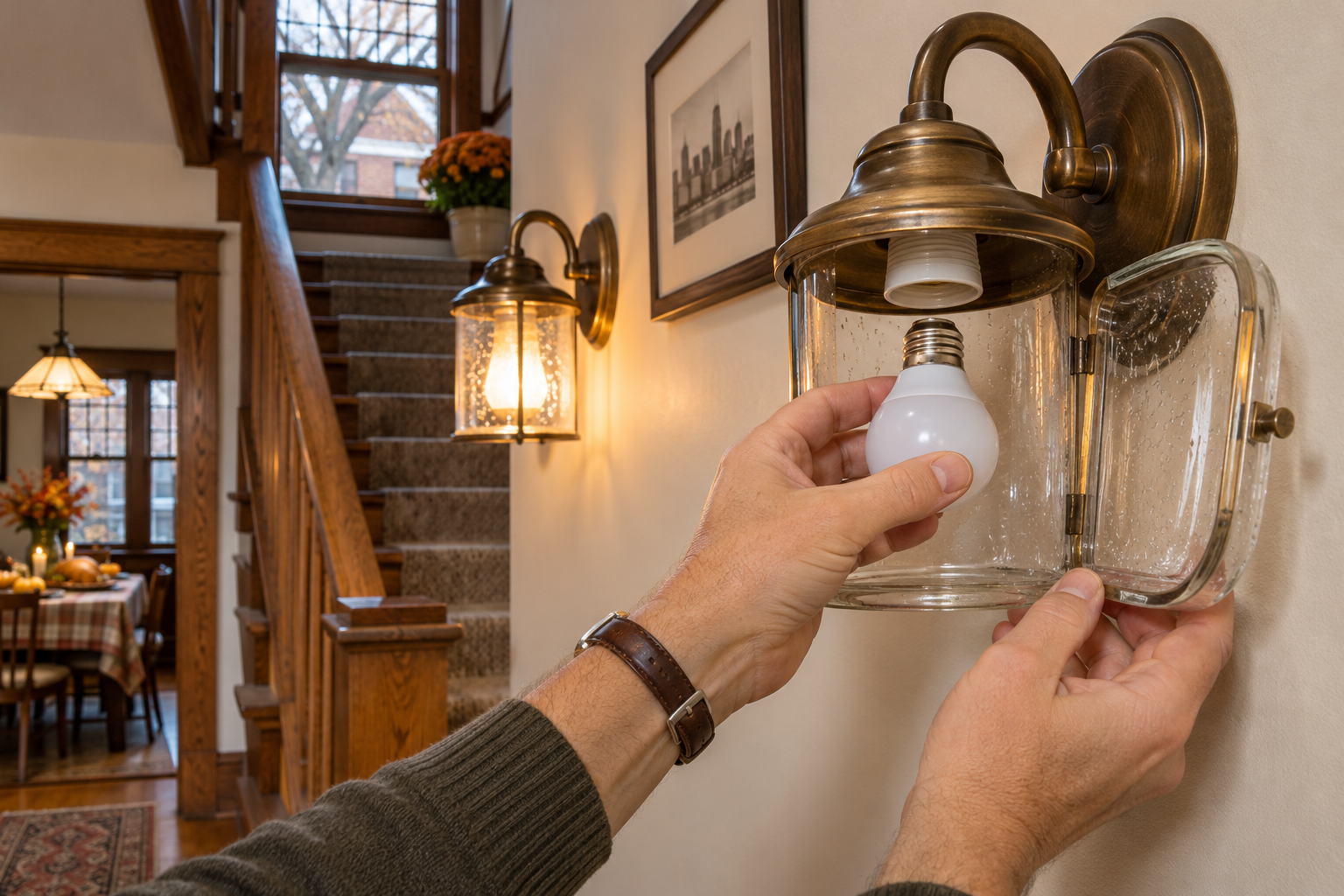
Some fixes take minutes, like waist-high shelves and brighter bulbs. Others take a call. A doctor may refer your parent to an occupational therapist for a home-safety evaluation.
Keep each task open until someone confirms it's done.
"A plan without a date is just a wish. Put the follow-up call on your calendar before you drive home." — Wells Ye
Holiday home check FAQ
Short Answer: Do the check together with your parent, at each visit or at least once a year. If you live far away, the Eldercare Locator and local Area Agencies on Aging can connect you with services. If your parent says no, respect it and try again later. For costs, start with our cleaning-cost guide, then ask for a written quote.
How often, and how long does it take?
At each visit, or whenever something changes; the CDC recommends yearly fall-risk screening for older adults. There's no set time: do one room, pause, and come back later.
What if I live far away?
The Eldercare Locator connects families to local services by ZIP code at 1-800-677-1116 [36][37]. In Chicago, the Area Agency on Aging is the Department of Family and Support Services, 312-746-5682 [38]. In suburban Cook County, it's AgeOptions, 708-383-0258 [38].
What if my parent says no?
Accept it for now, keep the list, and bring it up again next visit. See section 5.
Download your holiday home check and agree on one next step
Short Answer: The check works best on paper, filled in with your parent. Download the free Holiday Home Check Kit: the color-coded checklist, a "what to say" card, questions for a cleaning provider, a who-does-what sheet and a 7-day plan. Then agree on one next step before you head home.
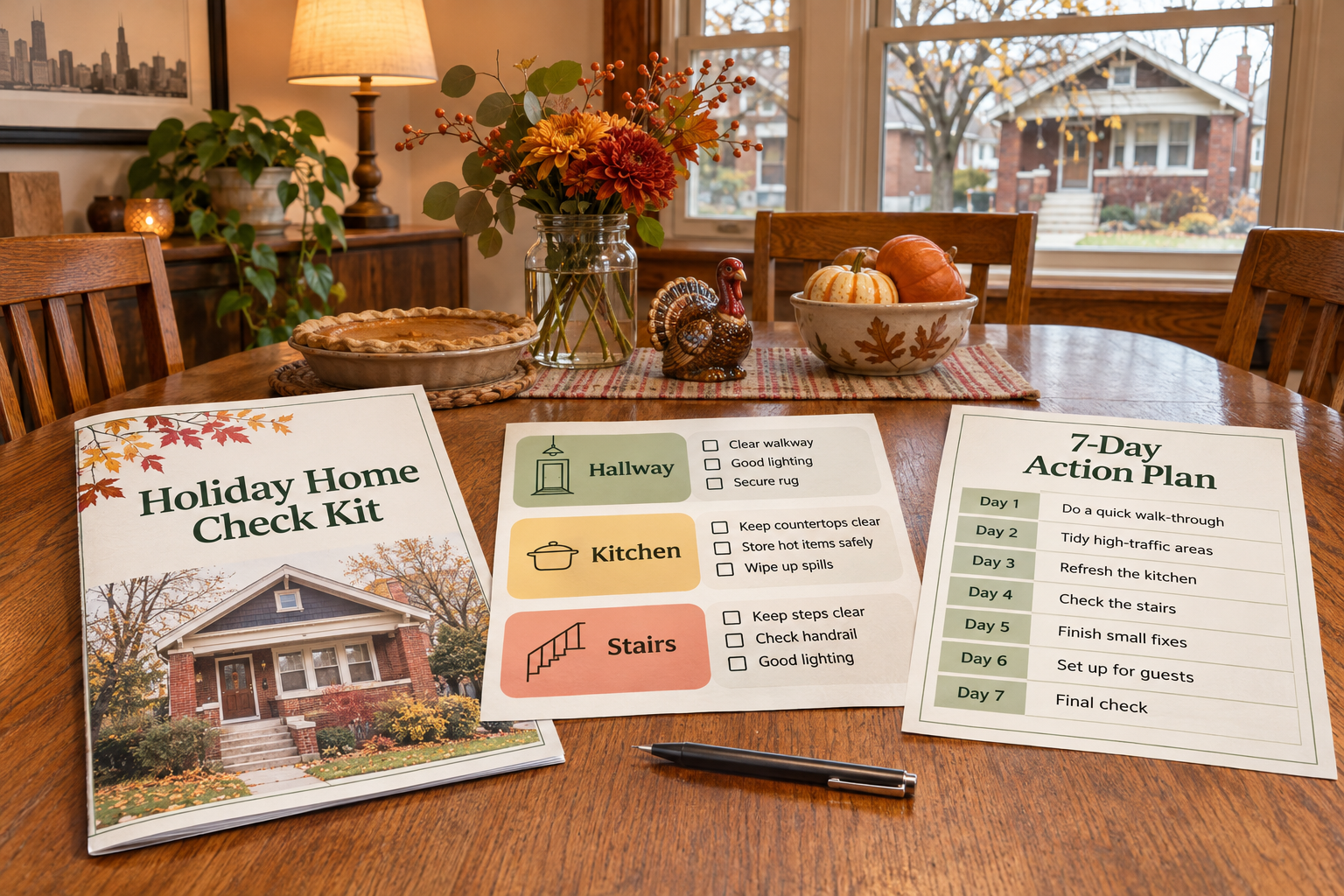
Get the free Holiday Home Check Kit
Print it, fill it in with your parent, and leave with a plan you both agree on.
If the next step is cleaning help, see our senior cleaning service in Chicago, and check our zip codes. Hosting this year, too? See Clean Enough for Company.
"The best gift you can bring home for the holidays is a little help your parent actually wants." — Wells Ye
Evidence note: the green, yellow and red check is Fresh Tech Maid's practical guide, not a medical or memory assessment. Statistics are cited to their sources.
Sources
1. Home Instead (via PR Newswire). “Home Instead Hiring 30,000 Care Professionals to Support Aging Population.” 2024. https://prnewswire.com/news-releases/home-instead-hiring-30-000-care-professionals-to-support-aging-population-302056519.html. Accessed November 14, 2026.
2. SUNY Upstate Medical University. “Tattoos and cancer; adults with special needs; helping aging parents: Upstate Medical University's HealthLink on Air for Sunday, April 20, 2025.” April 2025. https://www.upstate.edu/informed/2025/042025-radioshow.php. Accessed November 14, 2026.
3. Administration for Community Living. “ACL Releases 2023 Profile of Older Americans.” May 2024. https://acl.gov/news-and-events/announcements/acl-releases-2023-profile-older-americans. Accessed November 14, 2026.
4. AARP. “New AARP Report: Majority of Adults 50-plus Want to Age in Place, But Policies and Communities Must Catch Up.” December 2024. https://www.aarp.org/press/releases/2024-12-10-new-aarp-report-majority-adults-50-plus-age-place-policies-communities-catch-up.html. Accessed November 14, 2026.
5. University of Virginia (UVA Today). “Home for the Holidays? Worried About a Relative? Make Observations, Not Assumptions.” December 2021. https://news.virginia.edu/node/340116. Accessed November 14, 2026.
6. Centers for Disease Control and Prevention. “Check for Safety: A Home Fall Prevention Checklist for Older Adults.” 2017. https://www.cdc.gov/steadi/pdf/steadi-brochure-checkforsafety-508.pdf. Accessed November 14, 2026.
7. Centers for Disease Control and Prevention. “Check for Safety: A Home Fall Prevention Checklist for Older Adults.” 2017. https://www.cdc.gov/steadi/pdf/steadi_checkforsafety_brochure-print.pdf. Accessed November 14, 2026.
8. Centers for Disease Control and Prevention. “Family Caregivers: Protect Your Loved Ones from Falling.” 2018. https://www.cdc.gov/steadi/pdf/steadi-CaregiverBrochure.pdf. Accessed November 14, 2026.
9. Centers for Disease Control and Prevention. “Preventing Falls and Hip Fractures.” January 2026. https://www.cdc.gov/falls/prevention/. Accessed November 14, 2026.
10. National Institute on Aging. “Preventing Falls at Home: Room by Room.” September 2022. https://www.nia.nih.gov/health/falls-and-falls-prevention/preventing-falls-home-room-room. Accessed November 14, 2026.
11. U.S. Department of Health and Human Services (FoodSafety.gov). “People at Risk: Older Adults.” September 2023. https://www.foodsafety.gov/people-at-risk/older-adults. Accessed November 14, 2026.
12. U.S. Fire Administration. “Older Adult Fire Death Risk (2014-2023).” April 2025. https://www.usfa.fema.gov/statistics/deaths-injuries/older-adults.html. Accessed November 14, 2026.
13. U.S. Consumer Product Safety Commission. “Senior Injuries and Deaths Associated with Consumer Products: 2024 Report.” January 2025. https://www.cpsc.gov/s3fs-public/Senior-Report-2024-POSTED2.pdf. Accessed November 14, 2026.
14. Polco for AgeOptions. “2024 AgeOptions Suburban Cook County Older Adult Survey: Report of Results.” June 2024. https://www.ageoptions.org/wp-content/uploads/2025/02/AgeOptions-Suburban-Cook-County-Older-Adult-Survey-2024-Report-of-Results.pdf. Accessed November 14, 2026.
15. U.S. Environmental Protection Agency. “Sources of Indoor Particulate Matter (PM).” March 2026. https://www.epa.gov/indoor-air-quality-iaq/sources-indoor-particulate-matter-pm. Accessed November 14, 2026.
16. American Lung Association. “Cleaning Supplies and Household Chemicals.” June 2026. https://www.lung.org/clean-air/indoor-air/indoor-air-pollutants/cleaning-supplies-household-chem. Accessed November 14, 2026.
17. Administration for Community Living (Eldercare Locator). “10 Warning Signs Your Older Family Member May Need Help.” https://eldercare.acl.gov/Public/Resources/Factsheets/Ten_Warning_Signs.aspx. Accessed November 14, 2026.
18. Centers for Disease Control and Prevention. “Older Adult Falls Data.” September 2026. https://www.cdc.gov/falls/data/. Accessed November 14, 2026.
19. Centers for Disease Control and Prevention. “Facts About Older Adult Falls.” September 2026. https://www.cdc.gov/falls/data-research/facts-stats. Accessed November 14, 2026.
20. National Center for Health Statistics. “Unintentional Fall Deaths in Adults Age 65 and Older: United States, 2023.” June 2025. https://www.cdc.gov/nchs/products/databriefs/db532.htm. Accessed November 14, 2026.
21. Centers for Disease Control and Prevention. “Facts About Older Adult Falls.” September 2026. https://www.cdc.gov/falls/data-research/facts-stats/index.html. Accessed November 14, 2026.
22. Centers for Disease Control and Prevention. “Information for Older Adults.” August 2025. https://www.cdc.gov/still-going-strong/older-adults/. Accessed November 14, 2026.
23. Journal of the American Geriatrics Society. “Overcoming Reluctance to Accept Home-Based Support from an Older Adult Perspective.” August 2018. https://agsjournals.onlinelibrary.wiley.com/doi/10.1111/jgs.15526. Accessed November 14, 2026.
24. The Journals of Gerontology Series B (via PubMed Central). “"My Parent is so Stubborn!"�Perceptions of Aging Parents' Persistence, Insistence, and Resistance.” 2016. https://pmc.ncbi.nlm.nih.gov/articles/PMC4903030. Accessed November 14, 2026.
25. Ageing & Society. “Homecare refusal or acceptance? A framework analysis of perceptions of older people receiving homecare in Scotland.” October 2025. https://www.cambridge.org/core/journals/ageing-and-society/article/homecare-refusal-or-acceptance-a-framework-analysis-of-perceptions-of-older-people-receiving-homecare-in-scotland/B8FDAB4D5A0ABCC305E2D36437E69B84. Accessed November 14, 2026.
26. Family Caregiver Alliance. “Introducing In-Home Care When Your Loved One Says �No�.” 2012. https://www.caregiver.org/resource/introducing-home-care-when-your-loved-one-says-no/. Accessed November 14, 2026.
27. Northwestern Medicine. “Why Some Older Adults Are Reluctant to Ask for Help.” September 2024. https://www.nm.org/healthbeat/healthy-tips/emotional-health/Why-Some-Older-Adults-Are-Reluctant-to-Ask-for-Help?sf95824817=1. Accessed November 14, 2026.
28. AgeSmart Community Resources. “FY2024 Area Plan on Aging Public Hearing Packet.” May 2023. https://agesmart.org/pdf/2023/PID_24-PSA08.pdf. Accessed November 14, 2026.
29. U.S. Environmental Protection Agency. “Learn About the Safer Choice Label.” September 2026. https://www.epa.gov/saferchoice/learn-about-safer-choice-label. Accessed November 14, 2026.
30. Better Business Bureau. “BBB Tips: 7 Tips for Hiring a Cleaning Service.” April 2020. https://www.bbb.org/article/news-releases/20552-bbb-tips-7-tips-for-hiring-a-house-cleaning-service. Accessed November 14, 2026.
31. U.S. Environmental Protection Agency. “Safer Choice Fragrance-Free Certification.” October 2016. https://www.epa.gov/sites/default/files/2016-10/documents/saferchoice-factsheet-fragrancefree_0.pdf. Accessed November 14, 2026.
32. AARP. “New Report Reveals Crisis Point for America's 63 million Family Caregivers.” July 2025. https://www.aarp.org/press/releases/2025-07-24-new-report-reveals-crisis-point-for-americas-63-million-family-caregivers.html. Accessed November 14, 2026.
33. AARP and National Alliance for Caregiving. “What are Caregivers Doing?.” 2025. https://www.caregivingintheus.org/reports/what-are-caregivers-doing/. Accessed November 14, 2026.
34. Family Caregiver Alliance. “Holding a Family Meeting.” 2003. https://www.caregiver.org/resource/holding-family-meeting/. Accessed November 14, 2026.
35. Centers for Disease Control and Prevention. “Resource Algorithm for Fall Risk Screening, Assessment, and Intervention.” 2019. https://www.cdc.gov/steadi/media/pdfs/STEADI-Algorithm-508.pdf. Accessed November 14, 2026.
36. Administration for Community Living. “Federal Resource Guide: Real Life Considerations for Older Adults: Housing Assistance for Renters.” December 2023. https://acl.gov/sites/default/files/Retirement/HousingAssistanceForRentersGuide_508.pdf. Accessed November 14, 2026.
37. Administration for Community Living. “Eldercare Locator.” 2026. https://eldercare.acl.gov/home. Accessed November 14, 2026.
38. Illinois Department on Aging. “2026 Home Delivered Meals Report.” March 2026. https://ilaging.illinois.gov/content/dam/soi/en/web/aging/resources/newsandpublications/publications/documents/home-delivered-meals-report-2026.pdf. Accessed November 14, 2026.
Turn Holiday Observations Into Support Your Parents Feel Good About