What if the nursery looks perfect, but the dust that matters is hiding in the cabinet, the stair trim, the basement, and the garage-entry mat?
That is the question I ask before every newborn cleaning in Hoffman Estates.
I am Wells Ye, founder of Fresh Tech Maid, a chemical-free maid service serving Hoffman Estates and the northwest suburbs. I have spent about 20 years inside homes where people are trying to make life safer, cleaner, and calmer.
Hoffman Estates homes are a little different from Chicago apartments. About 60.7% of homes here are detached single-family houses, and the median home was built in 1976 (CMAP, 2025). That means more rooms, more stairs, more basements, and more places for dust to hide.
The CDC says cleaning removes germs, dirt, and impurities, and that surfaces should be cleaned before you sanitize or disinfect. The EPA warns that many VOCs can be higher indoors than outdoors. That matters when a baby will sleep, eat, and breathe in the same room for hours.
This post is not medical advice. It is not lead remediation advice, and it is not water-damage advice. If I see possible lead paint, active water, sewage backup, or real mold growth, I tell the household to pause and call the right licensed professional.
My job is different.
I prepare the normal home environment with chemical-free house cleaning: soil removal first, HEPA vacuuming, microfiber, DI water, steam when safe, and targeted HOCl when sanitizing is truly needed.
All for the health and safety of new babies and the people caring for them.
Here is how I get Hoffman Estates homes ready for a new baby without filling the house with harsh cleaner smell.
What Parts of a Hoffman Estates Home Need Cleaning Before Baby Arrives?
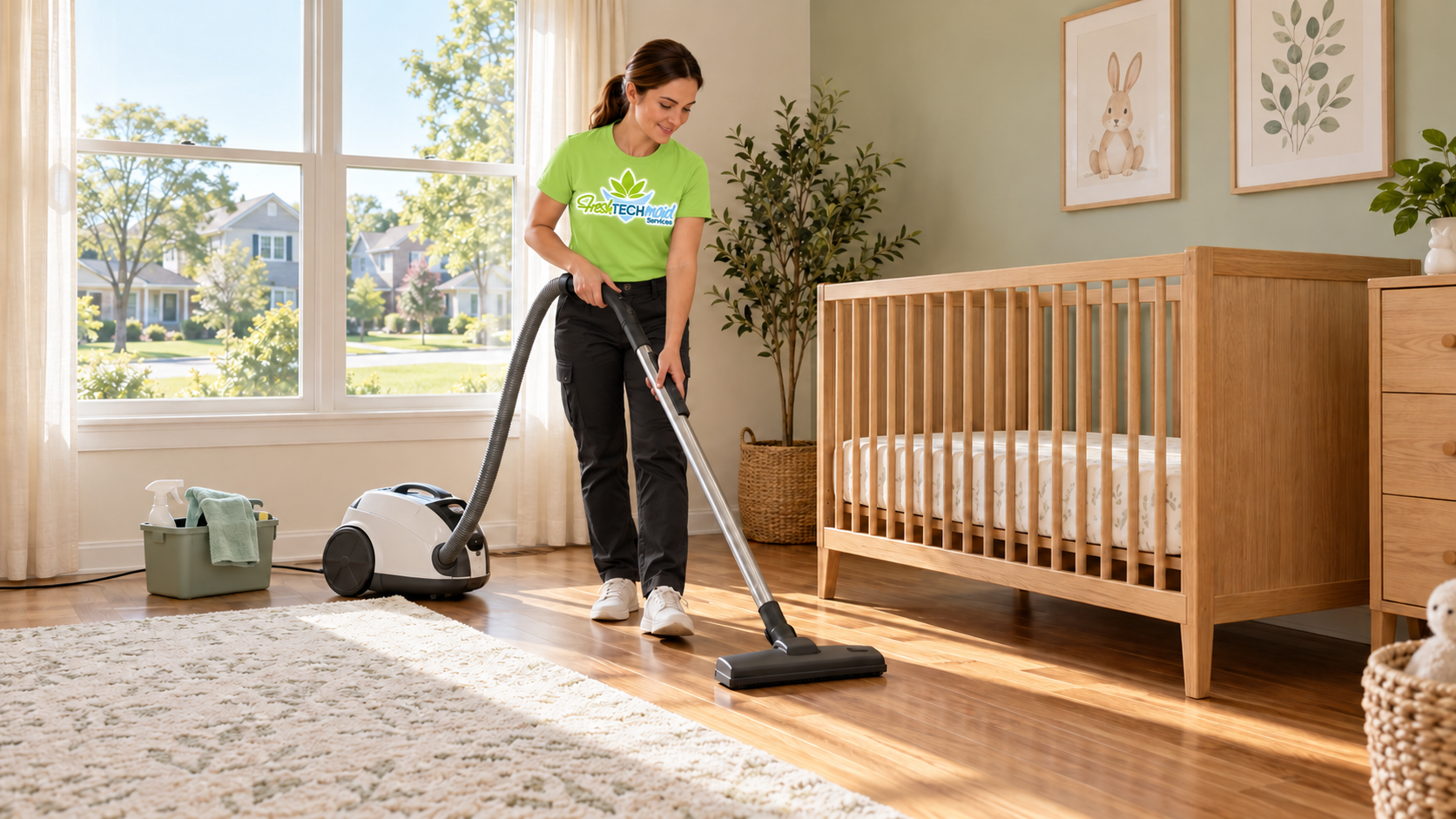
Short Answer: I clean the nursery sleep zone, feeding zone, bathroom recovery zone, floors, and high-touch areas first. I start where the baby breathes, feeds, and touches. In Hoffman Estates houses, I also check stair trim, cabinet shelves, baseboards, the lower level, and the garage entry. Those spots look fine but move dust and grit into baby spaces every day.
Here is a scene I see often in Hoffman Estates: a 1970s split-level where the nursery is painted and the crib is built.
Then I open the lower kitchen cabinet and find sawdust from new cabinet hardware behind the bottle bin.
The baseboards on the half-flight of stairs are gray. The garage-entry mat still holds last winter's salt. The bathroom faucet handles have old soap film.
I follow the Fresh Tech Maid basic cleaning method: prep the bucket, remove trash and rugs, dust high to low, do the dry trip, do the wet trip, then disinfect high-touch points.
That order matters because dust falls down. If I mop first and dust later, I make the floor dirty again.
In a larger suburban home, I use that order inside the areas that matter most: crib zone, bottle zone, recovery bathroom, stair path, door handles, light switches, cabinet pulls, and the laundry room.
Families with older children need this because kids bring school dust, park soil, crumbs, and sticky hands into the baby's space.
Two-income households need it too. Health care is the top industry for Hoffman Estates residents at 12.4%, and 15.2% of working residents commute to Chicago (CMAP, 2025). Shift work and long commutes leave very few free Saturdays.
Renters and condo owners need a smaller version. About 25.8% of occupied homes here are renter-occupied (U.S. Census Bureau, 2019–2023), and storage is tighter, so bottle items often sit near shoes and pet gear.
This is why I link this work to Fresh Tech Maid's Expecting Parents Cleaning package when a household wants the whole reset done before the due date.
Action Steps
- I map six zones: nursery sleep, feeding, bathroom recovery, floors and stairs, touchpoints, and the lower level or garage entry.
- I dust high to low before any wet wiping or mopping.
- I open cabinets and drawers that will hold bottles, pump parts, diapers, and linens.
- I finish with door handles, faucet handles, stair railings, light switches, cabinet pulls, and fridge handles.
"The nursery is not ready until the hidden dust zones are ready.
— Wells Ye, Founder, Fresh Tech Maid
The reward is a home that feels calm before the first hard night.
The crib area is not just cute. The hidden dust zones are handled, the bottle station is ready, and the birthing parent is not trying to scrub a bathroom after delivery.
With the priority map clear, the next question is why I choose this low-residue process instead of a stronger-smelling shortcut.
What Makes Chemical-Free Cleaning So Important When You're Expecting?
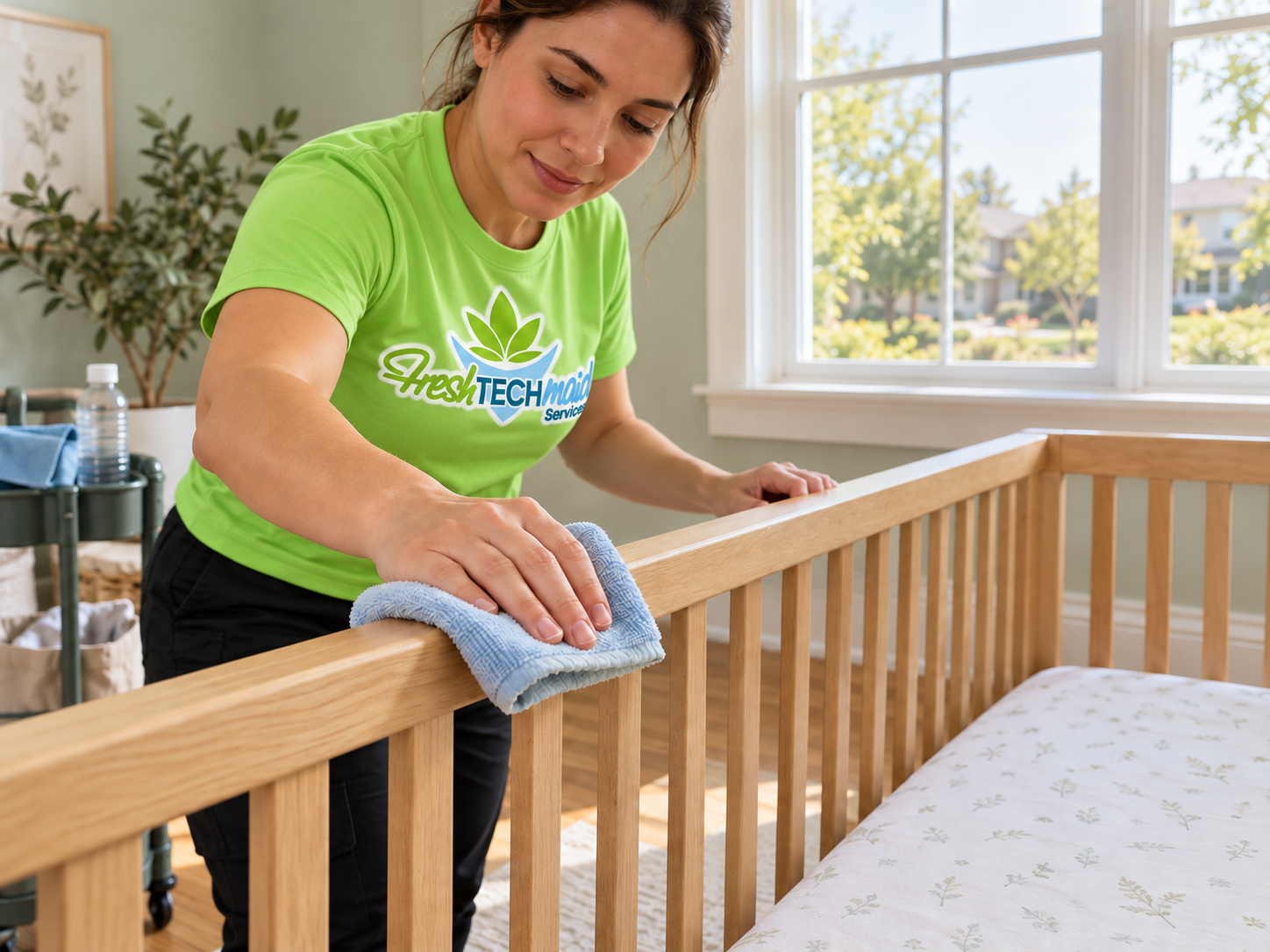
Short Answer: Chemical-free cleaning matters because a newborn does not need a perfumed home; the baby needs a clean, low-residue home. I clean first, remove soil with microfiber, DI water, HEPA vacuuming, and steam where safe, then sanitize only when needed. This matches CDC guidance to clean before sanitizing and helps avoid adding VOCs indoors.
Chemical-free does not mean weak cleaning.
It means I remove the soil first instead of covering it with scent.
Here is the part that matters for a newborn's lungs: the EPA found that levels of common organic pollutants run two to five times higher inside homes than outside, and cleaning products are one source (EPA).
The EPA says many VOCs come from household products, including cleaning and disinfecting products.
A bigger suburban house does not dilute that problem much. In winter, Hoffman Estates homes stay closed for months, so whatever I spray stays inside with the baby.
For a newborn home, I do not want to trade dust for odor. Strong fragrance can make a room feel clean while leaving more in the air.
Fresh Tech Maid's Chemical-Free Cleaning page explains why we use deionized water, microfiber, and other physics-based tools instead of relying on harsh residue.
When I use HOCl (hypochlorous acid), I use it as a targeted disinfectant for the right surface, with the right dwell time, after soil is removed.
That matters in households where grandparents live with the family or visit often. Older adults with asthma, allergies, or sensitivity to strong smells should not have to leave the room while I clean.
Action Steps
- I remove loose dust and soil before any sanitizing step.
- I avoid scented sprays in the nursery and feeding zone.
- I choose DI water and microfiber for general cleaning where it fits.
- I reserve HOCl for high-touch and feeding-related areas that truly need it.
"I do not want a newborn home to smell clean. I want it to be clean."
— Wells Ye, Founder, Fresh Tech Maid
The reward is a home that smells like home, not like cleaner.
The household gets less residue, clearer air, and a plan that stays safe once the baby starts crawling on the same floor.
Once the method is clear, the nursery becomes the place where that method has to be quiet, careful, and practical.
How Do I Get a Nursery Truly Clean With No Chemical Residue Left Behind?
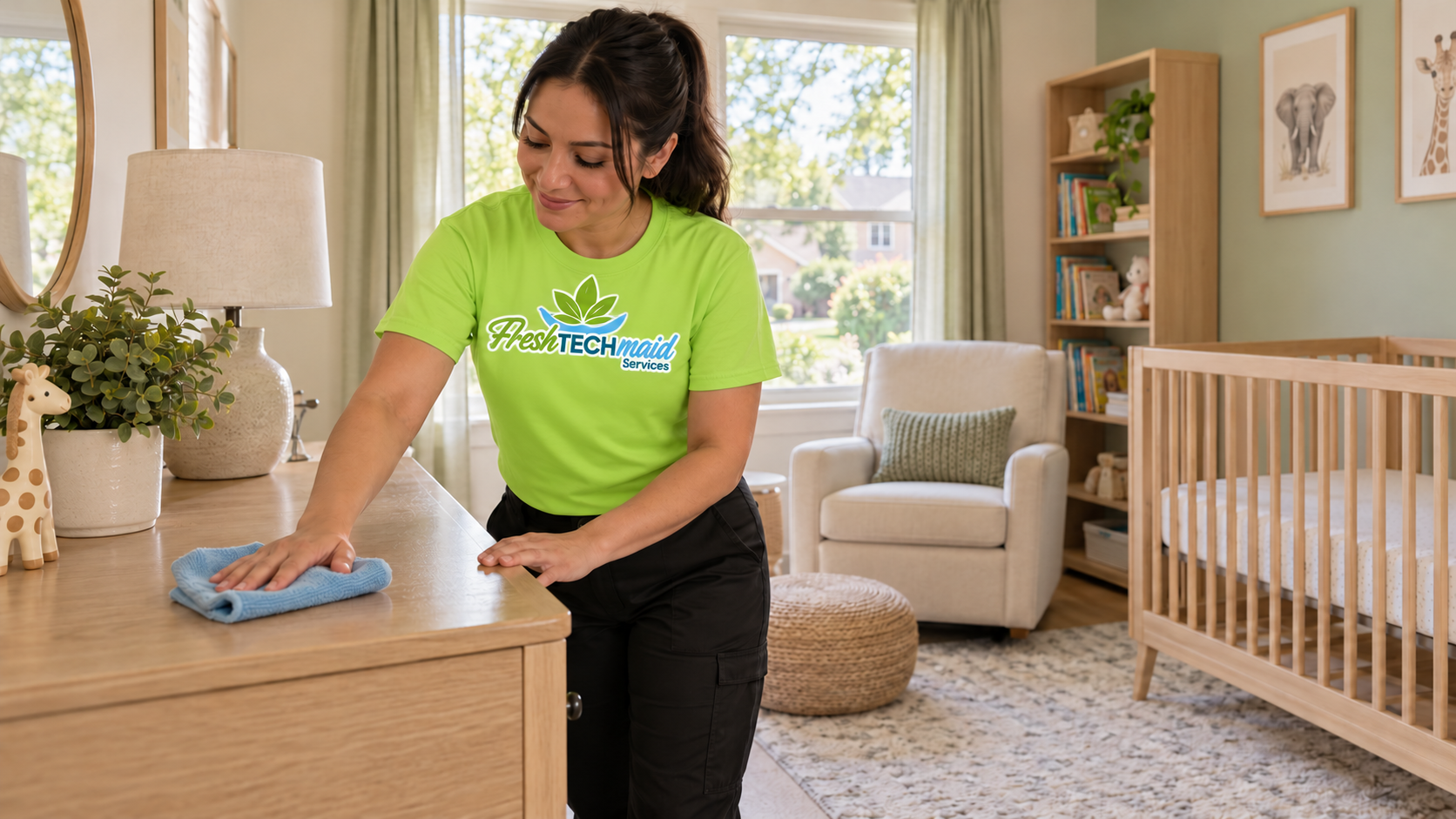
Short Answer: I clean the nursery high to low, then dry to wet, then touchpoints last. I HEPA vacuum floors and edges, use damp microfiber on sills and shelves, and steam only surfaces that can take heat. In older Hoffman Estates homes, I go gently on original trim, older closet doors, and painted surfaces. The goal is calmer air and cleaner touch zones.
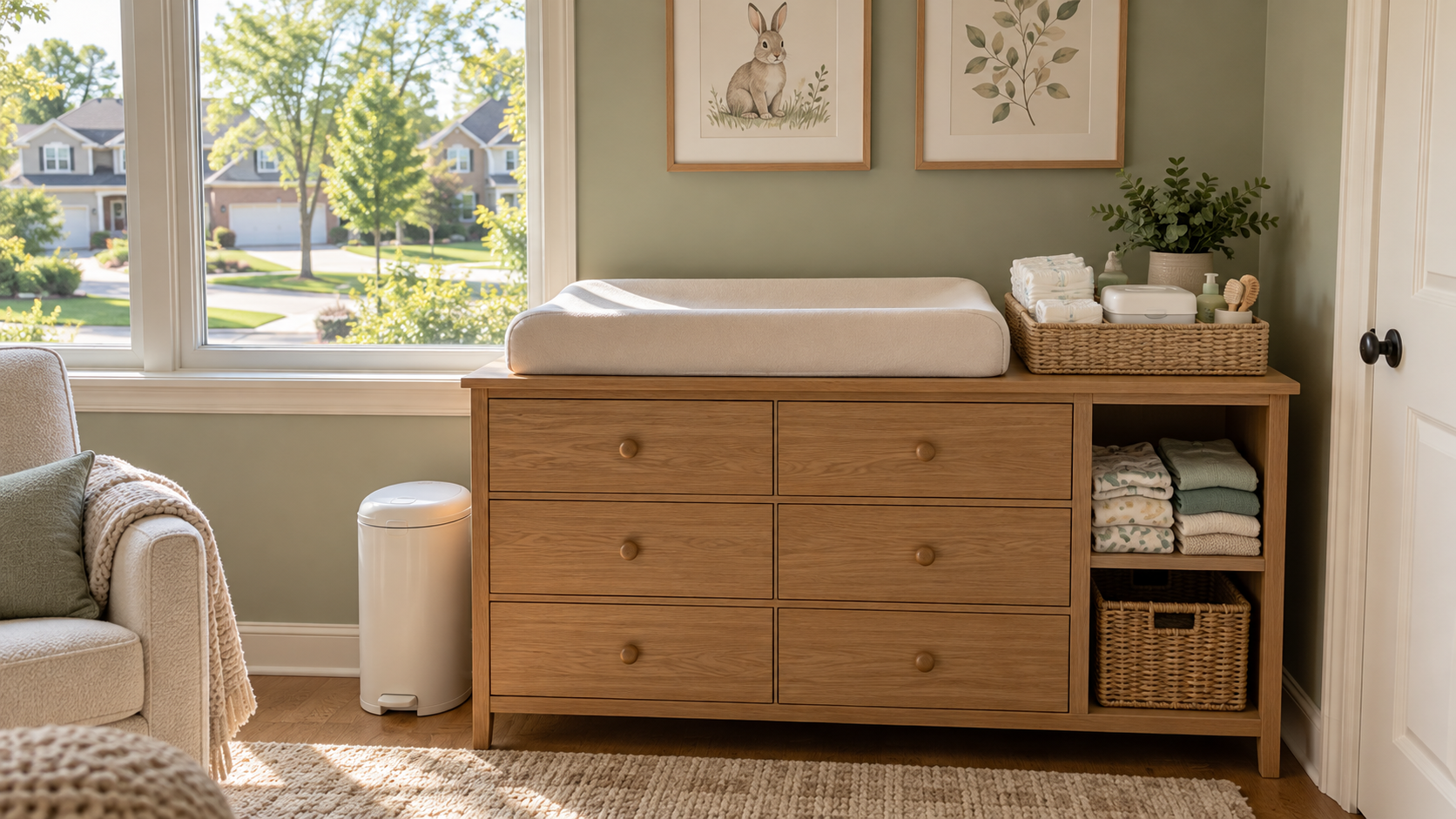
The nursery is a small room, but it has many dust shelves: window sills, blinds, vent covers, lamp bases, closet shelves, crib legs, baseboards, and the top of the changing station.
In many Hoffman Estates homes, the nursery is a second bedroom that was used as an office or guest room for years. Closet shelves and the top of the door frame often have years of dust.
I start high because the dust on a shelf becomes the dust on the floor.
Then I HEPA vacuum the floor edges, carpet if present, and the path from the door to the crib.
Homes from the 1970s and 1980s often have older carpet, painted trim, and bifold closet doors. I use damp microfiber, not soaking wet cloths, and I do not scrub hard on old paint.
The CDC says dust mites can trigger asthma and recommends washing bedding weekly, vacuuming with a HEPA filter, and keeping indoor humidity around 30% to 50%.
For newborn prep, I also remind households that safe sleep is not about more nursery items. CDC and AAP safe-sleep guidance focuses on a firm, flat sleep surface and keeping soft items out of the sleep space.
For families with older kids, I also clean the sibling touch path: door knob, toy shelf, rocker arm, hamper lid, and light switch.
For Empty Nesters helping their adult children, this is a perfect support task: wash textiles, clear closet shelves, and make the nursery easy to maintain.
Action Steps
- I HEPA vacuum floor edges, vent areas, carpet edges, and baseboards.
- I damp-wipe window sills, blinds, shelves, lamps, closet ledges, and door-frame tops.
- I wash baby linens before use and keep extra textiles out of the crib.
- I steam only washable, heat-safe surfaces and avoid older painted trim, sealed wood, or delicate finishes unless approved.
The reward is a nursery that feels quiet.
The shelves are not shedding dust, the crib is simple, and no one is guessing whether a strong smell means clean.
After the nursery, I slow down for one question that matters in a village where most homes were built before 1990: older-home lead dust.
Why Is Lead Dust Still a Question in Hoffman Estates' Older Homes?
Short Answer: If a Hoffman Estates home was built before 1978, I treat old paint dust as a serious question, not a normal dust problem. About 30.8% of homes here were built between 1940 and 1969, and many more in the early 1970s (CMAP, 2025). I do not replace licensed lead testing or abatement. I help with normal cleaning only after the risk is understood.
This is the section I never rush, especially in ranches, split-levels, and townhomes from the 1950s, 1960s, and early 1970s.
Lead-based paint was banned for home use in 1978. The CDC says homes built before 1978 probably contain lead-based paint, and peeling or cracking paint can make lead dust.
Hoffman Estates is not a pre-war city, but it is not new either. Only 2.7% of homes were built in 2010 or later, and the median build year is 1976 (CMAP, 2025).
EPA data shows why age matters: 87% of homes built before 1940 may contain lead-based paint, 69% of homes built from 1940 to 1959, and 24% of homes built from 1960 to 1978.
The Cook County Department of Public Health says 1 in 5 homes in suburban Cook County have significant lead paint risks. It also reports that about 200 children in suburban Cook County test positive for elevated blood lead levels each year (2026).
Lead exposure during pregnancy can also pass to the baby before birth, according to the same Cook County campaign.
Not sure when your home was built? Cook County suggests looking up your address on the Cook County Assessor's property search. Homes on the Kane County side of the village can check with Kane County records.
This is why I do not dry dust peeling paint, scrape windows, sand trim, or treat renovation dust like normal dirt.
If there was recent work on old windows, doors, trim, or walls, I tell households to stop and call a lead-safe certified contractor or the right local health resource.
For suburban Cook County homes, that includes Lead-Safe Cook County, which offers free lead hazard reduction to eligible homeowners and renters.
Fresh Tech Maid can help with normal non-lead cleaning after the hazard is addressed, but we do not replace testing, abatement, or medical guidance.
Action Steps
- I ask the build year and whether any paint, window, or remodel dust was disturbed.
- I look for peeling paint, dusty window tracks, old trim dust, and chipped stair spindles without disturbing them.
- I avoid dry sweeping or dry dusting suspect areas and recommend lead-safe testing or contractors.
- After clearance or proper guidance, I use wet-cleaning methods for normal dust and touchpoints.
"In a 1960s split-level, the safest cleaning sometimes starts with saying no until the right pro checks it."
— Wells Ye, Founder, Fresh Tech Maid
The reward for these steps is not panic.
It is a clear decision path: test when needed, fix when needed, and clean normally only when the home is safe to clean normally.
Lead is not the only hidden issue in an established suburban house. The next one sits one floor down.
Why Do Basements, Garage Entries, and Winter Grime Need Their Own Check Before Baby Comes Home?
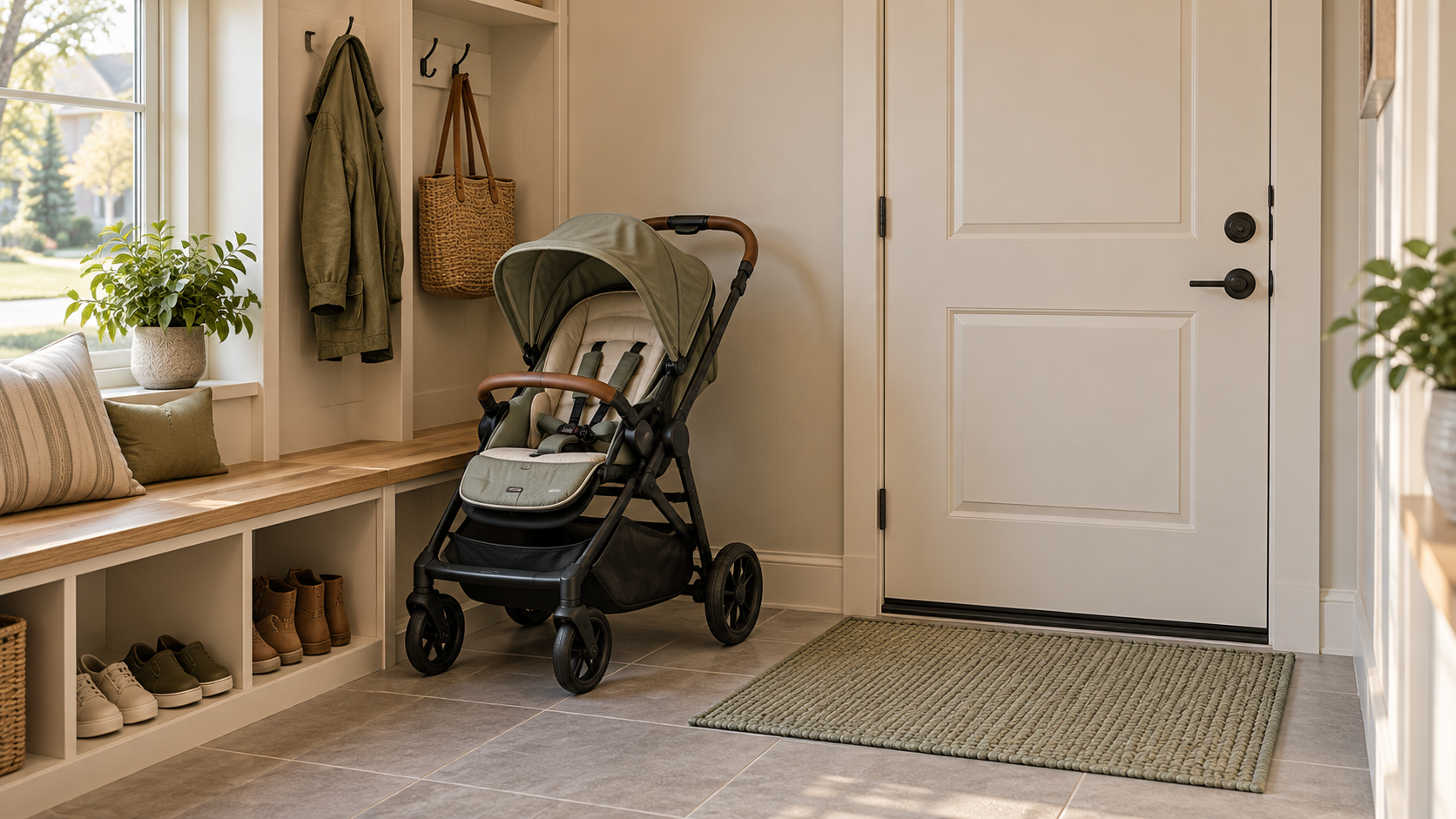
Short Answer: In Hoffman Estates, the lower level and garage entry are where strollers, car seats, laundry, and stored baby gear often end up. I check those areas for water stains, dampness, musty odors, and winter salt before cleaning. If there is active water, sewage, or real mold growth, routine cleaning is not the fix. The source must be repaired first.
Most Chicago baby-prep cleans stop at the apartment door. In Hoffman Estates, the job keeps going downstairs and into the garage.
Many households here store the extra crib mattress, the pack-and-play, and bulk diapers in the basement. The laundry room is often down there too. So is the path from the garage to the kitchen.
That makes the lower level a baby zone, even if the baby never sleeps there.
The Village of Hoffman Estates says its stormwater system is more than 50 years old and parts of it are beginning to fail. It runs a stormwater utility program, offers drainage investigations, and keeps FEMA floodplain information for properties (Village of Hoffman Estates: Stormwater Utility Program; Stormwater & Floodplain Management).
Outside, keep the ground sloped away from your foundation and clean your gutters regularly, so rain does not collect around the basement walls (EPA Mold Guide).
So before I clean a lower level, I look first. I check for water stains on drywall, dampness on the floor, musty odor, warped or lifting flooring, and white mineral lines on concrete.
If I see active water, a sewer backup, or visible mold growth larger than a small patch, I stop. The EPA says you must fix the moisture problem first, or mold will come back. It also says larger mold areas (more than about 10 square feet) may need professional help.
For a sewer blockage or a storm drain that will not drain, the Village tells residents to call Public Works at (847) 490-6800 (Village of Hoffman Estates).
Winter adds a second layer. From November to March, salt, grit, and slush ride into the house on boots, stroller wheels, and car-seat bases.
That grit lands on the garage-entry floor, the mudroom, the basement stairs, and the kitchen path. It scratches floors and gets tracked to the play mat.
For these areas, I use HEPA vacuuming first, then warm DI water and microfiber to lift salt film. I do not flood wood or laminate near the garage door.
For households that just moved into an older house before the due date, this check matters even more. You do not know how the last owner handled the basement.
Action Steps
- I walk the basement, laundry area, and garage entry before I start cleaning there.
- I look for water stains, dampness, musty smells, lifting floors, and sump-area issues.
- I stop and refer out when I find active water, sewage, or significant mold.
- I clean normal lower-level dust and winter salt with HEPA, DI water, and microfiber, then set a washable mat at every entry.
"A clean nursery upstairs does not help much if the stroller comes in through a wet basement."
— Wells Ye, Founder, Fresh Tech Maid
The reward is a home that is baby-safe from top to bottom, not just the one room with the crib.
Stored baby gear stays dry, the garage path stops tracking salt to the play mat, and real water problems get fixed before they become a newborn problem.
With the lower level handled, I move to the most repeated newborn task in the house: feeding-item cleaning.
What Is the Chemical-Free Way to Sanitize Bottles and Feeding Gear?
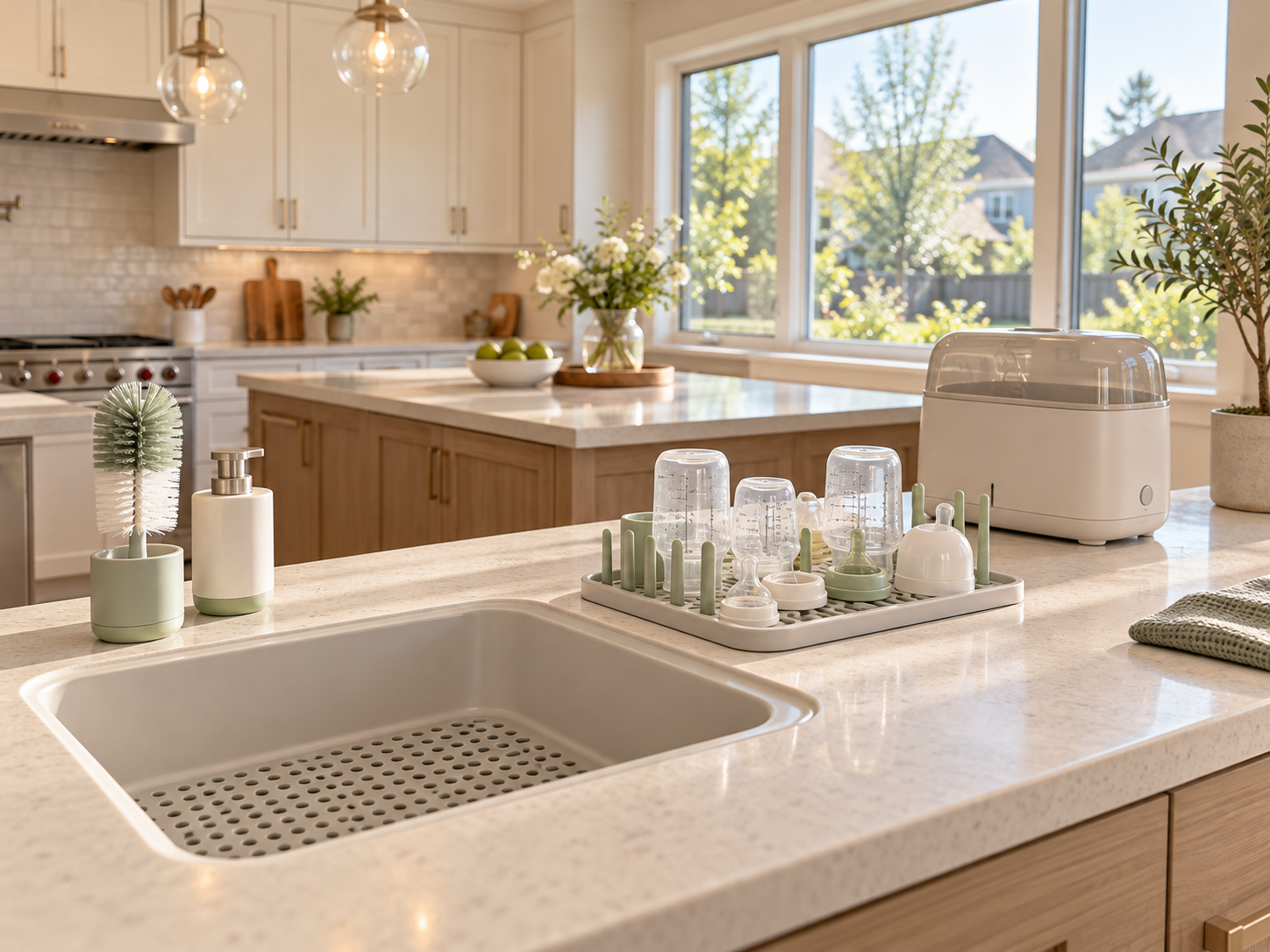
Short Answer: Heat does the work. For baby bottles and feeding items, I follow the CDC approach: clean after each feed and use boiling or steam sanitizing when extra germ removal is needed. The CDC says daily sanitizing is especially important when a baby is under 2 months, born premature, or has a weakened immune system.
Bottle cleaning is where I see the most confusion, because people use cleaning, sanitizing, disinfecting, and sterilizing like they mean the same thing.
The CDC guidance is clear enough for daily life: clean feeding items after each use, and sanitize when extra germ removal is needed.
The CDC also says daily sanitizing is especially important for babies under 2 months, babies born premature, or babies with a weakened immune system.
For a chemical-free setup, I like heat because boiling or steam can sanitize without adding a scented product to the bottle path.
I set up a dedicated bottle basin because the sink is not automatically clean. Raw food, dishcloths, coffee grounds, and old sponge water all pass through that space.
I also separate the bottle brush from the dish brush. A brush used on greasy pans should not become a newborn bottle tool.
For parents who work 12-hour hospital shifts or commute on the Jane Addams Tollway, a simple system matters. Whoever is home at 2 a.m. should know exactly what is clean.
Action Steps
- I rinse and separate bottle parts after feeding so milk does not dry in hidden seams.
- I wash parts in a dedicated basin with a dedicated bottle brush.
- I air-dry on a clean rack in a low-traffic spot, not on a used towel.
- I use boiling or a steam sterilizer when CDC guidance or the baby's health calls for sanitizing.
"For bottles, I want a boring system that works at 2 a.m."
— Wells Ye, Founder, Fresh Tech Maid
With these steps, the feeding station works even when no one has slept.
Everyone knows what is clean, what is drying, and what is ready for the next feeding.
Once bottles have a system, the kitchen itself needs one clean lane that tired parents can trust.
How Should I Get the Kitchen and Feeding Zones Ready for Baby?
Short Answer: I build one safe feeding lane: sink, bottle basin, counter, drying rack, cabinet shelf, fridge handle, and bottle-brush storage. I clean soil first, then sanitize only the small food-contact zone that needs it. In older Hoffman Estates kitchens, I also clean inside cabinets, behind appliances, and along worn laminate edges where crumbs collect.
After the baby arrives, the kitchen is not just the room with the stove. It becomes a milk prep room.
I start by taking out trash and rugs, then I pre-treat hard-to-clean sink and counter areas, then dust high to low, then do the dry trip, wet trip, and high-touch finish.
The lane is simple: clean counter, clean basin, clean brush, clean drying rack, clean cabinet shelf, and clean hands.
The CDC feeding guidance covers cleaning, sanitizing, and storage, because clean items can get dirty again when they dry or sit in a dirty spot.
That is why I clean the underside of upper cabinets, the shelf where bottles will live, the fridge handle, the drawer pull, the faucet handle, and the soap pump.
Many Hoffman Estates kitchens still have original or 1990s cabinets, laminate counters, and older appliances. I use material-safe methods: damp microfiber on painted and wood cabinets, no soaking seams, and no abrasive pads on laminate.
I also pull out what I can reach safely and clean the floor edges beside and under the fridge and range. Crumbs and dust there travel to the baby's floor later.
In a condo or apartment, I often turn one 18-inch stretch of counter into the baby station. In a larger house, I still keep it to one lane so no one has to guess.
Action Steps
- I clear one counter zone for feeding items only.
- I clean and dry the sink area before the bottle basin is used.
- I wipe cabinet pulls, faucet handles, fridge handles, and the drying-rack area.
- I store clean bottle items in a clean cabinet or closed bin after they fully dry.
The reward is speed.
A tired parent can find a clean bottle, clean nipple, clean prep space, and clean storage without moving mail, keys, pet bowls, or yesterday's dishes.
From the kitchen, I move to the room that supports the birthing parent most directly: the bathroom.
Which Bathroom and Postpartum Recovery Zones Matter Most?
Short Answer: The bathroom matters because it becomes a recovery station, not just a toilet room. I focus on toilet handles, faucet handles, shower floors, counters, trash bins, laundry baskets, and door handles. In a two-story Hoffman Estates house, I also pick the bathroom closest to where the birthing parent will sleep, so recovery does not mean extra stairs.
I have cleaned many bathrooms where the nursery was finished but the recovery bathroom was not.
That matters because the birthing parent may use the bathroom many times a day while healing.
The American Academy of Family Physicians' postpartum care plan template includes a housework section and lists hired help as one way to ease the load (AAFP).
Many northwest-suburban families deliver close to home. Ascension has made Saint Alexius Women and Children's Hospital on Barrington Road its labor and delivery center for the northwest region (Daily Herald, 2025). A short drive home is nice. A ready bathroom at the end of it is better.
So I clean the bathroom like a recovery zone: sink, faucet handles, toilet handle, shower floor, tub edge, counter, trash bin, laundry basket, and door knob.
Homes from the 1970s and 1980s often have older grout, cultured-marble vanities, and original tubs. I use soak time and soft tools, not harsh scrubbing, so I clean the surface without damaging it.
I also leave space for postpartum supplies. A counter packed with old bottles, makeup, and random items makes recovery harder.
In our method, bathrooms start with trash and rugs out, soaking hard-to-clean areas, high-low dusting, dry trip, wet trip, then targeted high-touch disinfection.
For households that need the whole bathroom reset, Fresh Tech Maid's Deep Cleaning Services page is the natural next step, because bathroom buildup often needs more than a light recurring clean.
"After birth, the bathroom is part of the care plan!"
— Wells Ye, Founder, Fresh Tech Maid
Action Steps
- I choose the recovery bathroom closest to the bedroom and clear its counter for supplies.
- I clean and sanitize toilet handles, faucet handles, door knobs, and light switches.
- I scrub shower floors and tub edges to reduce soap film and slip risk, using methods that fit older grout and fixtures.
- I set a simple laundry and trash flow so supplies do not pile up.
It is about dignity.
The birthing parent has a bathroom that feels ready for healing, not another room asking for work.
After the recovery zone is ready, I look low, because the floor soon becomes the baby's world.
How Do I Safely Clean the Floors and Surfaces My Baby Will Touch?

Short Answer: Babies live low, so I clean floors, stairs, and low surfaces carefully as baby time gets close. I use HEPA vacuuming, DI water, microfiber, and steam only on sealed surfaces that can handle it. In Hoffman Estates homes with carpet, hardwood, laminate, and older vinyl, I match the method to the floor. I use targeted HOCl only when disinfecting is needed.
People often ask me about counters first, but babies teach us to look down.
The floor is where pacifiers fall, toys land, pets walk, and older siblings drop snacks.
My floor process starts with levels: I finish all rooms on a floor first, then vacuum and mop, so I am not walking dirt back into wet areas. In a two-story home with a basement, that means three floor passes, top level first.
For sealed floors, I use a low-residue method: HEPA vacuum, then DI water or steam when the surface can handle it.
I do not flood wood floors, and I do not use steam on laminate, older vinyl, or any surface where the maker says no heat or moisture.
Staircases get their own attention. I vacuum each tread and riser edge, then damp-wipe the railing and spindles, because every adult carrying a baby will hold that rail.
Pet Owners need a cross-contamination plan. Pet bowls, litter areas, paws, and floor throws should not share the baby's main crawl zone.
"A clean floor should not leave a chemical film on tiny hands later."
— Wells Ye, Founder, Fresh Tech Maid
Condo and apartment households need the same idea in a smaller space: shoes stop at the door, pet gear has one zone, and the baby play mat has another.
EPA VOC guidance is one reason I avoid heavy sprays on floors.
A shiny look and a strong smell are not worth adding more air pollution to a newborn room.
Action Steps
- I vacuum with HEPA before any mopping or steam work, top floor first.
- I use DI water and microfiber on washable low surfaces, stair treads, and railings.
- I keep pet bowls, litter tools, and shoe storage away from baby floor zones.
- I sanitize high-touch surfaces only after cleaning and only where the surface needs it.
The reward is a floor you can trust for tummy time later.
It is not sterile, but it is clean, low-residue, and easier to keep that way.
Once floors and surfaces are low-residue, I look at the air the baby will breathe.
What Keeps Indoor Air Safe for a Newborn to Breathe?
Short Answer: I keep newborn air clean by filtering particles and not adding new pollutants. I use HEPA vacuuming, suggest a properly sized HEPA air cleaner, check that the furnace filter is not overdue, open windows when outdoor air is good, and avoid scented cleaners. EPA says VOCs can be much higher indoors, and HEPA filters capture fine particles when used correctly.
Air cleaning starts with a quiet question: what am I adding to this room?
A nursery can collect dust from textiles, furniture boxes, old vents, remodel work, candles, plug-ins, sprays, and scented laundry products.
In a single-family house with forced-air heat, the furnace moves air through every room. A dusty return vent or an overdue filter spreads the problem.
The EPA says portable air cleaners and HVAC filters can reduce indoor air pollution, but no air cleaner removes every pollutant.
The EPA also says a HEPA filter can theoretically remove at least 99.97% of dust, pollen, mold, bacteria, and other airborne particles at 0.3 microns.
That does not mean a filter replaces cleaning. Filtration and source control work together.
I use HEPA vacuuming to remove particles from surfaces before they become airborne again. I also vacuum and damp-wipe return vents and floor registers in the nursery and hallway.
Then I ask households to avoid scented cleaners, candles, and air fresheners in the baby's room, especially in the last weeks before birth.
A musty smell from the basement is an air signal too. If it reaches the upstairs, go back to the lower-level check before buying another air freshener.
Grandparents who live with the family or visit often may also be more sensitive to strong scents and indoor air changes.
Action Steps
- I HEPA vacuum the nursery, hall path, vents, and soft dust zones before wet wiping.
- I suggest a correctly sized HEPA air cleaner and a fresh furnace filter if the household wants filtration support.
- I avoid scented cleaners, plug-ins, and spray-heavy products in baby zones.
- I ventilate when outdoor air is good and keep windows closed during poor air, heavy pollen, or smoke days.
These steps give the baby and caregivers cleaner breathing space.
No one is covering odor. They are removing dust and avoiding new pollutants.
When the air plan is set, I put the work on a timeline so it does not become a last-minute scramble.
How Does the 30-Day Countdown Cleaning Plan Work Before Baby Arrives?
Short Answer: I use a 30-day timeline so cleaning never turns into a panic clean. Thirty days out, I deep clean, declutter, and check the basement. Fourteen days out, I reset the nursery and kitchen. Seven days out, I finish laundry and touchpoints. Forty-eight hours out, I refresh bottles, bathrooms, entries, and floors. After the baby arrives, I maintain it weekly.
The biggest mistake I see is waiting until the last weekend.
A late panic clean turns small choices into big stress, especially if the baby comes early or the birthing parent is tired.
In a Hoffman Estates house, the last weekend is also not enough time. A two-story home with a basement and 2.5 bathrooms takes much longer than a one-bedroom condo.
I prefer a 30-day plan because it matches how real homes work. There is ordering, folding, moving furniture, washing baby clothes, and making space in cabinets.
At 30 days, I want the deep work done: baseboards, stairs, bathrooms, cabinet interiors, vents, the lower level, and decluttering.
At 14 days, I want the nursery and feeding station reset so supplies have a clean place to land.
At 7 days, I want laundry systems, towels, sheets, and high-touch points finished.
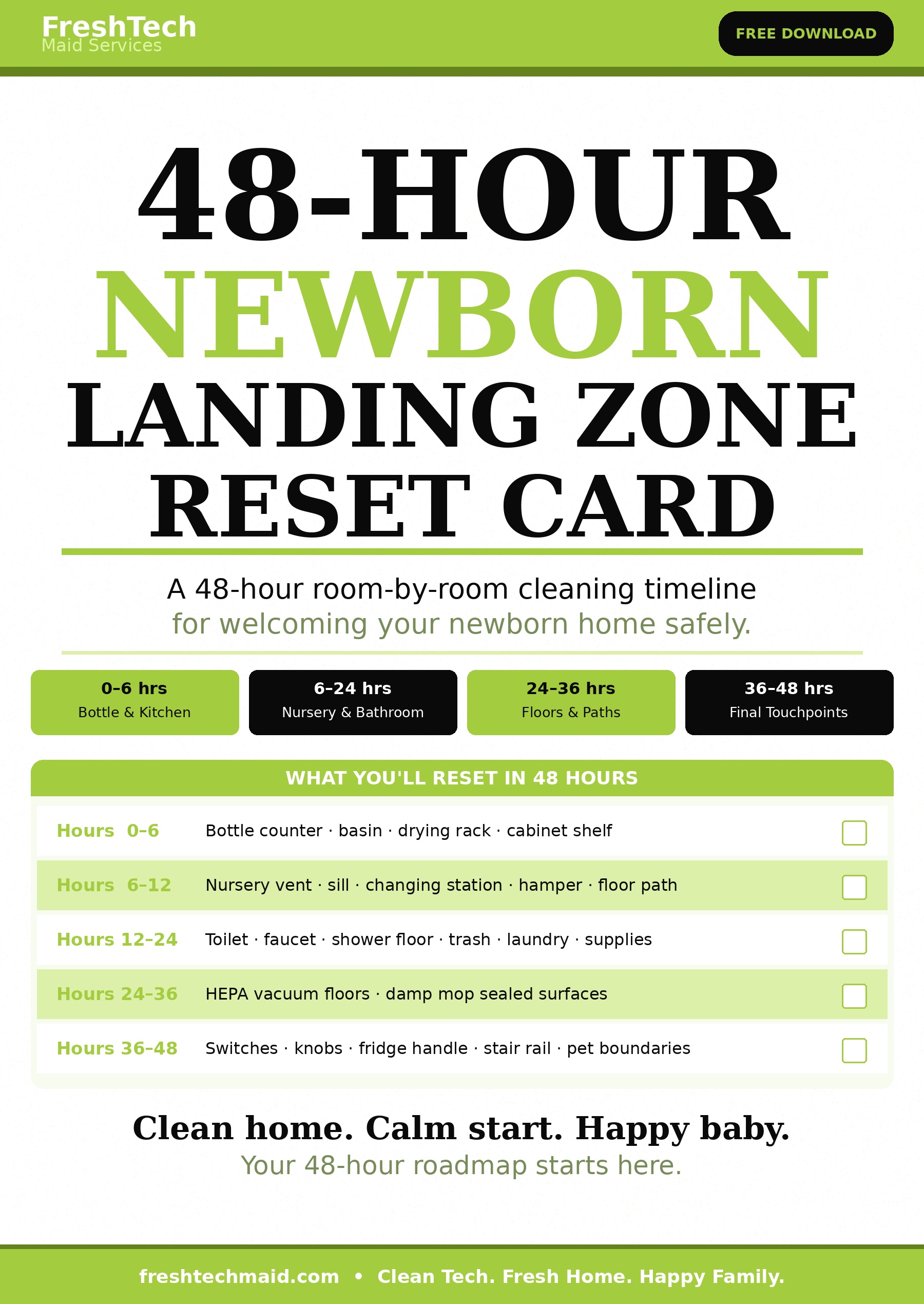
At 48 hours, I want only light refresh work: bottle area, bathroom handles, floors, garage entry, and trash.
Due in winter? Add a salt-and-slush check to the 48-hour refresh. Due in spring? Look at the basement again after the first heavy rain.
Moving within the northwest suburbs before the due date? Clean the empty home before furniture arrives. That is the easiest moment to reach cabinets, closets, and floors, and our Move In Cleaning service fits that window.
After the baby arrives, the plan shifts from deep cleaning to maintenance.
That is where Recurring Cleaning Service can help a household keep the system stable.
"A timeline gives parents back the one thing they feel losing: control."
— Wells Ye, Founder, Fresh Tech Maid
Action Steps
- I schedule deep cleaning before the last two weeks when possible.
- I finish the nursery and feeding station before all supplies arrive.
- I save final touchpoints, entries, and floors for the last 48 hours.
- I set a weekly maintenance rhythm after the baby arrives.
The reward is control. The household can handle surprise changes because the hard cleaning is already behind them.
With the timeline in place, the next honest question is whether to do the work yourself or get help.
When Does It Make Sense to Hire a Maid Service in Hoffman Estates Before Baby Arrives?

Short Answer: I tell households to hire cleaning help when the work creates risk, stress, or delay. Late pregnancy, a large multi-level home, recent remodel dust, pets, older kids, a recent move, shift work, or postpartum recovery are all good reasons. Family physicians list hired help in postpartum planning as a real support, not a luxury.
I do not tell every household to hire us.
But I do tell the truth when the home needs more than they have time or energy to give.
Hire help if the pregnancy is late-stage, if bending and lifting are hard, or if the house has three levels of stairs to clean.
Hire help if there are older kids, pets, or moving boxes still in the garage.
Hire help if there was remodel dust. And if that dust may involve old paint, hire the right lead-safe professional before any normal cleaner enters that problem.
Hire help if you keep saying, 'We will do it this weekend,' but the due date keeps getting closer and work schedules keep winning.
That is common here. Health care alone accounts for 24.3% of jobs located in Hoffman Estates (CMAP, 2025), and many of those are shift jobs. Add a Chicago or Schaumburg commute for the other adult, and free time disappears.
Cleaning help is not about being fancy. It is about lowering stress and protecting recovery time.
Fresh Tech Maid uses trained employee teams, not random gig labor. That matters when you open a newborn home to a service provider.
Our maid service in Hoffman Estates is run by our Northwest Suburbs team. The natural next step is Parents with Babies Cleaning if the baby is already home, or Book a Cleaning if you need a date on the calendar.
Action Steps
- I ask whether the household has time, energy, and safe mobility to clean.
- I ask about home size, levels, pets, older kids, moving boxes, and recent remodel dust.
- I separate normal cleaning from lead, water, mold, or construction hazards that need specialists.
- I suggest a professional reset when cleaning is blocking rest, recovery, or bonding.
"The right time to book is before cleaning becomes a fight between rest and guilt."
— Wells Ye, Founder, Fresh Tech Maid
The reward is relief without guilt.
The household can spend limited energy on medical visits, sleep, meals, and each other.
If you need help, grandparents and friends can make that help practical instead of stressful.
How Can Grandparents and Friends Lend a Hand Without Adding to the Chaos?
Short Answer: Grandparents and friends help most when the help is practical, scheduled, and specific. A clean bathroom, folded laundry, a stocked bottle station, or a Fresh Tech Maid gift card often matters more than another blanket. In Hoffman Estates, many grandparents live nearby or in the same home, so clear roles keep help from turning into pressure.
I meet many Empty Nesters and grandparents who want to help, but they do not want to step on the new parents' plan.
In the northwest suburbs, that help is often close. Some grandparents live a few miles away in Schaumburg or Palatine. Others share the same house. About 35.4% of Hoffman Estates residents were born outside the U.S. (U.S. Census Bureau, 2019–2023), and many households carry their own traditions for the weeks after birth.
Every family does this differently. The goal is the same: help that lowers the work, not help that adds decisions.
The best help is not vague. It is specific, scheduled, and easy to accept.
Instead of saying, 'Tell me what you need,' say, 'I can cover a bathroom reset, two loads of laundry, or a cleaning gift card. Which helps most?'
For grandparents, a house cleaning gift is often better than another item the parents must store, wash, return, or explain.
Fresh Tech Maid's Gift Card page fits this moment because it gives time, not clutter.
Friends can also help with tasks that do not require holding the baby: empty trash, wipe the bottle station, walk the dog, fold towels, shovel the driveway, or restock snacks.
Action Steps
- I suggest one exact task instead of a vague offer.
- I schedule help in a time window the parents choose.
- I avoid strong smells, surprise visitors, and unscheduled cleaning projects.
- I give practical help such as a cleaning gift card, laundry help, snow shoveling, or a bottle-station reset.
These steps make support feel like support.
The new parents get a calmer home, and helpers know they gave something useful.
After the support plan, I bring everything into one printable checklist you can use or share.
Which Baby-Safe Cleaning Checklist Can Hoffman Estates Parents Print and Follow?
Short Answer: My printable checklist starts with the baby's breathing, feeding, recovery, floor, and touch zones. Then it adds Hoffman Estates checks for pre-1978 paint, stairs, the basement, and the garage entry. Use it as a DIY plan for a smaller condo or townhome, or as a scope for a professional chemical-free cleaning in a larger house.
I like a checklist because it stops the home from becoming one giant worry.
The point is not to clean every inch. The point is to clean the right zones in the right order.
Start high, move low, clean first, sanitize only when needed, and do not disturb suspect lead dust or wet basement areas.
If the home is a small condo or townhome, this can be a DIY weekend plan with a partner, grandparent, or friend.
If the home is a large, older, multi-level house, pet-heavy, or late in pregnancy, use it as a service scope for Expecting Parents Cleaning or Parents with Babies Cleaning.
For a Hoffman Estates household, two lines matter most: the lead line and the water line. If the home is pre-1978 with disturbed paint, or the lower level has active water, pause and get the right help first.
For everyone else, the checklist creates a cleaner, calmer landing zone before the baby comes home.
Action Steps
- I print the checklist and mark the zones that matter most for this home.
- I assign DIY tasks to safe, simple areas and professional help to heavy zones and extra floors.
- I flag older-home and lower-level risks before anyone cleans aggressively.
- I finish with a 48-hour refresh of floors, entries, touchpoints, bottles, and bathrooms.
The reward is a ready home without over-cleaning. You know what was cleaned, why it matters, and what to maintain after the baby arrives.
Before I close, I answer the baby-prep questions Hoffman Estates households ask me most often.
Frequently Asked Questions